FREE DEBT PRINTABLE
Debt Snowball Free Printable: 6 Sheets for the Whole Run
Every free snowball worksheet online is a setup sheet you fill in once. These six are for the three years afterward, and they come with one whole run worked out to the cent so you can see what month fourteen is supposed to look like.
- 6 Sheets
- Free PDF
- Type Into Them
- No Signup
A debt snowball is not really a plan you make once. It is a run that lasts years, and the part worth knowing before you start is that its wins are front loaded while its work is not. In the run printed below, three of four debts clear inside the first 18 months and the last 18 months hold one win.
Jump to
You have already chosen the method. This page takes that as settled and goes at the part almost nobody prints, which is what the next three years feel like from the inside.
Every free printable debt snowball worksheet online is a setup sheet. You fill it in on a Sunday afternoon, feel organized, and then have nothing for the thirty-odd months that follow. The setup is easy. The run is the hard part, and it’s where people stop.
So here is one run, computed month by month with the interest in it, and six sheets built around what the arithmetic says goes wrong.
The ladder this page follows
Four balances, smallest first, because that is what a snowball is. If you’re still weighing up whether to order by balance or by rate, that argument lives on the debt payoff tracker printables page rather than this one.
| Debt | Balance | Minimum |
|---|---|---|
| Store card | $340 | $25 |
| Credit card | $1,120 | $25 |
| Second card | $2,600 | $52 |
| Biggest card | $6,450 | $129 |
| Opening balance | $10,510 | $231 |
On top of the minimums there is $175 a month spare, so $406 leaves the account every month and never changes. Every balance carries 22.15% a year, charged monthly on what is left. Minimums are held at 2% of the opening balance with a $25 floor, and they stay frozen. No new spending. One more rule decides the answer: when a balance clears part way through a month, whatever is left of the $406 goes straight onto the next debt rather than waiting for the first of the following month. Hold it back instead and the same four debts take 38 months and cost $4,159.87, so it’s worth knowing which version you’re reading.
Those assumptions matter, because the answer moves when they move. They are printed on the worked sheet too, so the page and the paper can never drift apart.
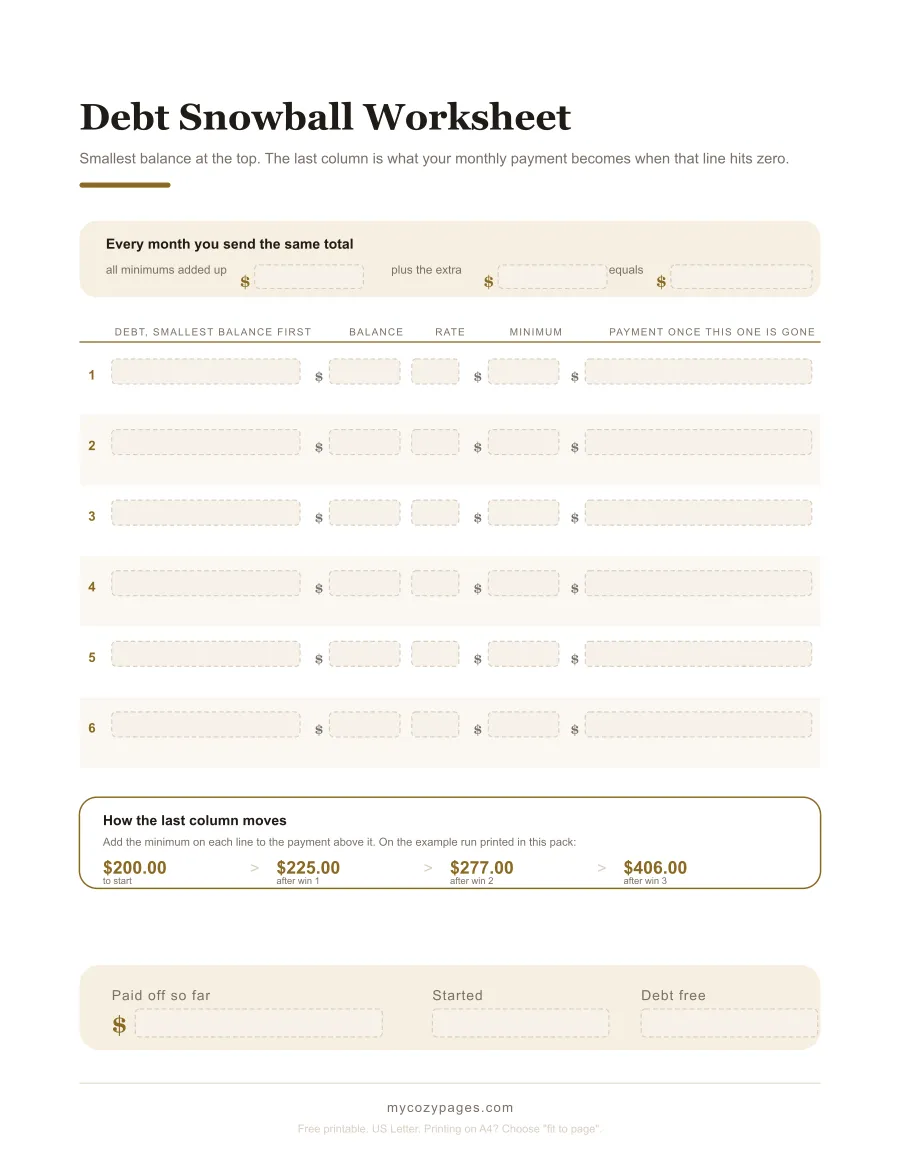
6 debts · a rate column · and one column nobody else prints: what your payment becomes when that line hits zero
Download the snowball worksheet (PDF)
What the first month actually moves
Month one sends $406. Of that, $194 is interest, which leaves $212 landing on the balance.
That’s the number worth sitting with. Slightly more than half of a serious monthly payment does real work in month one, and the rest pays rent on money you already spent. It gets better every month, because the interest is charged on a shrinking balance, but month one is where the ratio is at its worst.
It’s also why the log sheet has an interest column on the worked side and not on the blank one. You don’t need to calculate it. You just need to stop being surprised by it.
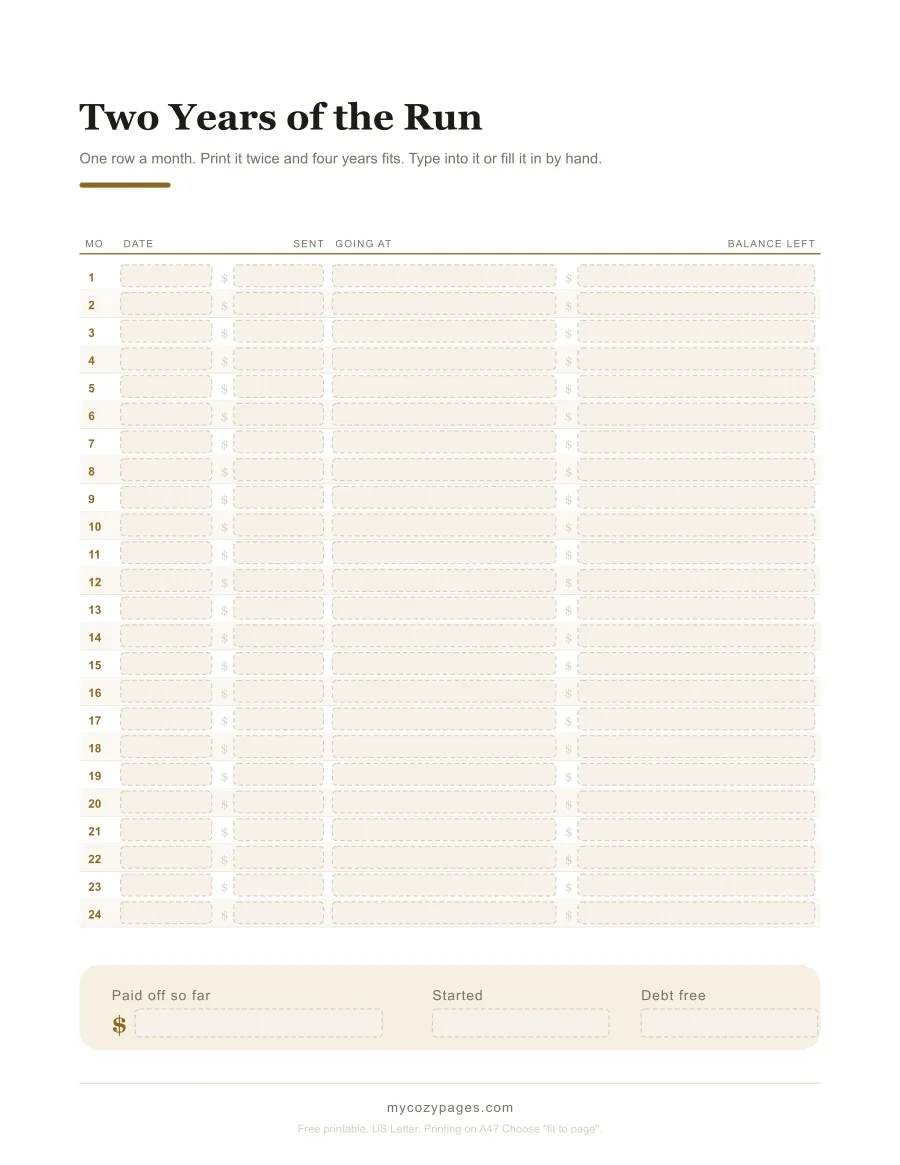
24 months, one row each · type into it or print it · print it twice and four years fits
Download the month by month log (PDF)
Your first win lands in month two
The store card is gone in month two. That’s the selling point of the method and it’s real: two months in, something is finished.
Here is what it changes. The store card was taking $25 a month, so from month three the payment aimed at the next card is $225 instead of $200. Your spending money doesn’t go up by a cent. The $25 exists, but it goes straight back into the pile, which is the whole mechanic.
So the first win buys you a hammer 12.5% bigger. Worth having. Smaller than it sounds.
After that the waits get longer
Four debts, four wins, and the space between them stretches every time:
| Win | Debt gone | Month | Wait since the last one |
|---|---|---|---|
| 1 | Store card | 2 | 2 months |
| 2 | Credit card | 7 | 5 months |
| 3 | Second card | 18 | 11 months |
| 4 | Biggest card | 36 | 18 months |
Nothing is going wrong there. A snowball sorts by balance, so each debt is bigger than the last, and each one takes longer even though the payment attacking it keeps growing. The first three waits roughly double. Knowing that in advance is most of what stops a long one from reading as failure.
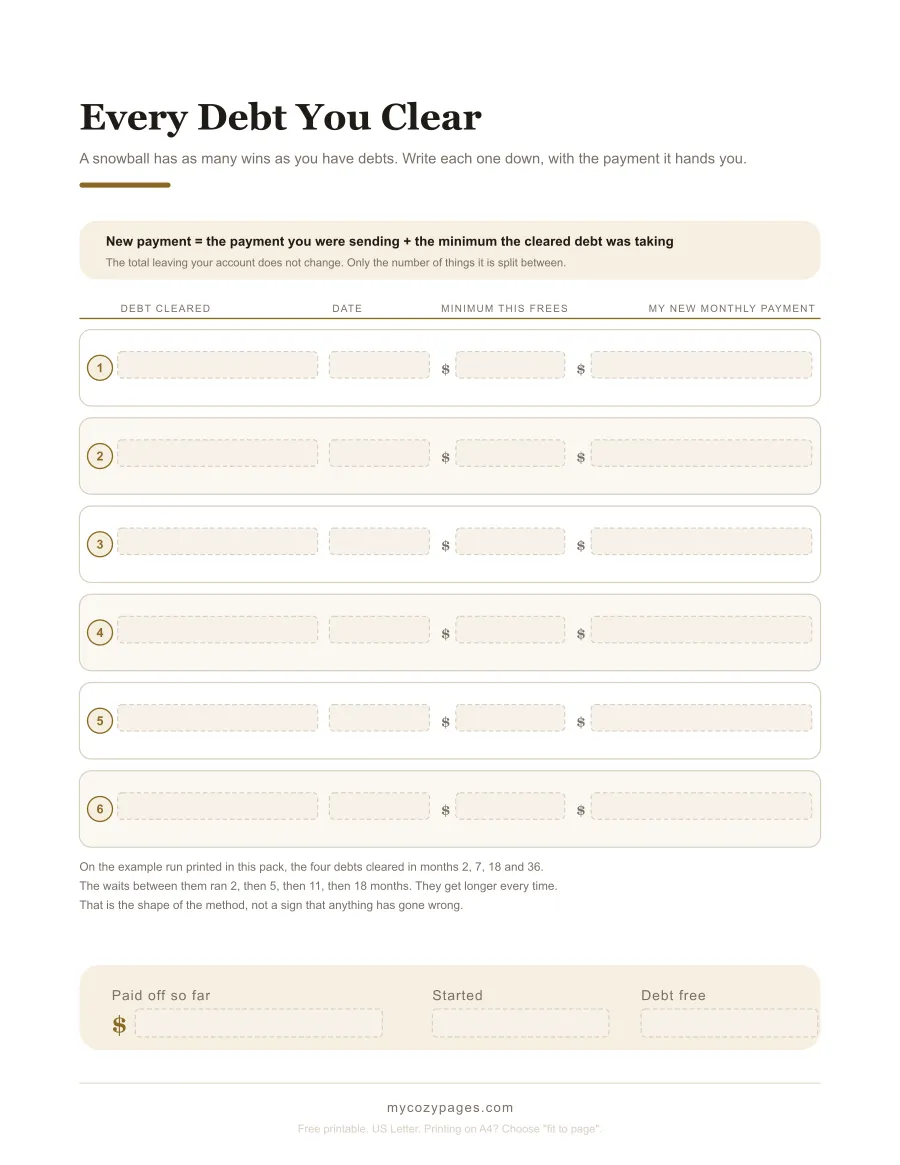
6 rows · the date each debt died, and the payment it handed you
What your payment is really doing
The total leaving your account is $406 from the first month to the last. What changes is how many places it gets split between, and so how hard it hits the one balance you’re aiming at.
| Aimed at | Payment | Against the payment you started with |
|---|---|---|
| Store card | $200 | opening payment |
| Credit card | $225 | 12.5% bigger |
| Second card | $277 | 38.5% bigger |
| Biggest card | $406 | 103% bigger |
Read the last two rows together. Your payment doesn’t double until it reaches the fourth debt, and the fourth debt is the biggest thing on the list. The hammer is at its smallest while the pile is at its largest, which is the honest shape of the method and not a criticism of it.
Month 18 is the one to plan for
Month 18 is when the third card clears, and it looks like a triumph. Three debts of four are gone. Only one is left.
Then you check the balance and it says $6,032.01.
| At the end of month 18 | |
|---|---|
| Debts cleared | 3 of 4 |
| Of the opening balance, retired | 42.6% |
| Of the opening balance, still owed | 57.4% |
| Interest paid so far | $2,830.01, which is 72.3% of all the interest in the run |
Three quarters of your debts are gone and more than half of your money is not. That isn’t a mistake in the plan. It falls out of sorting by balance: the small ones are quick to kill and small by definition, so clearing them retires very little of the total.
The balance doesn’t pass halfway until month 21, three months after the last thing you got to cross off.
Eighteen months with nothing to cross off
Here’s the finding, and it’s the reason this pack exists. The run is 36 months. The last win before the end lands in month 18. So months 19 to 36 contain exactly one win, and it’s the final payment.
Half the run has nothing to cross off in it.
A spreadsheet can’t help with that, because a spreadsheet’s answer is a date and the problem isn’t information. Paper can, because the only thing paper does better than a spreadsheet is get crossed off.
So the pack has two sheets whose only job is to manufacture wins during the silence. One box for every $100 the balance drops turns that $6,032.01 into 60 separate things you get to cross out. That’s better than three a month, against one win in eighteen.
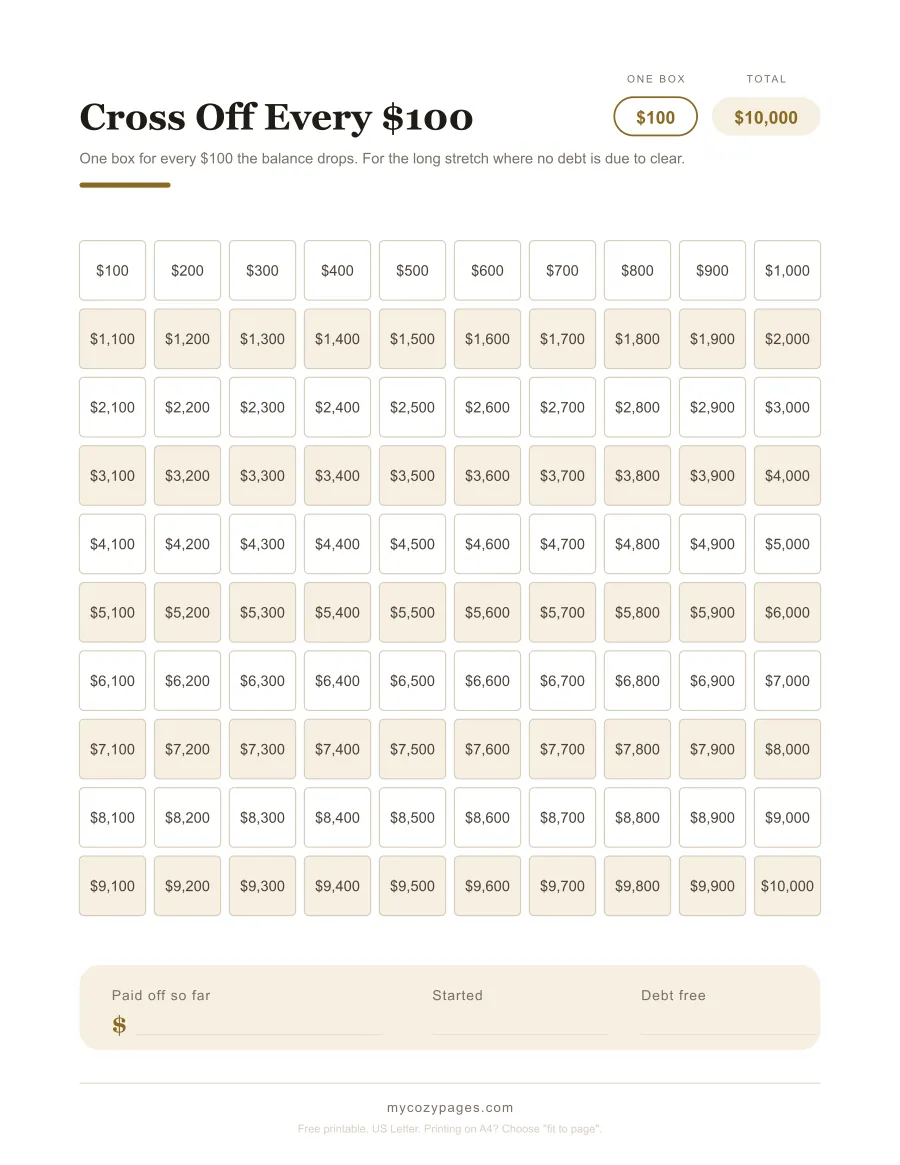
100 boxes · $100 each · up to $10,000
Download the $100 a box ladder (PDF)
If your last debt is big enough that $100 boxes would take six hundred of them, the same sheet comes at $250 a box and tops out at $25,000.
Download the $250 a box ladder (PDF)
The last payment is smaller than the rest
The run ends in month 36 with a payment of $214.07, because that’s all that was left. Over the whole thing you send $14,424.07 to clear a $10,510 balance, so $3,914.07 of it is interest.
The whole run is on one sheet, month by month, with the interest for each month printed beside it. It’s there so that someone at month fourteen, staring at a balance that has barely moved, can look at what month fourteen is supposed to look like and find out they are exactly on track.
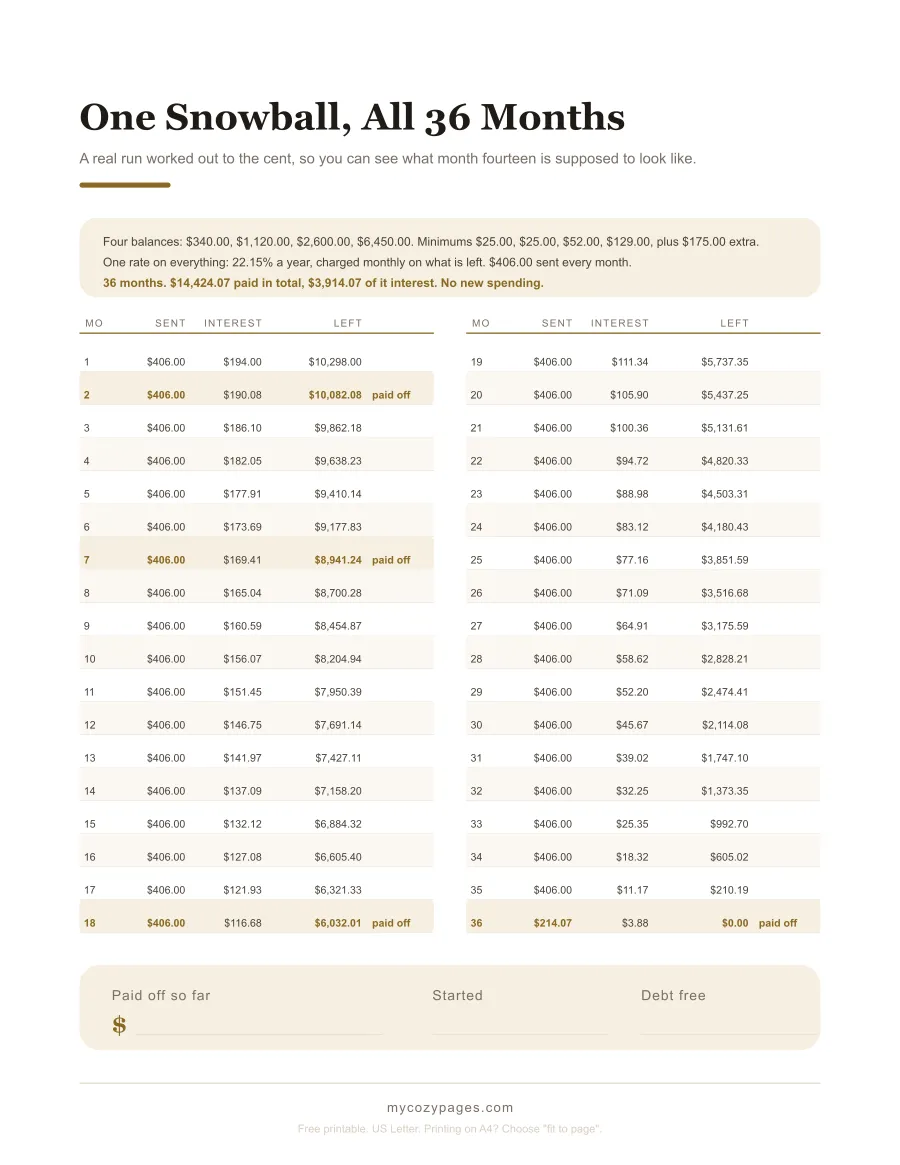
36 months · every payment, every month of interest, the four payoff months marked
Where that interest rate comes from
The 22.15% is not a number this page picked to make a point. It is the Federal Reserve’s G.19 Consumer Credit release, published on September 8, 2026, which put the average rate on credit card accounts assessed interest at 22.15% for the second quarter of 2026. Across all card accounts, including the ones that never carry a balance, the average was lower.
The Fed defines that series as the ratio of finance charges to the balances they were charged on, which makes it the right one here. If you’re running a snowball, you’re carrying a balance, so you’re in the group being charged.
Using one rate for all four cards is a simplification and it’s the only one in the arithmetic. A real ladder has a different rate per line, which is what the rate column on the worksheet is for.
The six sheets, and when each one earns its place
| Sheet | Use it | Pages |
|---|---|---|
| Snowball worksheet | before month one | 1 |
| Month by month log | every month, for two years a sheet | 1 |
| Win log | four or five times in three years | 1 |
| $100 a box ladder | the long stretch with no payoff due | 1 |
| $250 a box ladder | same, for a bigger last debt | 1 |
| The worked run | whenever you think you’re behind | 1 |
All six are US Letter, 8.5 x 11 inches, and print on A4 if you choose “fit to page”. Three of them are real PDF forms, so you can type into them and save the file instead of printing anything. Every figure on the worked sheet is computed, then read back off the rendered page before the file is written, so $14,424.07 is what the arithmetic produced rather than a figure anybody typed.
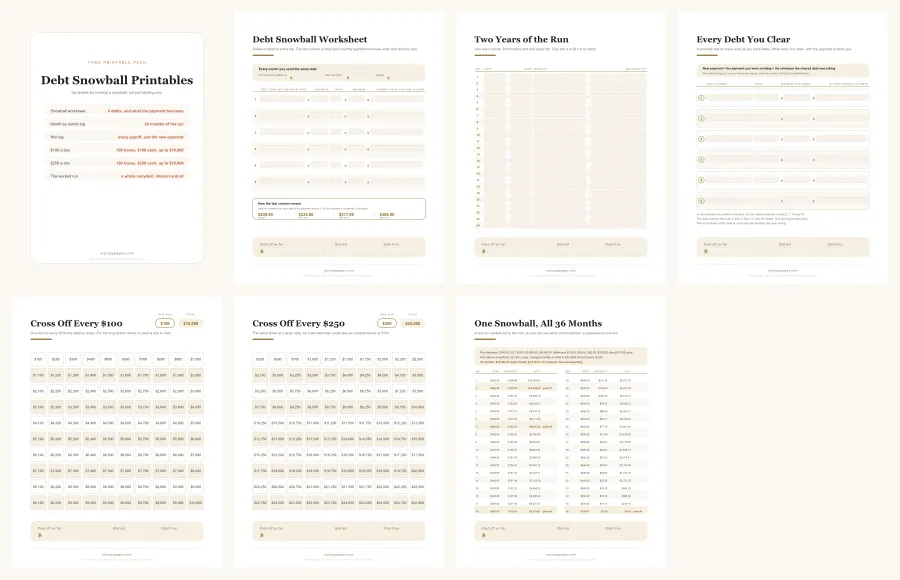
Download all 6 sheets as one PDF
A note before you start
These are tracking sheets. They are not financial advice, and nothing here promises an outcome, because the outcome depends on your balances and on what you can actually spare.
The one thing the arithmetic keeps pointing at is the extra. In the printed run the minimums are $231 and the extra is $175, and that extra is doing most of the work. Finding another few dollars a month shortens the run far more than any clever ordering will, so the question worth more of your attention is where another few dollars a month could come from.
If you have not settled on paying smallest balance first, or you want a tracker that suits any ordering, the debt payoff tracker printables page covers the choice and what it costs.
Save it for later
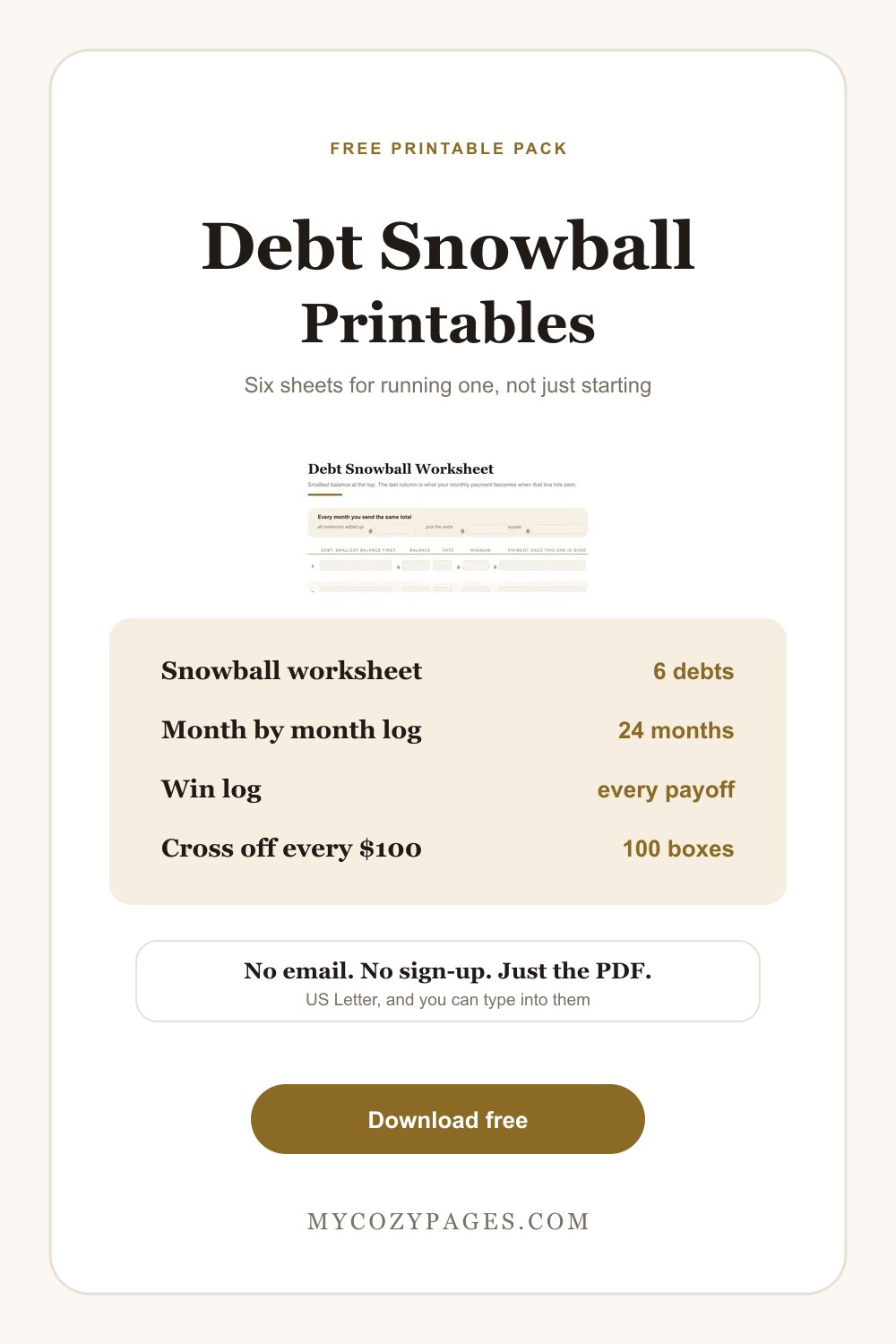
Free debt snowball printables. Six sheets for running a snowball rather than just starting one: the worksheet with a column for what your payment becomes, a 24 month log, a win log, two crossing-off ladders for the long stretch, and one whole run worked out month by month with the interest in it. US Letter, no email needed.
Save this pinFrequently asked questions
What is a debt snowball worksheet?
A sheet that lists your debts smallest balance first, with the balance, the rate and the minimum payment on each one. You pay every minimum, put whatever is spare on the top line, and move down the list as lines clear. The useful extra column, which most worksheets leave out, is what your monthly payment becomes once each line is gone.
Is this debt snowball printable really free?
Yes, all six sheets. No email address and no account. Take one sheet on its own or the whole pack as a single PDF.
How long does a debt snowball take?
It depends entirely on the balances and the extra. The run printed in this pack is four cards totaling $10,510 at 22.15%, with $406 going out every month, and it takes 36 months. Change the extra and the answer changes with it.
What happens to the money when a debt is paid off?
Nothing leaves your budget. The minimum that debt was taking gets added to what you send the next one, so the total going out stays the same and the payment aimed at one balance gets bigger. In the printed run it steps from $200 to $225 to $277 to $406.
Why does nothing seem to happen in the middle of a snowball?
Because the wins are sorted smallest first, so they are front loaded and the work is not. In the printed run three of the four debts clear inside the first 18 months, and the remaining 18 months hold one win, which is the final payment. That stretch is normal and it is where most people quit.
Does the debt snowball ignore interest rates?
The ordering does. The arithmetic does not, because interest keeps being charged on whatever is left whichever order you pay in. That is why the sheets in this pack have a rate column and why the worked run prints the interest for every month.
Can I type into these debt snowball printables?
The worksheet, the month log and the win log are real PDF forms, so you can type into them in any PDF reader and save the file. They also print perfectly well if you would rather use a pen.
What if I miss a month?
Leave the row blank and carry on with the next one. A snowball has no streak to break. Missing a month moves the finish line, and that is the whole of the damage.
This printable is part of our guide to Debt Payoff Tracker Printable: 8 Free Sheets.
Get new printables by email
Join the list and I'll email you when there's a new printable. That's all it is: no sales pitch, and every printable on the site stays free to download without it.
Unsubscribe any time. No spam, ever.
You might also like
Debt Payoff Tracker Printable: 8 Free Sheets
8 free debt payoff tracker printables and a calculator that prices your own payoff order. What paying the smallest debt first really costs, to the cent.
Get the printable
Debt Payoff Coloring Sheet: 6 Free Printable Charts
Six free debt payoff coloring sheets, and the arithmetic none of them prints: the bottom of your chart takes seven payments and the top takes three.
Get the printable