FREE BILL PRINTABLES
Bill Tracker Printable: 8 Free Sheets
A bill tracker is not one sheet, it is a small system: find every bill, get them on a page, line them up with your paydays. Here is how to build it, with the free printable you need at each step.
- 8 Sheets
- Autopay Column
- Free PDF
- No Signup
A bill tracker printable is one page with every bill on it: what it is, when it is due, how much, and whether it has been paid. You fill it in at the start of the month and check things off as they clear. Setting one up properly takes about twenty minutes, then five minutes a month. The four steps below are that setup, with the free sheet you need at each one.
Jump to a sheet
- Monthly bill tracker · the main one
- Yearly bill tracker · twelve months on a page
- Bill calendar · bills on the day they fall
- Paycheck bill planner · paid every two weeks
- Autopay audit · what pays itself
- Bills people forget · 36 prompts
Nearly every bill tracker page online hands you a gallery of pretty grids and wishes you luck. That was never the hard part.
Call it a bill tracker or a bill organizer, the hard part is the same: it only works if the list on it is complete, if it matches the way your money actually arrives, and if it tells you which bills still need you to do something. So this page is built as four steps rather than a catalog. Work through them once and you have a system instead of a sheet.
If you would rather skip all that and just take everything, all eight are at the bottom.
Step 1. Find every bill, including the ones that hide
A tracker built from memory will be missing things, and the things it is missing are the expensive ones.
Not because you’re careless. Because a monthly sheet has a blind spot right there in its name: anything that lands once a year is invisible on it for eleven months and then turns up like bad news. Car registration. The insurance you pay annually because it’s cheaper that way. The subscription that renews every January while you’re not looking.
So start with the checklist rather than a blank page. Thirty-six recurring costs sorted by how often they land, which means you’re recognizing things instead of trying to summon them.
Bills people forget checklist
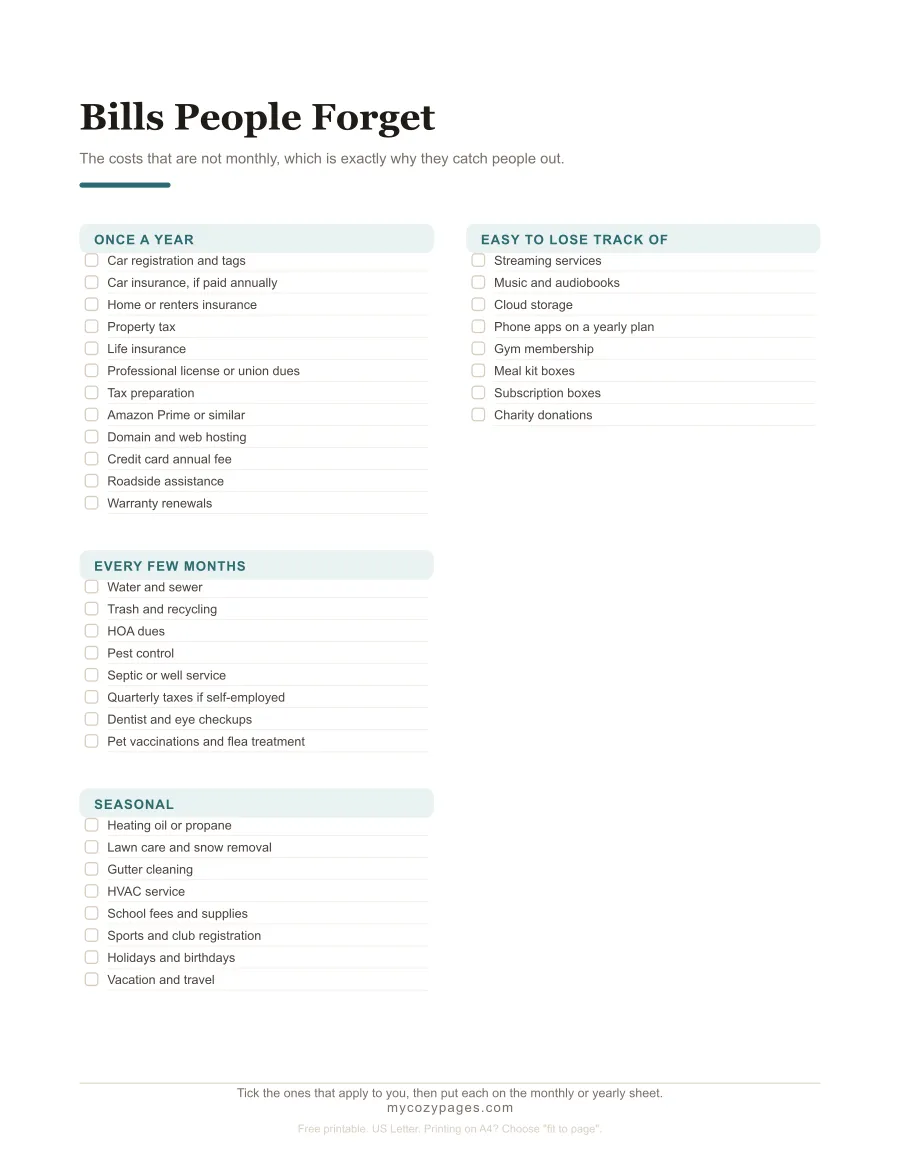
Bills People Forget · 36 items · 4 groups · 1 page
Then open last month’s bank statement and read down it slowly. Anything that repeats goes on the list. This is the bit everybody wants to skip and the bit that makes the difference.
For the costs that are not monthly, do this: take the yearly amount, divide by twelve, and put that on the tracker as a monthly line even though nothing leaves your account most months. Then the year the car registration lands, the money is already sitting there waiting for it.
Step 2. Get them onto one page
Now the list has somewhere to live. Write the bills in due date order rather than the order they came into your head, and add up the amount column. That total is what your month costs before you’ve bought a single thing to eat.
Put your income at the top, take the total off it, and what is left is the real number you have to work with. It’s usually a bit of a moment.
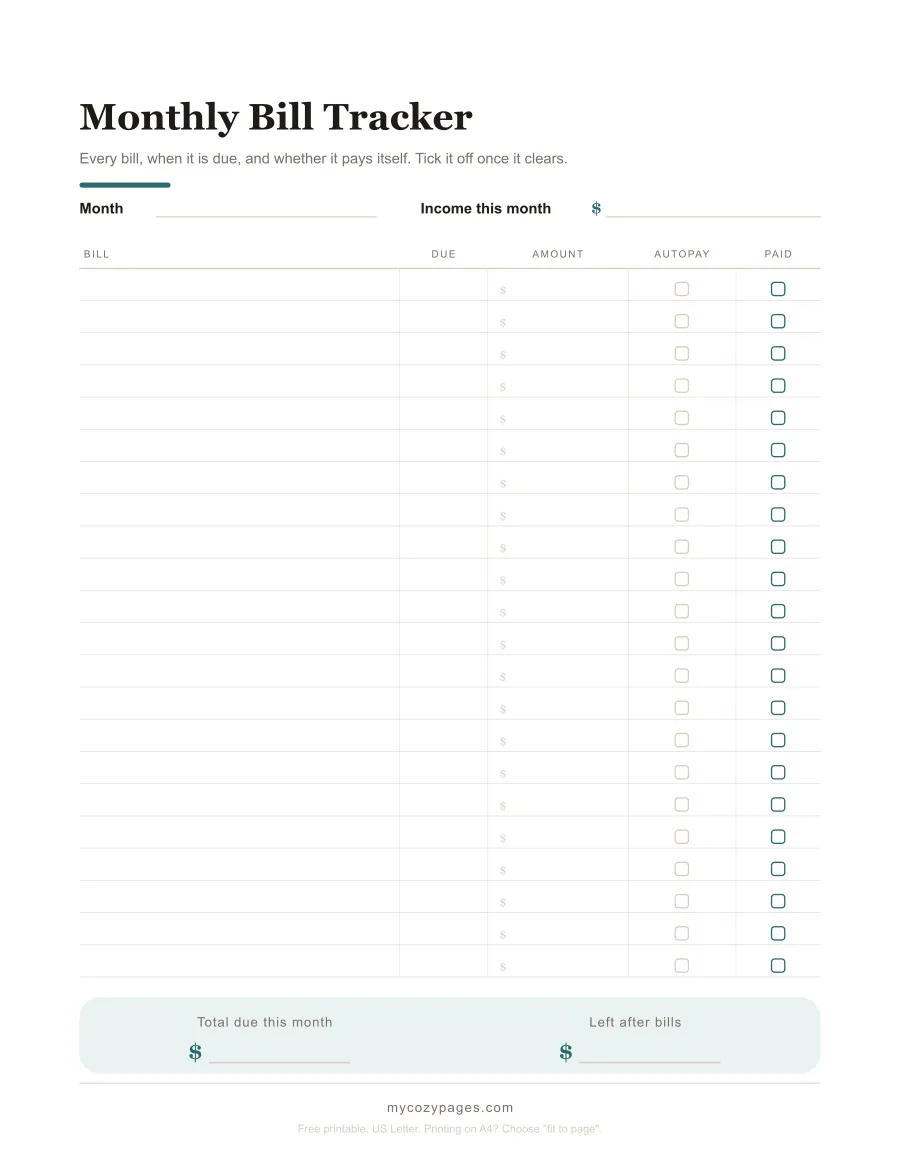
Monthly bill tracker
Monthly Bill Tracker · 22 rows · 1 page · light on ink
Download the monthly tracker (PDF)
Two versions of the same sheet, if the plain one isn’t quite right.
Monthly bill tracker, banded rows
Every other line is tinted, because the page is wide and it’s easy to slide into the wrong row halfway across. A free printable bill tracker is only useful if you can read it in a hurry.
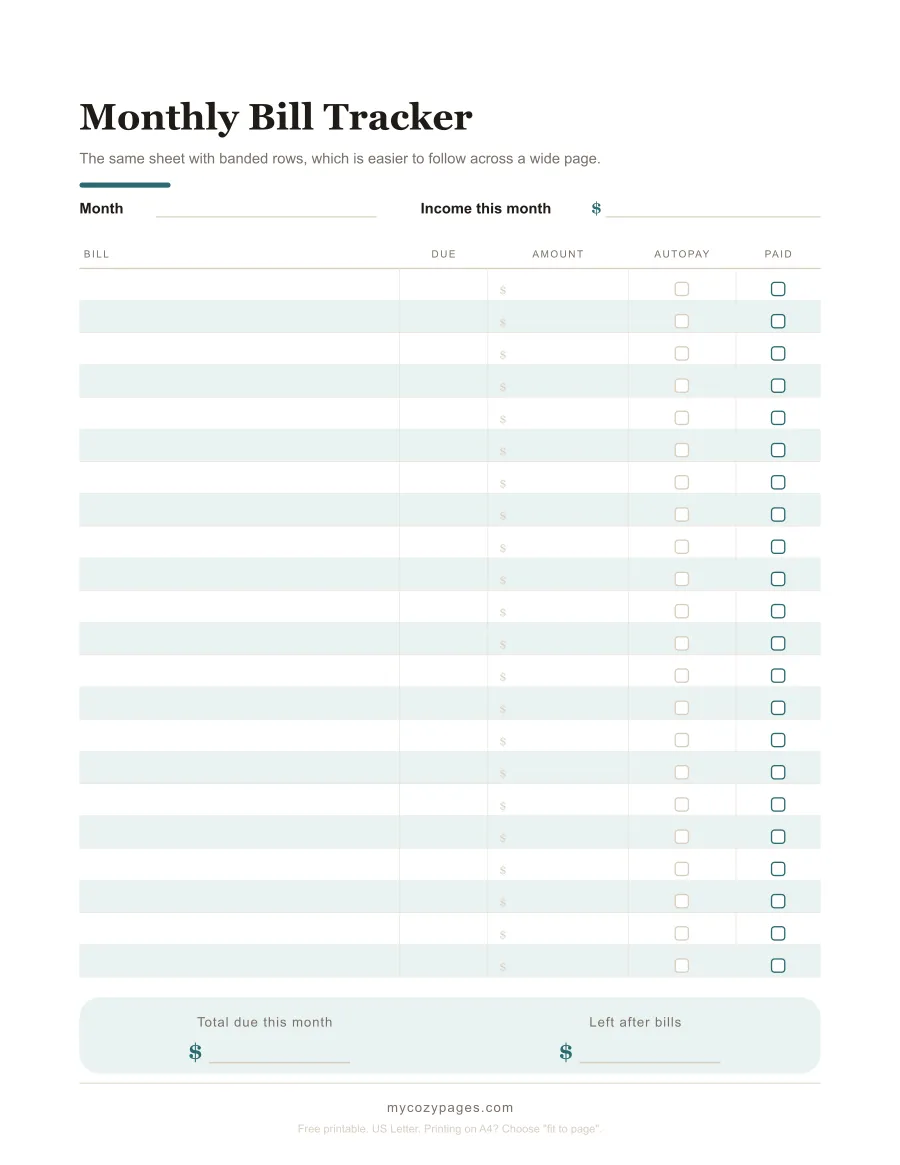
Download the banded version (PDF)
Fillable bill tracker
Sixty typeable boxes, so this bill payment tracker can live on a laptop instead of the fridge. It opens in any PDF reader.
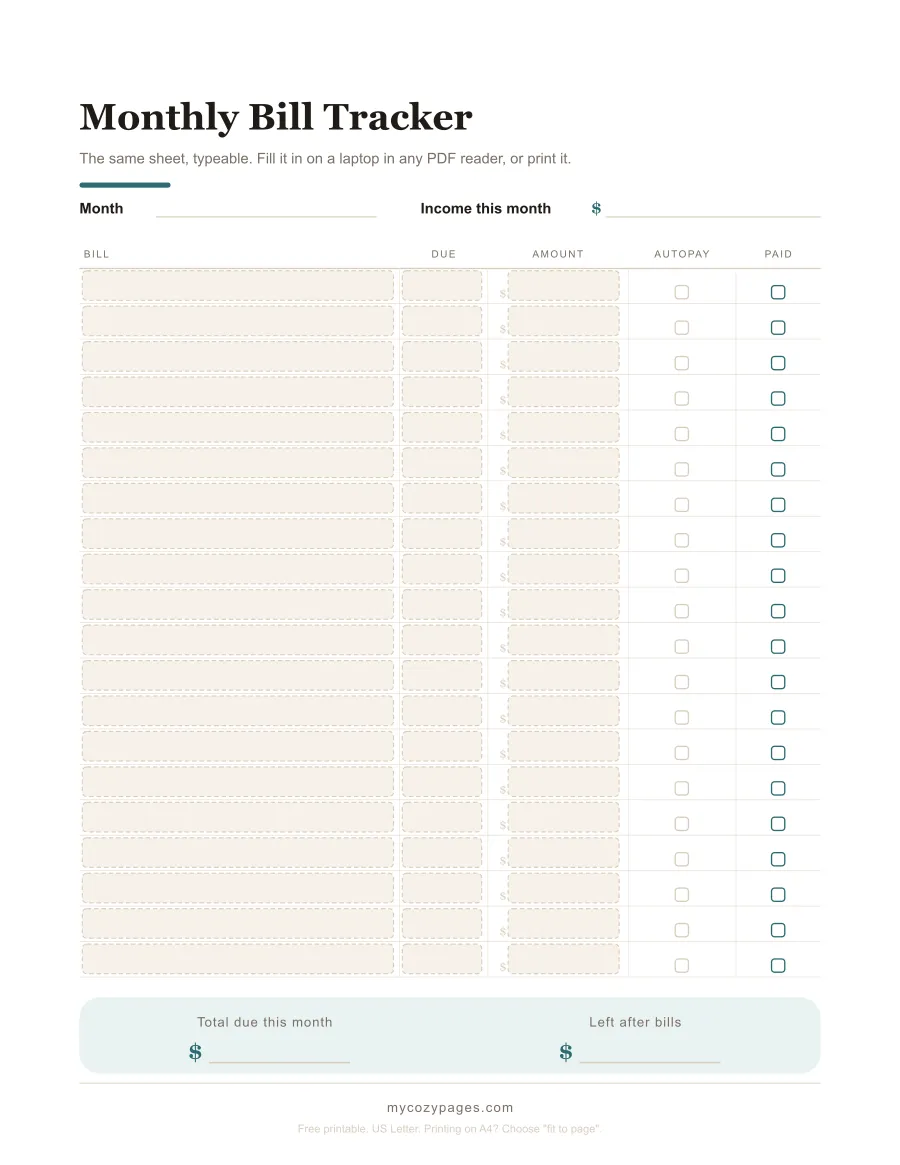
Download the fillable version (PDF)
The column nobody prints
While you are filling that in, one column deserves an explanation, because it’s the one every other template leaves out.
Open any bill tracker online and you get the same four headings. Bill, due date, amount, paid. That’s a layout from back when paying a bill meant writing a check and finding a stamp.
These days half of them leave your account whether you think about it or not. So a sheet with only a “paid” box is asking the wrong question, because checking it off tells you nothing about whether you had to lift a finger.
Every monthly sheet here has an autopay column sitting next to the paid box. Fill it in once and the page sorts itself into two piles:
- Autopay checked. Nothing to do. Glance at it, confirm it cleared, check it off.
- Autopay empty. That’s your actual to-do list. Usually four or five things, not twenty-two.
That second pile is the point of the whole exercise. It turns a page that looks like a lot into something you can finish with a coffee on a Sunday morning.
Autopay isn’t set-and-forget though, however much we’d all like it to be. Cards expire and the payment fails without telling you. A balance runs short and it bounces. A subscription renews at a price nobody mentioned. So the paid box still earns its place on those rows. It’s just doing a different job there.
If you aren’t certain what’s coming out automatically, the audit sheet is worth an afternoon. Fair warning: most people find at least one thing on it they stopped using a while ago.
Autopay audit
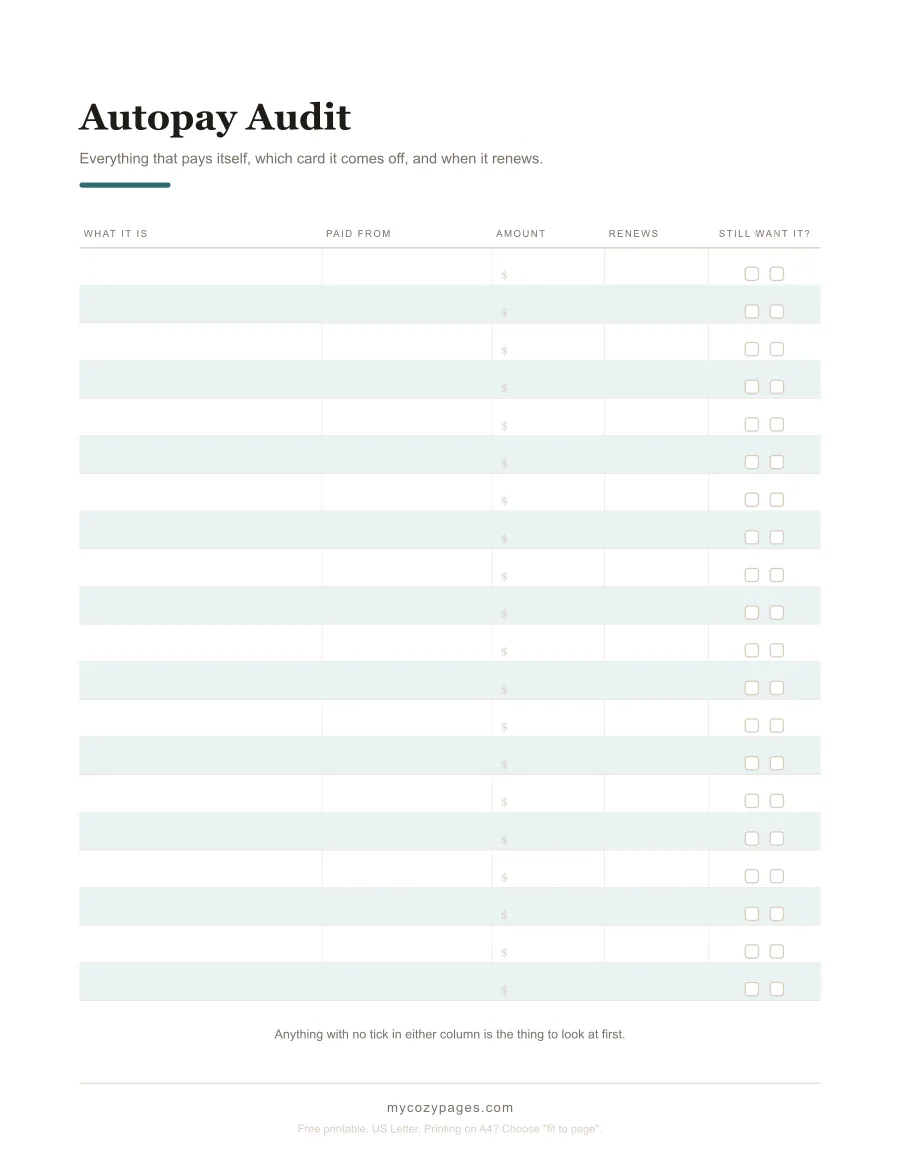
Autopay Audit · 20 rows · what it is, which card, when it renews, do you still want it
Download the autopay audit (PDF)
Step 3. Line the bills up with your paydays
Here’s the thing no printable seems to deal with. Your bills are due on the 1st, the 5th, the 12th and the 28th. Your money turns up on two Fridays. Nothing lines up, and every single month you end up doing the same sum in your head about whether the first paycheck stretches over the rent and the car.
Hand every bill to one payday or the other, in writing, once. You stop redoing that arithmetic, and you find out in advance which payday is the tight one. Much nicer way to learn it than on the day.
Paycheck bill planner
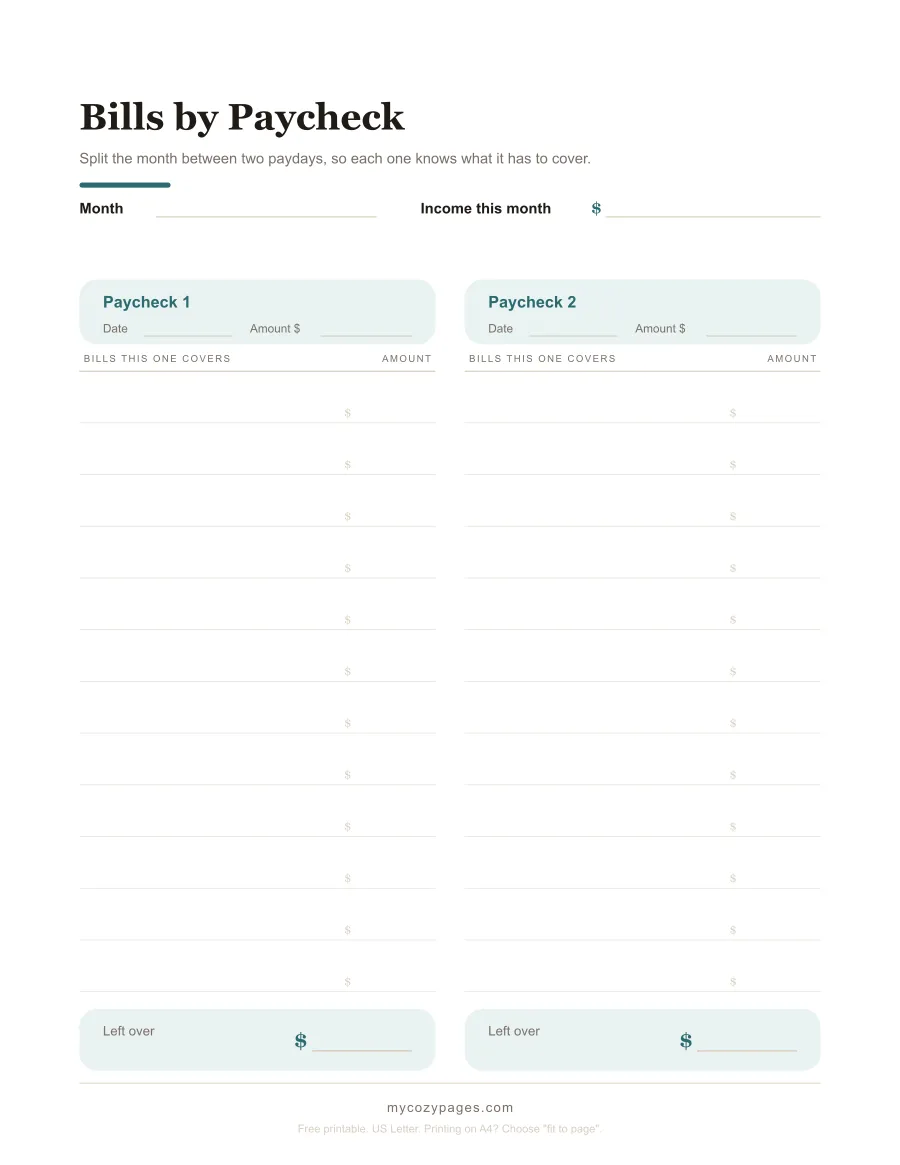
Paycheck Bill Planner · 2 paydays · 12 bills each · a line for what is left
Download the paycheck planner (PDF)
Paid monthly? Skip this step. Paid every two weeks? This is the one that changes the most.
Step 4. See the month coming
A list tells you something is due on the 12th. A calendar tells you that three things are, and that the 12th is four days before payday. Completely different feeling, and it’s the difference between knowing your bills and seeing them.
Write the date into each corner box so the sheet works for whatever month you are in.
Bill calendar
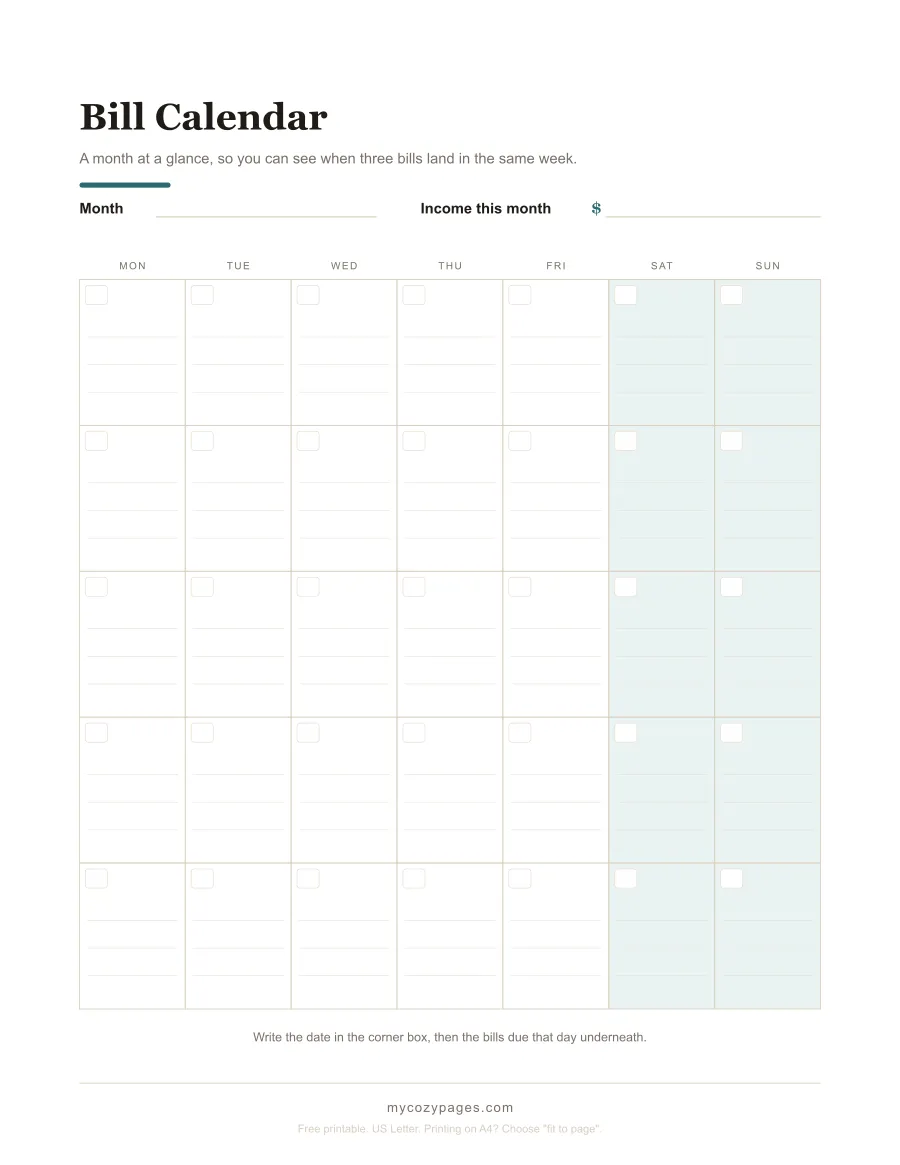
Bill Calendar · 35 days · 3 bills a day · undated, so it works for any month
Download the bill calendar (PDF)
Once a year, zoom out
The monthly sheet is what you work from. The yearly grid is what catches whatever the monthly sheets missed.
Eighteen bills down the side, twelve months across, one box per month. What you’re watching for isn’t the checks, it’s the gaps. An empty box halfway along a row is a month that slipped, and you can spot it from across the kitchen.
Yearly bill tracker
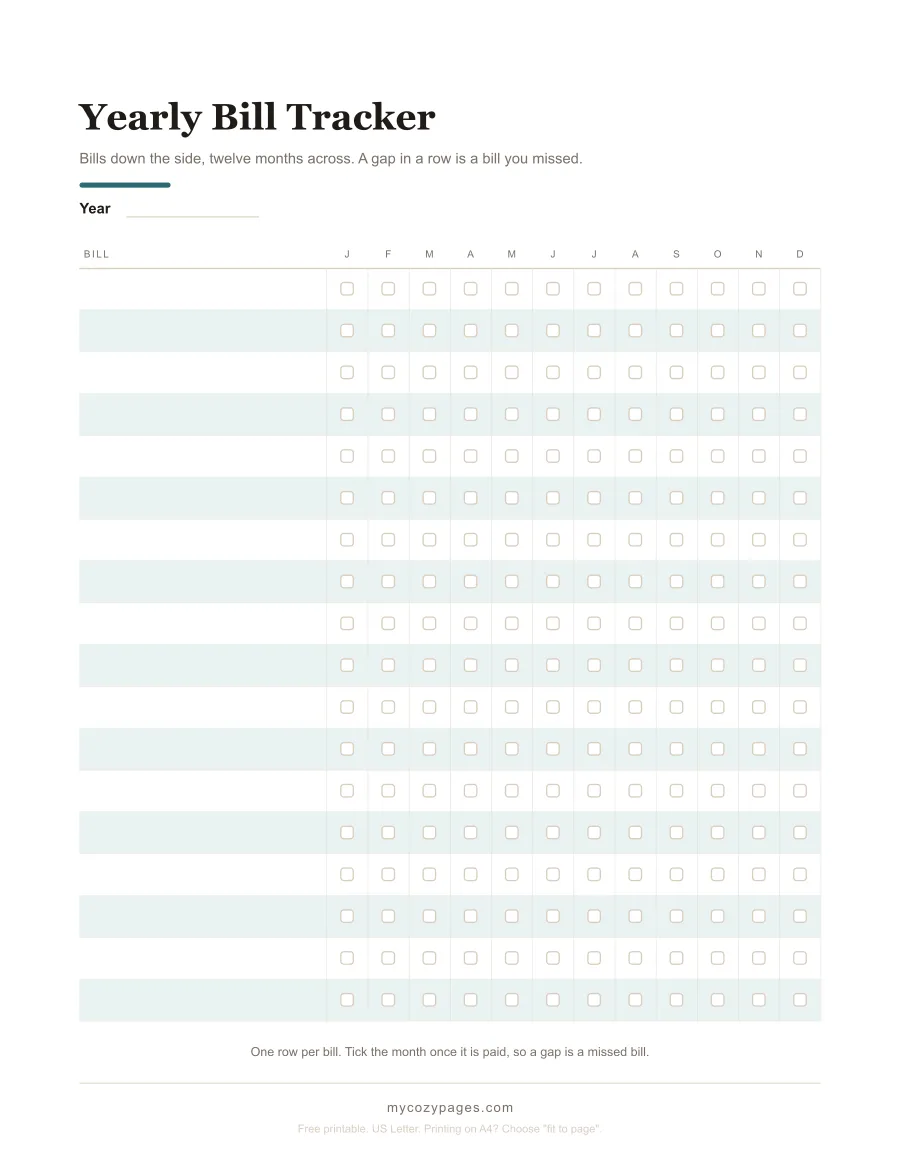
Yearly Bill Tracker · 18 bills × 12 months · 1 page
Download the yearly tracker (PDF)
How much this actually matters
In its 2025 survey, the Federal Reserve found that 16 percent of adults didn’t pay all their bills in full in the month before they were asked. Count everyone who paid but found it hard and it’s 28 percent.
I do want to be straight about what a piece of paper can do there. Most of that is people who didn’t have the money, and printing something doesn’t make money appear. What a tracker fixes is the smaller, more irritating problem: a bill that went unpaid because nobody remembered it, in a month when the money was sitting right there. That one is worth fixing, and honestly it’s the only one a sheet can touch.
Five minutes when the month ends
Most pages stop at “print the sheet”. Give it two more minutes on the last day and it earns a lot more.
- Look at the rows with nothing checked off. Either you missed it, or you don’t have it any more. Both are worth knowing.
- Check the autopay rows really did clear. This is exactly why that column is there.
- Carry the misses onto next month’s sheet before you file this one away.
- Keep the filled-in sheets. Twelve of them is a record of what your year actually cost, and that’s the thing nobody has when they sit down to write a budget.
Every sheet in one place
If you’d rather skip the steps and take the lot, here is the whole set.
| Sheet | Used at | What it does |
|---|---|---|
| Bills people forget | Step 1 | 36 prompts, so the list is complete |
| Monthly bill tracker | Step 2 | 22 rows, autopay column, two totals |
| Banded rows | Step 2 | Same sheet, easier to read across |
| Fillable bill tracker | Step 2 | 60 typeable boxes |
| Autopay audit | Step 2 | What pays itself, and whether you want it |
| Paycheck bill planner | Step 3 | Two paydays, bills split between them |
| Bill calendar | Step 4 | A month grid, bills on the day they fall |
| Yearly bill tracker | Yearly | 18 bills × 12 months, gaps show misses |
Every sheet is US Letter, 8.5 x 11 inches, and prints on A4 if you pick “fit to page”. They’re line drawings, so they barely touch your ink.
A note before you start
These are organizing sheets, not financial advice. They can’t tell you which bill to pay first when there isn’t enough for all of them, and if that’s where you are right now, a nonprofit credit counselor will help you far more than anything I can print.
If what the month reveals is a pile of balances rather than a surplus, the debt payoff tracker printables are the next sheet to print. If it reveals a month that leaks rather than a month that is short, the no spend challenge printables are about drawing the line somewhere. If there is money left over, the savings challenge printables page has eleven trackers for it, the 100 envelope challenge turns it into a bit of a game, and the Christmas savings challenge works to a deadline if the holidays are the thing coming at you.
Save it for later
Free bill tracker printables. Eight sheets in one PDF: a monthly tracker with an autopay column, a bill calendar so you can see when bills pile up, a yearly grid, a paycheck planner, an autopay audit and a checklist of 36 bills people forget. US Letter, no email needed.
Save this pinFrequently asked questions
What is a bill tracker?
One sheet with every bill on it: what it is, when it is due, how much, and whether it has been paid. It takes over the job your memory has been doing badly. Setting it up takes about twenty minutes the first time, then five minutes a month after that.
What should a monthly bill tracker include?
The bill, the due date, the amount, a box to check off when it clears, and one most sheets skip: whether it is on autopay. That last column is the one that tells you what still needs you to do something.
Do I need a bill tracker if everything is on autopay?
Yes, just for a different reason. Autopay means a bill pays itself, not that it paid properly. Cards expire, balances run short, subscriptions quietly go up. The sheet stops being a reminder and starts being the thing that catches those.
How do I track bills when I get paid every two weeks?
Give each payday the bills it has to cover, in writing, so you stop doing the sum in your head. The paycheck planner here has both paydays side by side and a line at the bottom for what is left once each one has done its share.
What is the difference between a monthly and a yearly bill tracker?
The monthly sheet is what you work from. The yearly one is twelve months across a single page, one row per bill, and its whole job is the gaps: an empty box halfway along a row is a month that got missed. Most people want both.
Which bills do people most often forget?
The ones that are not monthly. Car registration, annual insurance, property tax, quarterly water, HOA dues, the subscription that renews every January. There is a checklist of 36 of them on this page.
Are these bill trackers really free?
Yes. Every sheet is a free PDF. No email, no account, no catch. Download one or download all eight, and print them as often as you like.
Can I type into them instead of printing?
One of them, yes. The fillable version has typeable boxes for the bill, the due date and the amount, and it opens in any PDF reader. The other seven are made for a pen.
Get new printables by email
Join the list and I'll email you when there's a new printable. That's all it is: no sales pitch, and every printable on the site stays free to download without it.
Unsubscribe any time. No spam, ever.
You might also like
11 Free Printable Savings Challenges (PDF)
Pick from 11 free printable savings challenges, from a $500 mini sheet to $10,000. Color in a box each time you save. Instant download, no email.
Get the printable
100 Envelope Challenge Printable: 12 Free Designs
12 free 100 envelope savings challenge printables for kids, teens and families. Totals from $100 to $10,100. Pick a version and a pace you can finish.
Get the printable