FREE DEBT PRINTABLES
Debt Payoff Tracker Printable: 8 Free Sheets
Printing a tracker is the easy half. The half that stalls people is which debt goes in row one, and every page names the two methods without ever saying what the choice is worth. Here it is, worked out to the cent, with eight free sheets under it.
- 8 Sheets
- The Order, Priced
- Free PDF
- No Signup
Put your own debts in
The sheets below work for any order. This works out which order is cheaperfor you, and what the difference actually comes to. Nothing is sent anywhere, and the numbers stay in your browser.
The list is your own payoff order, top first. Use the arrows if you want to pay one off before another, for a reason the arithmetic does not know about, and it will price that order too.
On top of the minimums. Put 0 if there is nothing spare.
Interest is charged monthly on the balance left. Minimums are treated as fixed. It assumes nothing new goes on the cards.
A debt payoff tracker printable is one page holding every debt you owe: the balance, the rate, the minimum, and the order you’re paying them in. You fill it in once and update the balances as they drop. The sheets are the easy part, and the thing that stalls people is what goes in row one, so this page prices that choice before it hands you anything.
Work out your own order with the free calculator above, or jump to a sheet.
Jump to a sheet
- Which order worksheet · your debts, written twice
- What the order costs · the comparison, worked out
- Debt payoff tracker · 18 debts, with a rate column
- Fillable tracker · typeable boxes
- Progress chart · 100 boxes, one percent each
- One debt at a time · 36 payments
- Interest log · the number that shows the plan working
- Order cards · for the fridge
Printing a tracker takes four minutes, and deciding what goes in row one has stalled people for months.
You already know the two answers. Clear the smallest balance first and you get something crossed off early, or clear the highest rate first and you hand over less interest instead. Every debt page online says both of those things and then quietly stops, because the next question is the awkward one. How much less?
Nobody prints that. So here it is, worked out on one ordinary household, and then the sheets.
Write your debts down twice
Not one list. Two.
Write every debt you have in order of balance, with the smallest one at the top. Then write the same debts out again in order of interest rate, with the highest one at the top. Both numbers are on your last statement, so this is ten minutes with a pen and a stack of paperwork.
That’s the whole worksheet. It does something no paragraph can, which is show you in your own handwriting whether the two methods disagree at all.
Which order worksheet
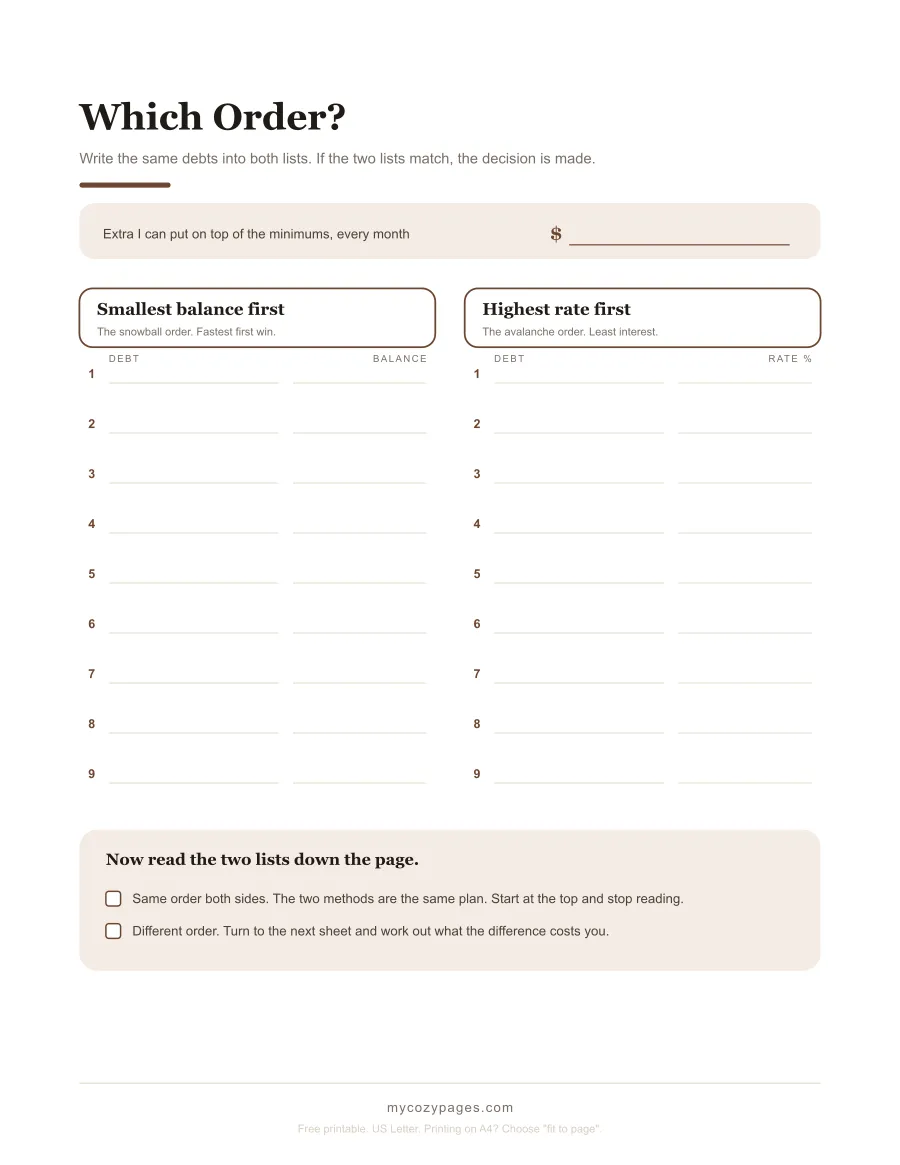
Which Order? · 9 rows each side · a verdict box at the bottom
When the two lists are the same list
This happens more often than anyone admits, and I haven’t found a single page that mentions it. Checking is worth the five minutes, because the internet has spent years arguing over a question that a good number of the people reading about it don’t actually have.
Small balances tend to carry the worst rates. A store card is frequently both the smallest thing you owe and the most expensive thing you owe, because that is what store cards are. When that pattern holds the whole way down your list, sorting by balance and sorting by rate produce the same order, and the famous argument turns out to be about nothing.
Here’s one. A $700 store card at 22.15%, a $3,200 credit card at 20.94%, and a $7,400 car loan at 7.14%, with $150 a month spare on top of the minimums. Sort those by balance and then sort them by rate, and you get store card, credit card, car loan both times. Both plans take 26 months and both pay $1,382.28 in interest, which makes the difference between the two famous methods exactly $0.00.
If your two columns match, you have nothing left to decide, so start at the top of the list and get on with it.
When they differ, here is the bill
Now the case where they genuinely pull apart: four debts, where the smallest balance also happens to be the cheapest money in the house.
| Debt | Balance | Rate | Minimum |
|---|---|---|---|
| Car loan | $1,450.00 | 7.14% | $295.00 |
| Store card | $2,300.00 | 22.15% | $58.00 |
| Personal loan | $3,900.00 | 11.86% | $183.00 |
| Credit card | $6,100.00 | 20.94% | $153.00 |
| All four | $13,750.00 | $689.00 |
Add $200 a month on top and both plans spend exactly $889.00 a month. Nothing else differs. These are the figures the calculator at the top of the page starts with, so you can swap in your own balances and watch the gap move. The rates are published Federal Reserve averages rather than numbers picked to prove a point, and the arithmetic runs month by month on the running balance, in whole cents.
| Smallest balance first | Highest rate first | |
|---|---|---|
| Months to clear all four | 18 | 18 |
| Interest paid | $2,084.07 | $1,943.21 |
| First debt gone | month 3 | month 6 |
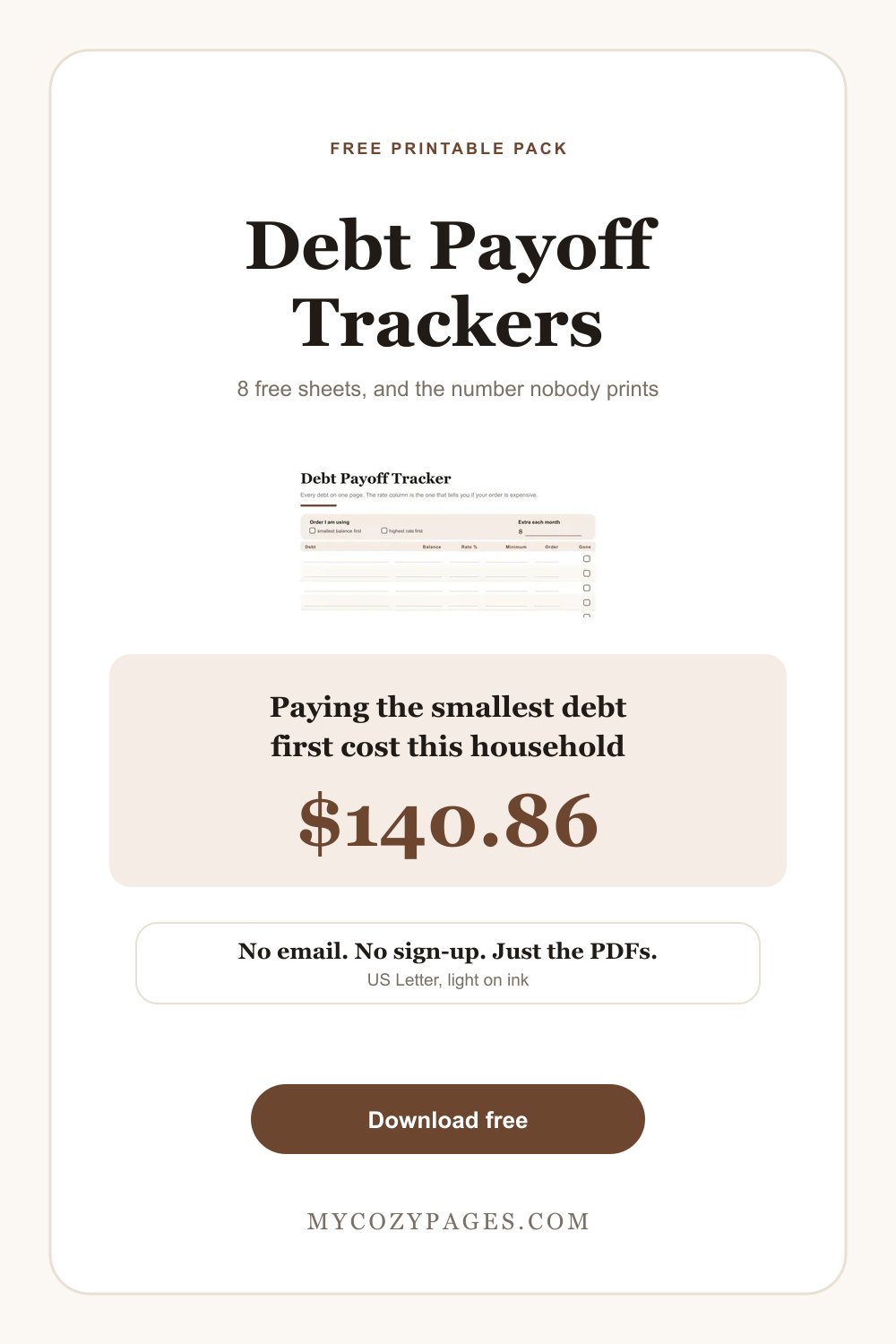
$140.86. That’s what the “wrong” order costs this household across the whole eighteen months. Spread over that long it’s under $8 a month, and under 7 percent of the interest either way.
Look at the months row too, because both plans finish in 18 and the cheaper order doesn’t get you out of debt any sooner. It only charges you less on the way.
What the $140.86 buys is the early win. Smallest-first clears the car loan in month 3, while highest-rate-first clears nothing at all until month 6. Three months of crossing nothing off is a long time, and that’s the real case for the snowball, laid out payment by payment on the debt snowball printable page.
What the order costs
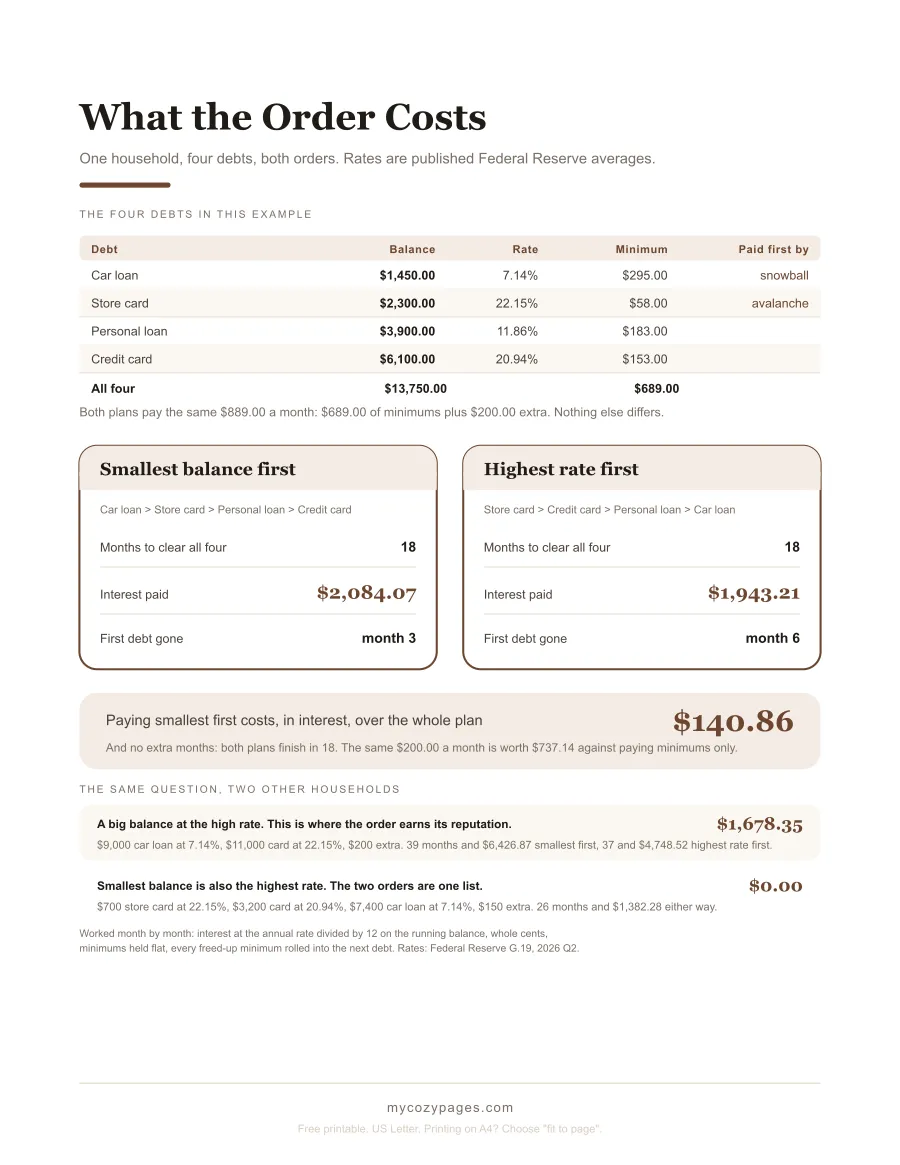
What the Order Costs · the worked example · two more households at the foot of the page
What costs more than the order does
Take the same four debts and pay nothing but the minimums, and the plan runs to 25 months and $2,821.21 of interest.
So that extra $200 a month is worth $737.14 and seven months off the end. The order is worth $140.86 and no months at all. The amount you pay is worth 5.2 times what the order is worth, and it’s the one thing nobody argues about online.
That’s the part the arguments keep skipping, because picking a sequence is free and finding another fifty dollars a month isn’t. Here’s the version of it I like best, because it settles the whole thing by refusing it. Pay smallest-first, find another $57 a month, and you finish on $1,942.41, which is less than the avalanche’s $1,943.21. Fifty-seven dollars a month buys the entire decision back.
When the gap is worth caring about
None of that means the order never matters. Sometimes it’s real money, and I’d rather show you when than hand you a rule.
The gap grows when a large balance carries the high rate. Two debts: a $9,000 car loan at 7.14% and an $11,000 credit card at 22.15%, with the same $200 a month extra. Smallest-first takes 39 months and $6,426.87 in interest, while highest-rate-first takes 37 months and $4,748.52. The gap there is $1,678.35 and two months, which is worth a bit of discomfort to go after.
That gives you something better than a rule of thumb: the order matters in proportion to how much money is sitting at the high rate, and for how long it sits there. A small expensive debt is cheap to pay late. A big expensive one isn’t.
Both cases are printed at the foot of the comparison sheet, so you can see all three side by side without opening this page again.
Sheets for whichever order you picked
Everything below works the same for either method. Write the order you chose into the Order column and the sheets stop caring which argument you came from. That matters more than it sounds, because a tracker built around one method has to be thrown out the first time you change your mind about a decision nobody ever gave you the figures for.
Debt payoff tracker
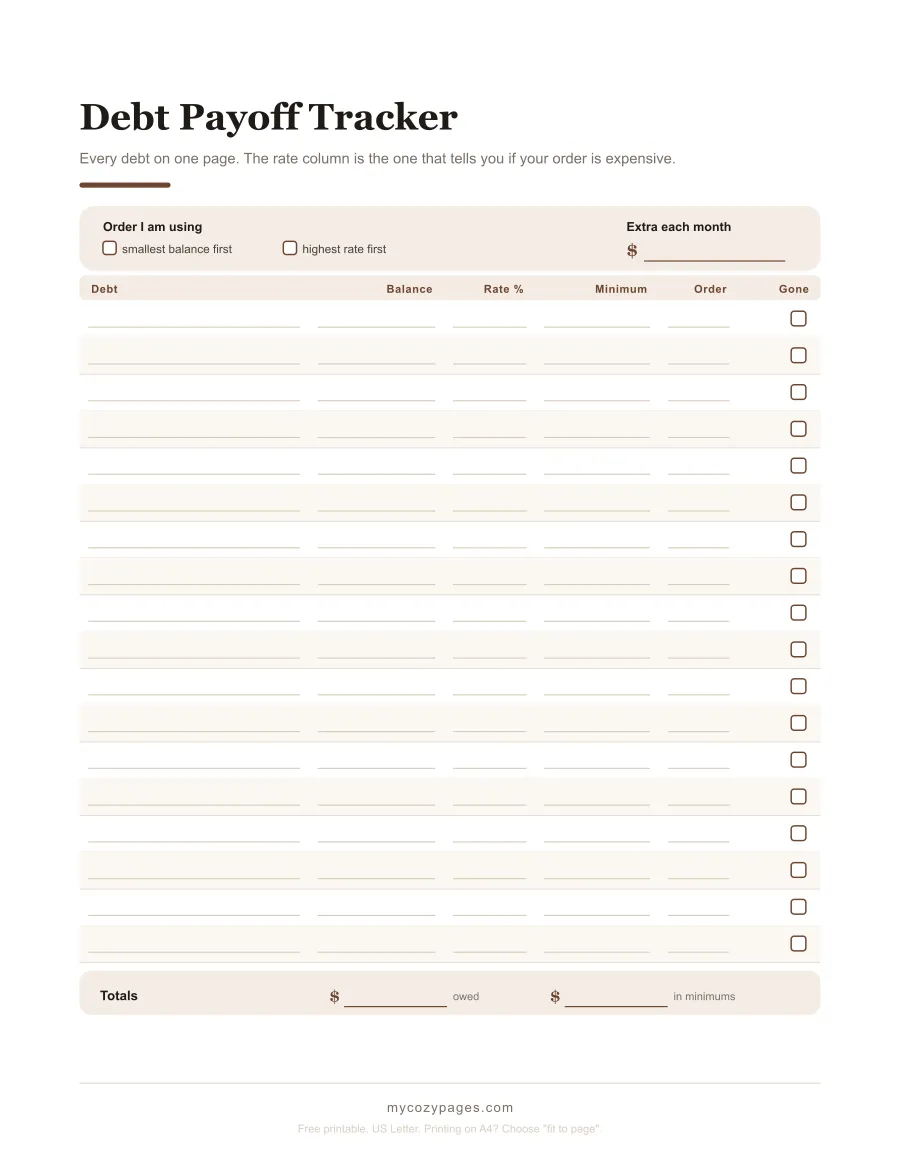
Eighteen rows, and next to each balance a column for the interest rate. That column is the reason this sheet exists: without it you can’t tell whether your order is the expensive one, and most printable debt trackers leave it out entirely.
Debt Payoff Tracker · 18 debts · rate column · totals line
Fillable debt payoff tracker
The same sheet with 91 typeable boxes, for anyone who would rather keep this on a laptop than on the refrigerator. It opens in any PDF reader and it doesn’t add up for you.
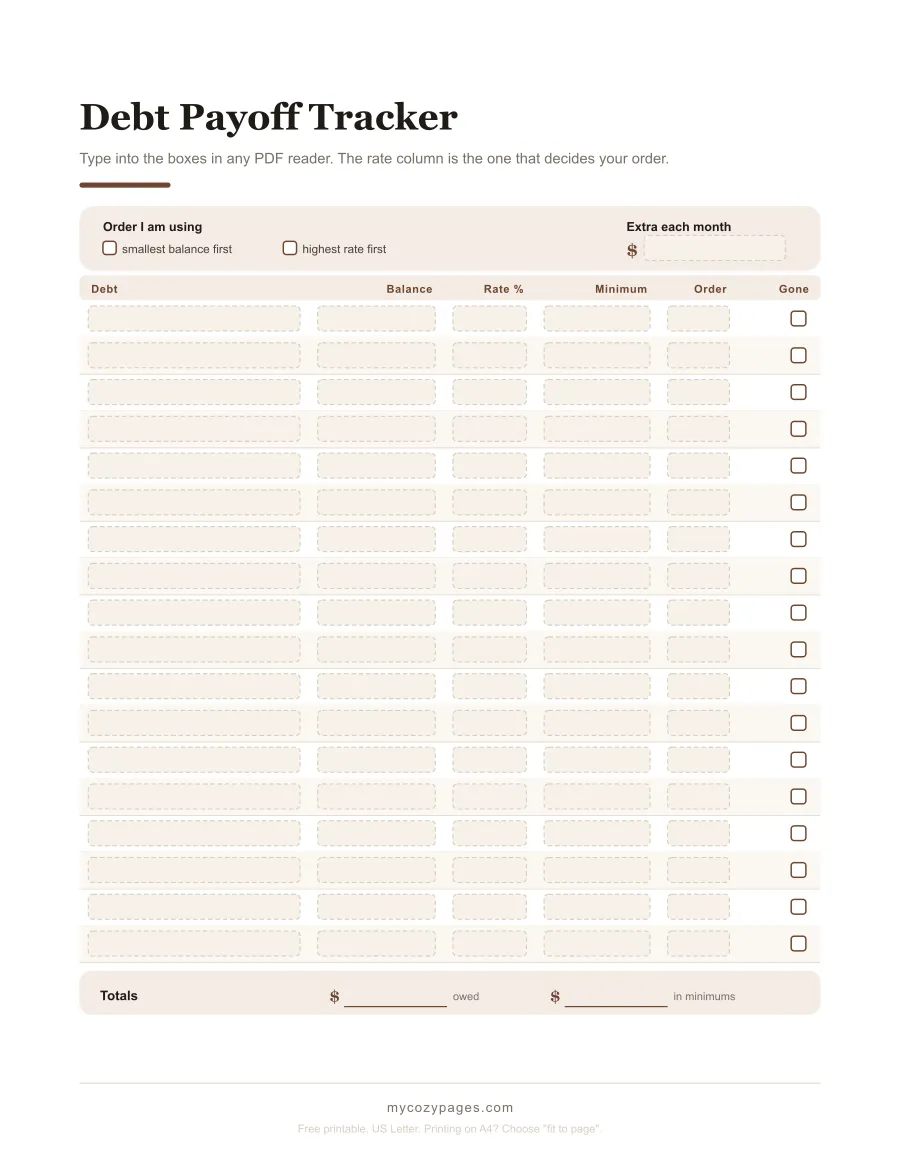
Download the fillable version (PDF)
Payoff progress chart
A hundred boxes, one percent of your total each. Every chart like this tells you a box is one percent and then leaves you to divide your own balance by a hundred, so this one prints the line to write that figure on. If you would rather color a picture than tick a box, the debt payoff coloring sheets do the same job as a thermometer, a road and a shrinking bar. Work it out once, in pen, and the sheet does the rest of the year for you.
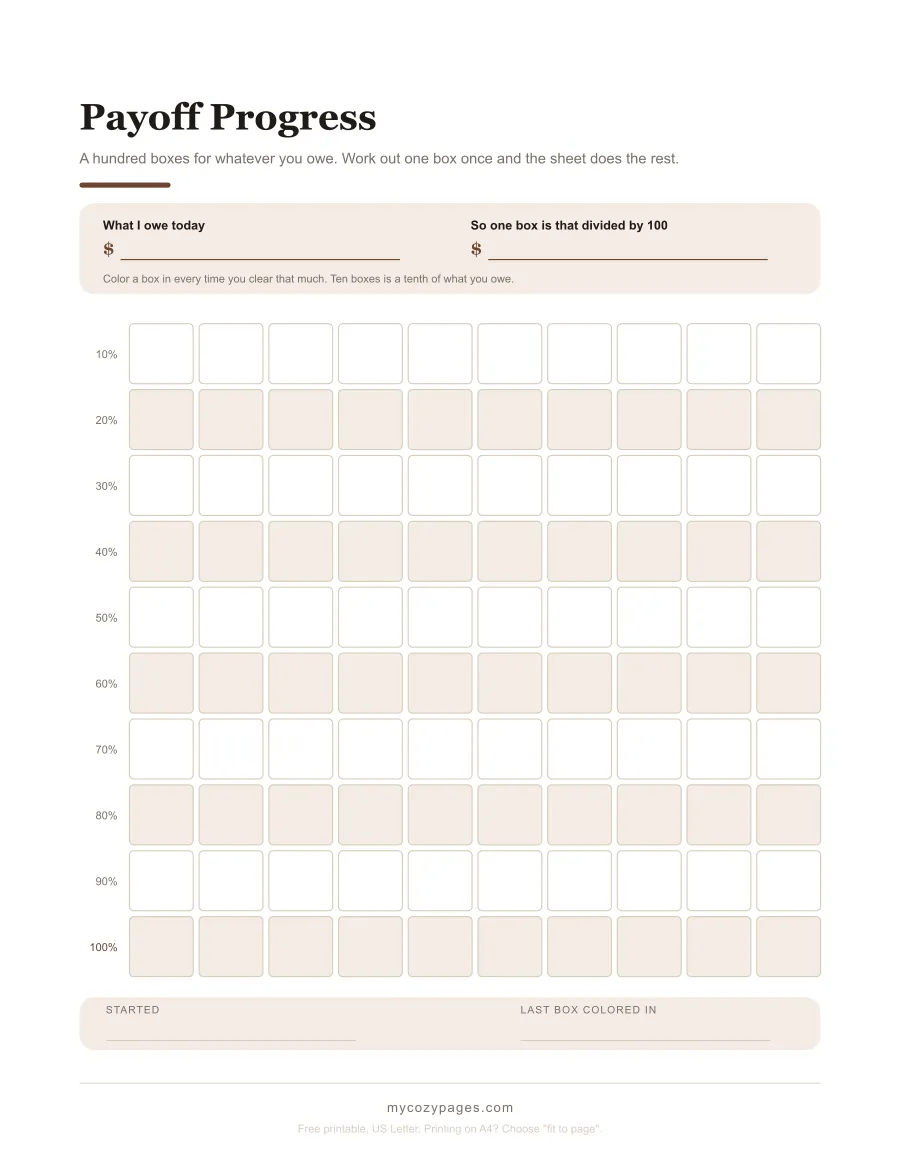
Payoff Progress · 100 boxes · one line for what one box is worth
Download the progress chart (PDF)
One debt, payment by payment
Thirty-six rows for a single debt: date, what you paid, how much of it was interest, and the balance that was left. The interest column is the whole point. It’s the difference between a payment and a dent, and on a high-rate card those two things aren’t the same size.
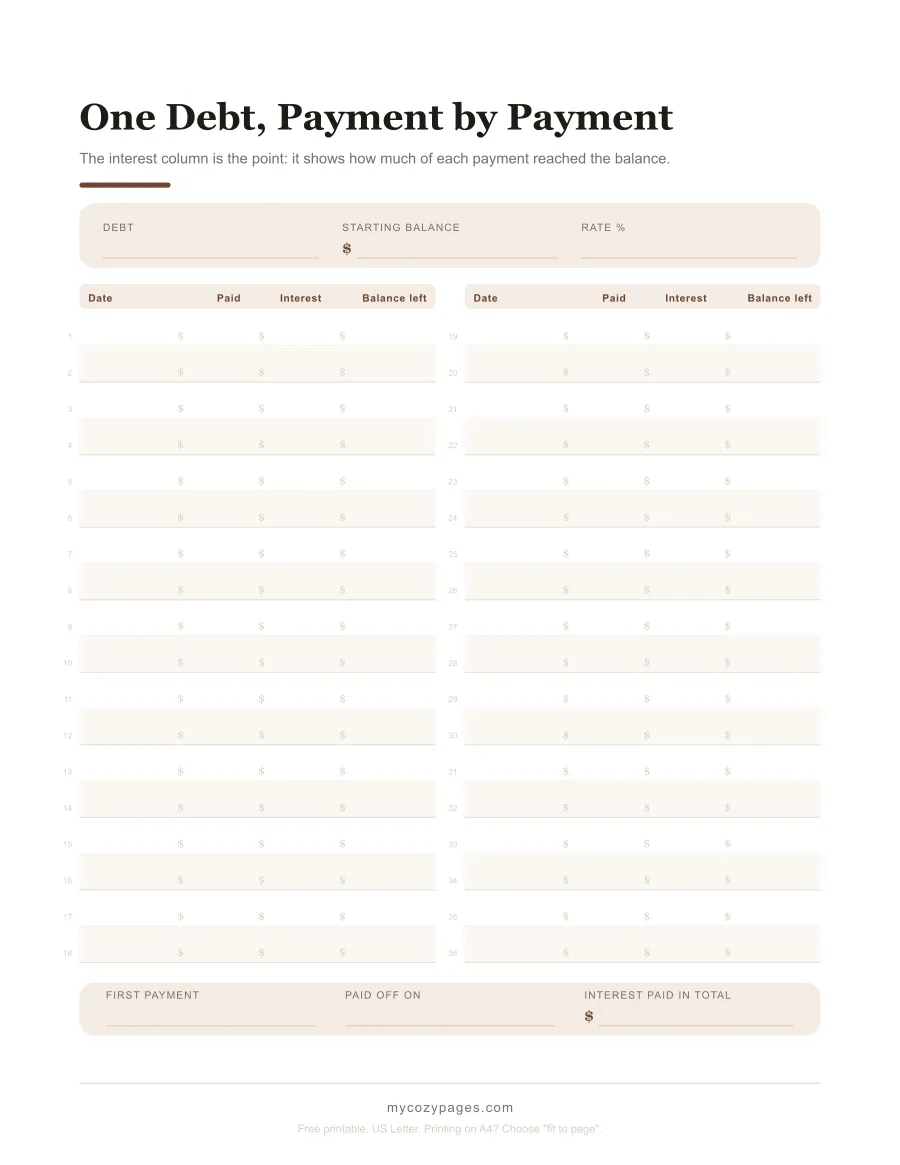
Download the payment ledger (PDF)
Interest paid log
Twenty-four months, everything you owe on one line each. Watch this column rather than the balance. In a thin month the balance barely moves and it feels like nothing happened, but the interest figure still drops, and that drop is the plan working.
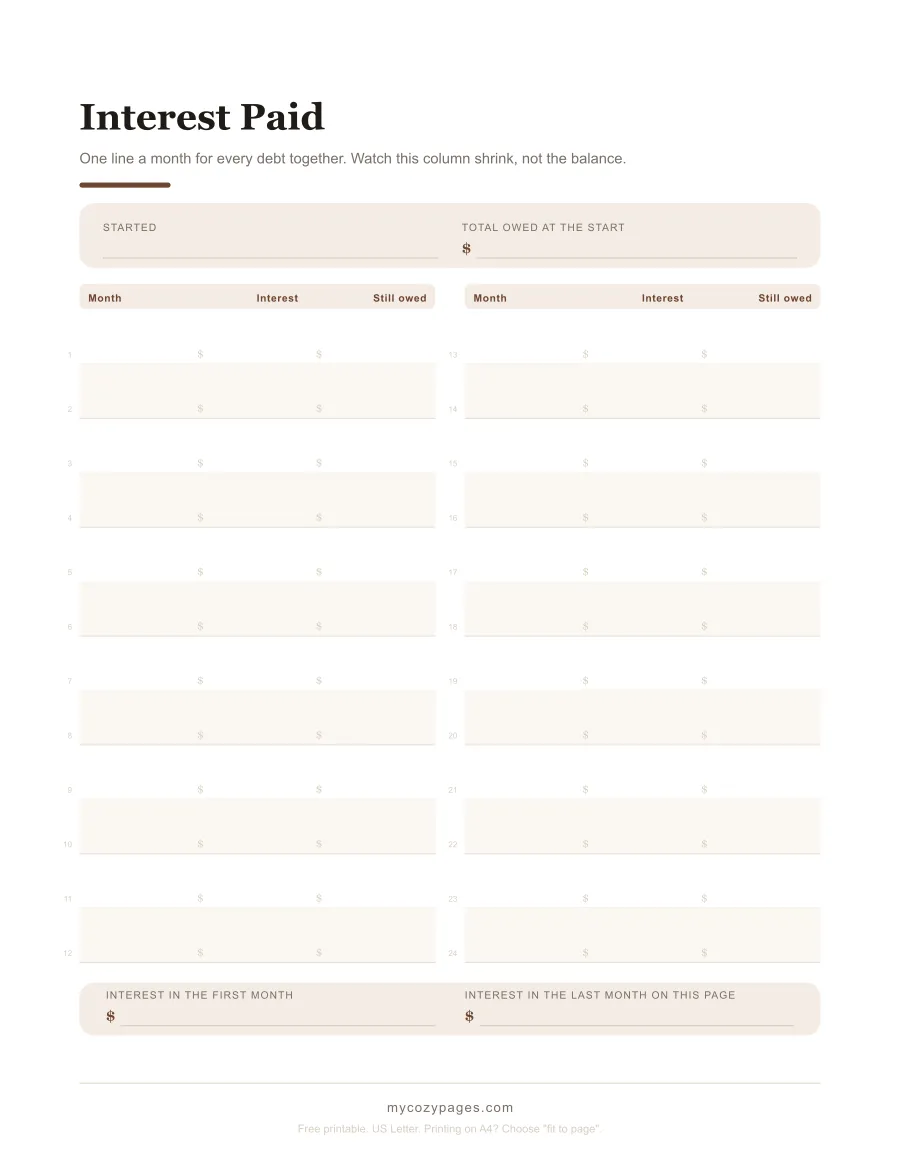
Download the interest log (PDF)
The order, in writing
Four small cards, cut them out. Stick one somewhere annoying. One goes on the refrigerator and one lives in a wallet, and the other two are for whoever else is in on this with you. The order you settled on is worth having somewhere visible on the evening a card feels like the easy option.
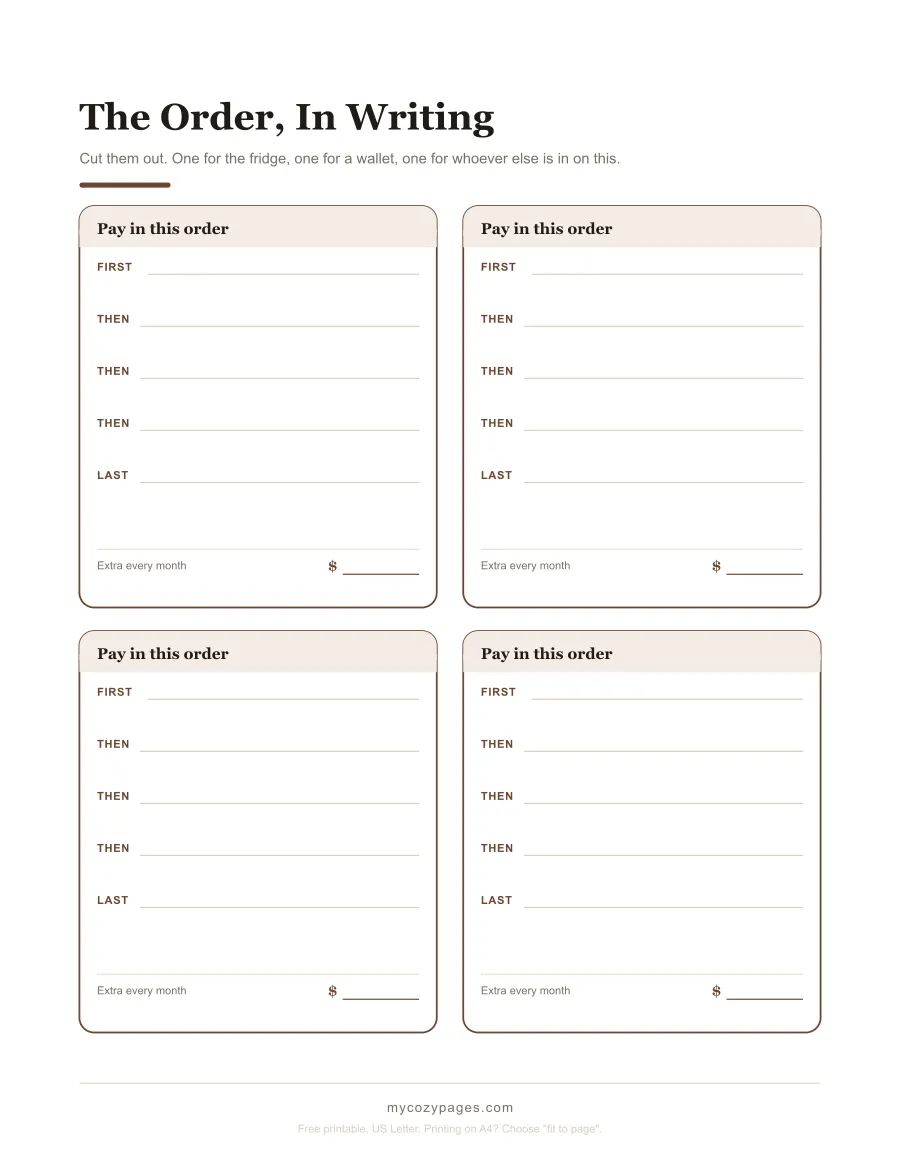
Download the order cards (PDF)
The rate you are actually up against
Two figures worth having, both straight from the source.
In its Quarterly Report on Household Debt and Credit released on August 11, 2026, the Federal Reserve Bank of New York put total household debt at $18.8 trillion in Q2 2026. Credit card balances rose by $21 billion in the quarter and stood at $1.26 trillion.
The rate on those balances comes from the Federal Reserve’s own G.19 consumer credit release, published September 8, 2026. For 2026 Q2 the average rate at commercial banks was 22.15% on credit card accounts assessed interest, and 20.94% across all accounts. Those are the rates used in the examples above, along with 11.86% on a 24 month personal loan and 7.14% on a 60 month new car loan from the same release.
Twenty-two percent is why the interest column earns its place on these sheets. At that rate a $5,000 balance costs roughly $92 in the first month before you have paid a cent toward what you owe.
What is in the pack
| Sheet | What it does | Pages |
|---|---|---|
| Which order worksheet | Your debts written twice, so you can see if the methods disagree | 1 |
| What the order costs | The comparison, worked out, plus two more households | 1 |
| Debt payoff tracker | 18 debts, with the rate column most sheets skip | 1 |
| Fillable tracker | The same sheet, 91 typeable boxes | 1 |
| Progress chart | 100 boxes, and a line for what one box is worth | 1 |
| One debt, payment by payment | 36 payments with an interest column | 1 |
| Interest paid log | 24 months of interest, so you can watch it fall | 1 |
| Order cards | 4 cut-out cards with your order on them | 1 |
Every sheet is US Letter, 8.5 x 11 inches, and prints on A4 if you choose “fit to page”. They are line drawings, so they barely touch your ink. No watermark.
The figures on the comparison sheet aren’t typed in by hand. They are computed month by month, asserted before the page is drawn, read back off the finished sheet, and then recomputed a third time by a separate script that shares no code with the first two. Three separate implementations have to agree before $140.86 goes on the page, and if any two of them disagree the build stops.
A note before you start
These are organizing sheets, not financial advice. The comparison here is one worked example with its assumptions printed on it, and your own numbers will give a different answer, which is exactly why the worksheet asks you to write yours down. If the minimum payments alone are more than you can cover, a sheet can’t fix that, and a nonprofit credit counselor will be far more use than anything I can print.
If you picked smallest-balance-first, the debt snowball printable follows that order month by month and shows where the long quiet stretch falls. And wherever the extra payment comes from, the thing that decides how fast this ends is its size, not the order you chose.
Save it for later
Free debt payoff tracker printables. Eight sheets: a master list with a rate column, a 100 box progress chart, a per payment ledger with an interest column, an interest log, cut out order cards, and two worksheets that price the snowball against the avalanche for you. US Letter, no email needed.
Save this pinFrequently asked questions
Is there a debt payoff calculator on this page?
Yes, near the top, and it is free with no sign up. Put your balances, rates and minimums in and it works out what each payoff order costs you in interest and months, including an order you set yourself with the arrows. It also gives your debt free date and prints a one page plan.
What is a debt payoff tracker?
One page holding every debt you owe: what it is, the balance, the interest rate, the minimum payment and the position you gave it in your payoff order. You fill it in once, then update the balances as they fall. The rate column is the one most templates leave out, and it is the only column that can tell you whether your order is the expensive one.
Should I pay the smallest debt first or the highest interest rate first?
On the four debt household worked out on this page, paying smallest first costs $140.86 more in interest and finishes in the same 18 months. It also clears the first debt in month 3 instead of month 6. The gap grows when a large balance carries the high rate, so work out your own numbers rather than taking a rule from anybody.
How much does the debt snowball actually cost compared with the avalanche?
It depends entirely on your balances and rates, which is why no honest page can give one figure. On the example here it is $140.86 over 18 months, under $8 a month. On a two debt example with a $11,000 card at 22.15% behind a $9,000 car loan it is $1,678.35 and two extra months.
What if my smallest debt is also my highest rate?
Then the two methods produce the same list and you have nothing to decide. This is common, because store cards are usually both the smallest thing you owe and the most expensive. Write your debts out by balance and by rate on the worksheet here and compare the two columns.
Does a debt payoff tracker need to show interest?
It helps more than the balance does. A balance that drops slowly feels like failure, while an interest figure that drops every month shows the plan working even in a month where the balance barely moved. Two of the sheets here have an interest column for that reason.
Are these debt payoff tracker printables free?
Yes, all eight. No email address, no account, no watermark. Take one sheet or take the whole pack as a single PDF, and print it as often as you like.
Can I type into them instead of printing?
One of them, yes. The fillable tracker has typeable boxes for the debt, the balance, the rate, the minimum and the order, and it opens in any PDF reader. The other seven are made for a pen.
How were the numbers on this page worked out?
Month by month, with interest applied to the running balance at the annual rate divided by twelve, money held in whole cents, minimums held flat, and every freed up minimum rolled into the next debt. The rates are published Federal Reserve averages for 2026 Q2. Three separate scripts check the figures, including one that recomputes every number in this article from scratch.
Get new printables by email
Join the list and I'll email you when there's a new printable. That's all it is: no sales pitch, and every printable on the site stays free to download without it.
Unsubscribe any time. No spam, ever.
You might also like
Bill Tracker Printable: 8 Free Sheets
8 free bill tracker printables: monthly, yearly, a bill calendar, by paycheck and an autopay audit. Every sheet has a column for bills that pay themselves.
Get the printable
11 Free Printable Savings Challenges (PDF)
Pick from 11 free printable savings challenges, from a $500 mini sheet to $10,000. Color in a box each time you save. Instant download, no email.
Get the printable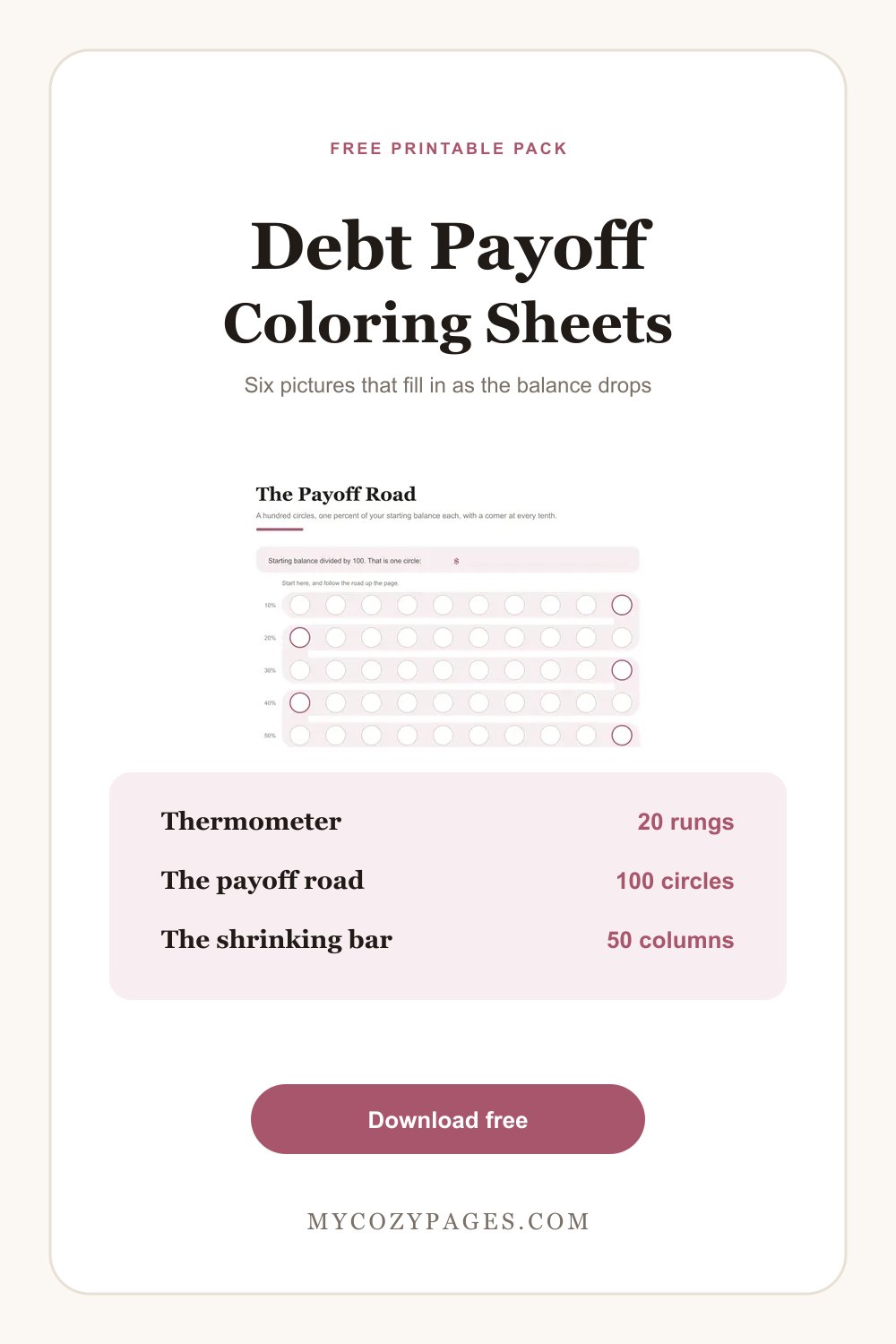
Debt Payoff Coloring Sheet: 6 Free Printable Charts
Six free debt payoff coloring sheets, and the arithmetic none of them prints: the bottom of your chart takes seven payments and the top takes three.
Get the printable