FREE BUDGET PRINTABLES
Printable Budget Planner: 7 Free Sheets
A budget decides what a month is allowed to cost before the month happens. These seven sheets do that, and one of them counts the paydays your month actually has, something the MONTH box at the top of a planner quietly assumes away.
- 7 Sheets
- Pay Cycle Printed
- Free PDF
- No Signup
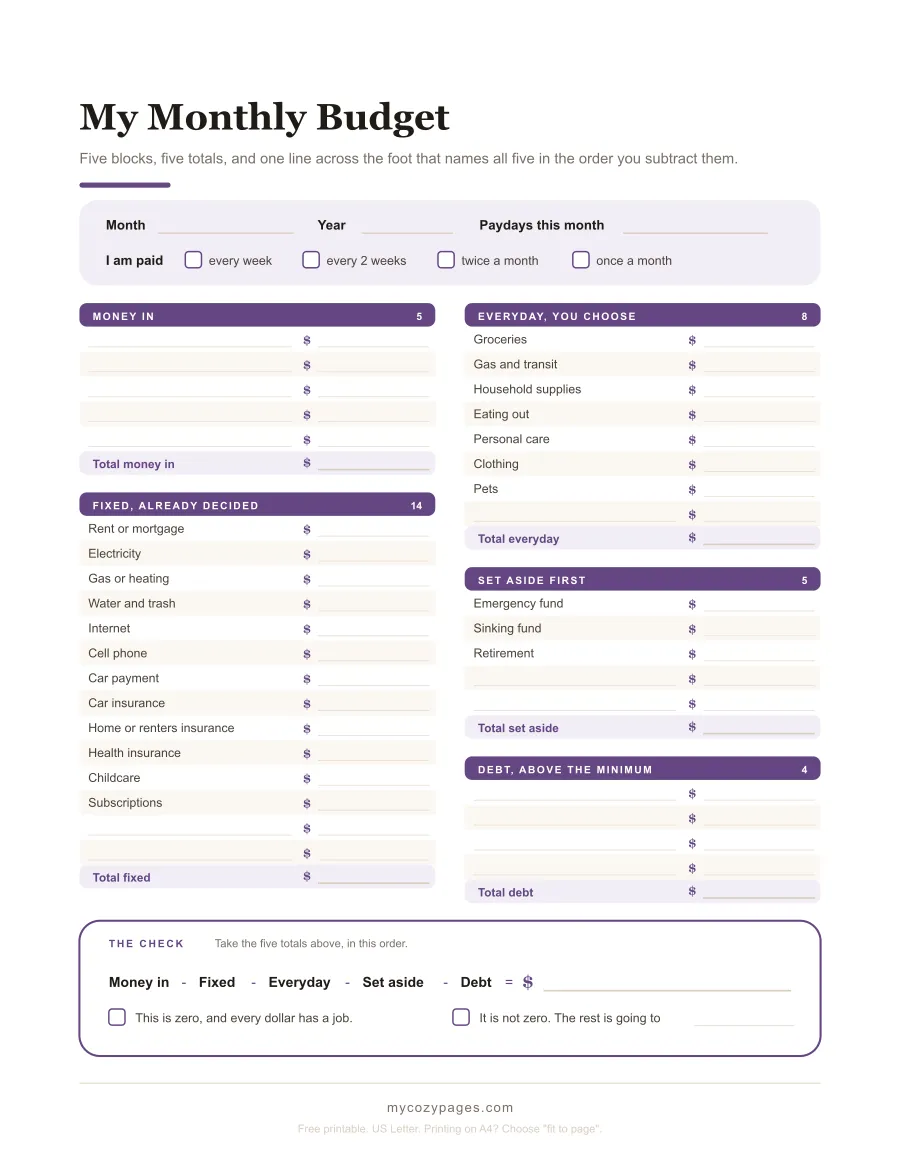
A printable budget planner is one page where you decide what a month is allowed to cost before it starts, and the last line has to balance. Seven sheets, and one of them counts the paydays your month actually has.
Jump to a sheet
- Monthly budget planner · 36 lines, five totals
- Paycheck count · for the months with a fifth one
- What the month already owes · bills that are not monthly
- Needs, wants, set aside · with a fit test
- A shorter sheet · nine lines
- All seven · one PDF
At the top of almost any budget sheet you can print there is a small box marked MONTH. It is the only thing on the page about time, and it has already made a decision for you.
Most people come to paper after an app. The app was free and it was better at arithmetic than anyone needs to be. What it would not do is decide. It showed what had happened, beautifully, and it never stopped updating. A plan written in pen on a Sunday does not move when a charge posts on a Tuesday, and that stillness is the point.
So these sheets are for deciding. The arithmetic stays yours. The sheet’s job is to make sure it is the right arithmetic and that nothing was left off the page.
The month, and what it is allowed to cost
The main sheet is five blocks: money in, fixed costs you have already committed to, everyday spending you choose each month, what you set aside, and debt payments above the minimum. Thirty-six lines. Each block totals itself directly under its own rows.
That last part sounds obvious, and it is where most printed planners come apart. Among the free budget planner sheets in circulation, one has two separate expense blocks with a total each and never adds them together. Another has five labeled blocks and no total anywhere on it. A third ends in a summary listing income, expenses, savings and debt with a row underneath marked “Total”, so a reader who does what the word says adds four numbers that cannot be added.
This sheet ends with a strip that names all five totals in the order you take them away. Money in, less fixed, less everyday, less set aside, less debt. One box, one figure you have not already written down somewhere else. Zero means every dollar has a job. Anything else gets a line saying where the rest is going.
Set aside sits above that strip rather than below it. Funded alongside the rent, not out of whatever survives.
Monthly budget planner
Monthly Budget Planner · 36 lines · 5 totals · a check strip at the foot
Download the monthly planner (PDF)
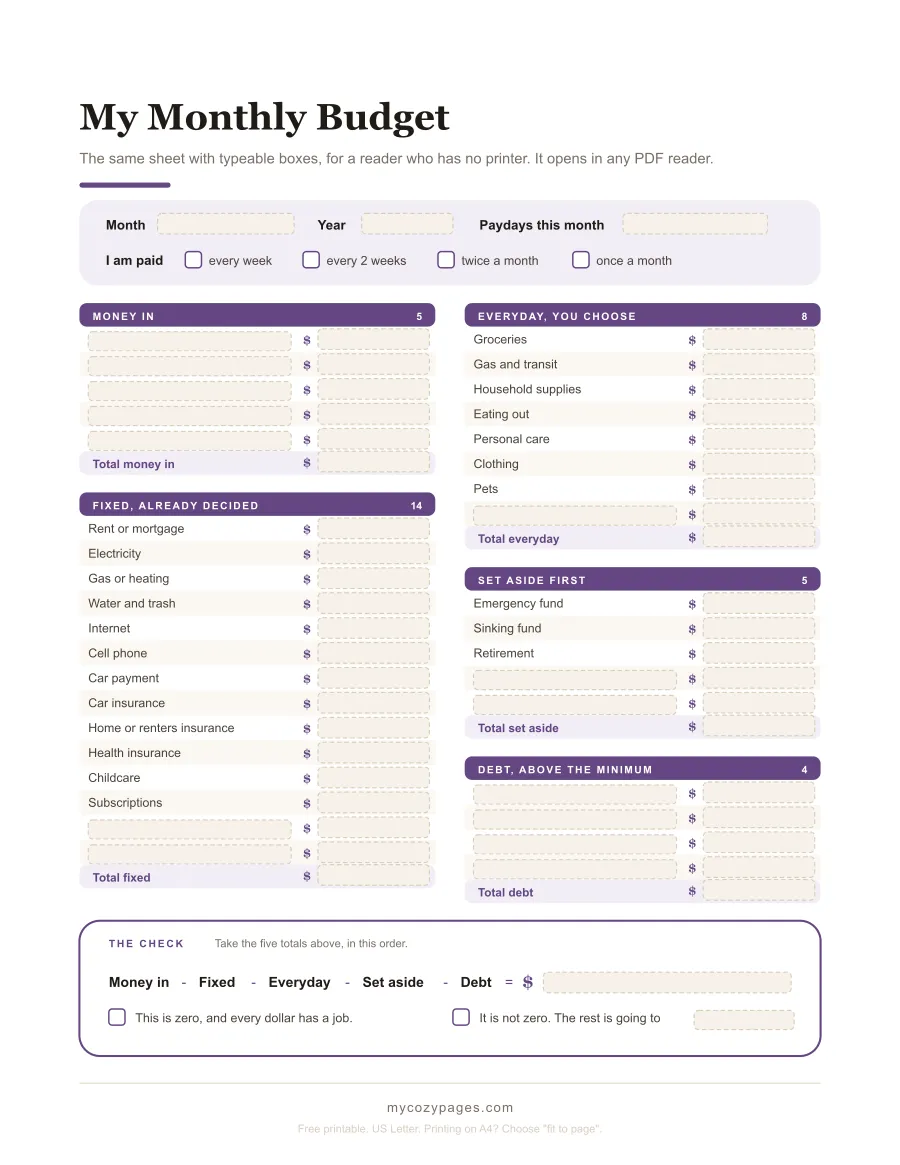
Fillable budget planner
Typeable boxes for every category and every amount, so this budget planner printable can live on a laptop instead of the refrigerator.
Download the fillable version (PDF)
Your pay cycle is not a month
A budget plans twelve times a year. Pay does not arrive twelve times a year for most people, and the MONTH box at the top of the sheet quietly assumes it does.
The Bureau of Labor Statistics counts how often American employers run payroll. Its pay period table, for February 2023 and last modified on August 4, 2023, puts 27% of private establishments on a weekly cycle, 43% on every two weeks, 19.8% twice a month and 10.3% once a month. Those four add to 100.1%, which is the table’s own rounding, and it seemed better to say so than to quietly nudge a column.
Two of those cycles go into twelve. Two do not.
| How you are paid | Paydays a year | Goes into 12? | Months with an extra one |
|---|---|---|---|
| Every week | 52 | no | 4 |
| Every two weeks | 26 | no | 2 |
| Twice a month | 24 | yes, exactly 2 | none |
| Once a month | 12 | yes, exactly 1 | none |
So 70% of private establishments pay on a cycle that does not fit the sheet.
Now the part that catches people. Plan four weekly paychecks a month and you have planned 48 of 52. Plan two a month on the two-week cycle and you have planned 24 of 26. Both drop exactly one pay period in thirteen, because 52 is four thirteens and 26 is two thirteens. Call it 7.69% of the year, missing from the page.
None of this is hypothetical. Count the Fridays in 2026 and you get five in January, May, July and October and four in the rest: 52 Fridays, four months with five. Count 2027 and you get 53, with five in January, April, July, October and December. Someone paid every other Friday starting January 1, 2027 collects 27 paychecks that year across three big months. Start the same calendar a week later and it is 26 across two. Your answer depends on a weekday and a start date, so nobody can hand it to you. You have to count it.
The big months are not gently bigger, either. A fifth weekly paycheck makes that month 125% of a four-paycheck plan, so 25% over. A third paycheck on the two-week cycle makes it 150%: half a month’s income arriving with no line to land on.
The expense side has the same crack, facing the other way. Groceries are weekly. Write a weekly figure in as four weeks and you have budgeted 48 weeks of food. In the months that carry a fifth shopping week the need is 25% over plan, and it turns up in the last few days.
A bill you pay every four weeks is the quiet one. Four weeks times thirteen is 364 days, so it lands thirteen times a year and not twelve. Its monthly line is the amount times 13, divided by 12.
One more pair gets confused constantly. “Every two weeks” and “twice a month” are different cycles: 26 paychecks against 24. For the same salary the twice-a-month check is 8.33% bigger, and a sheet that says “two paychecks a month” is exactly right for one of them and wrong twice a year for the other.
How much is on the table? The Census Bureau’s Income in the United States: 2024, released September 9, 2025, puts median household income at $83,730. One pay period in thirteen of that is $6,440.77 a year before taxes. Nobody loses that money. It is the size of the blind spot, split 52 ways at $1,610.19 a check or 26 ways at $3,220.38.
Two honest limits on those figures. The payroll percentages count private establishments rather than workers, so a corner store weighs the same as a corporation. And the Census median is money income before taxes across all households, including ones with nobody earning, so dividing it by 52 shows a scale and says nothing about your own paycheck.
The months that carry an extra paycheck
Twelve rows, one per month. Write in how many paydays each month holds, tick the ones that carry an extra, and name what that extra one is for before it arrives. The sheet prints the consequence of each cycle beside it, and a check at the foot: add the column down, and weekly pay should come to 52 or 53.
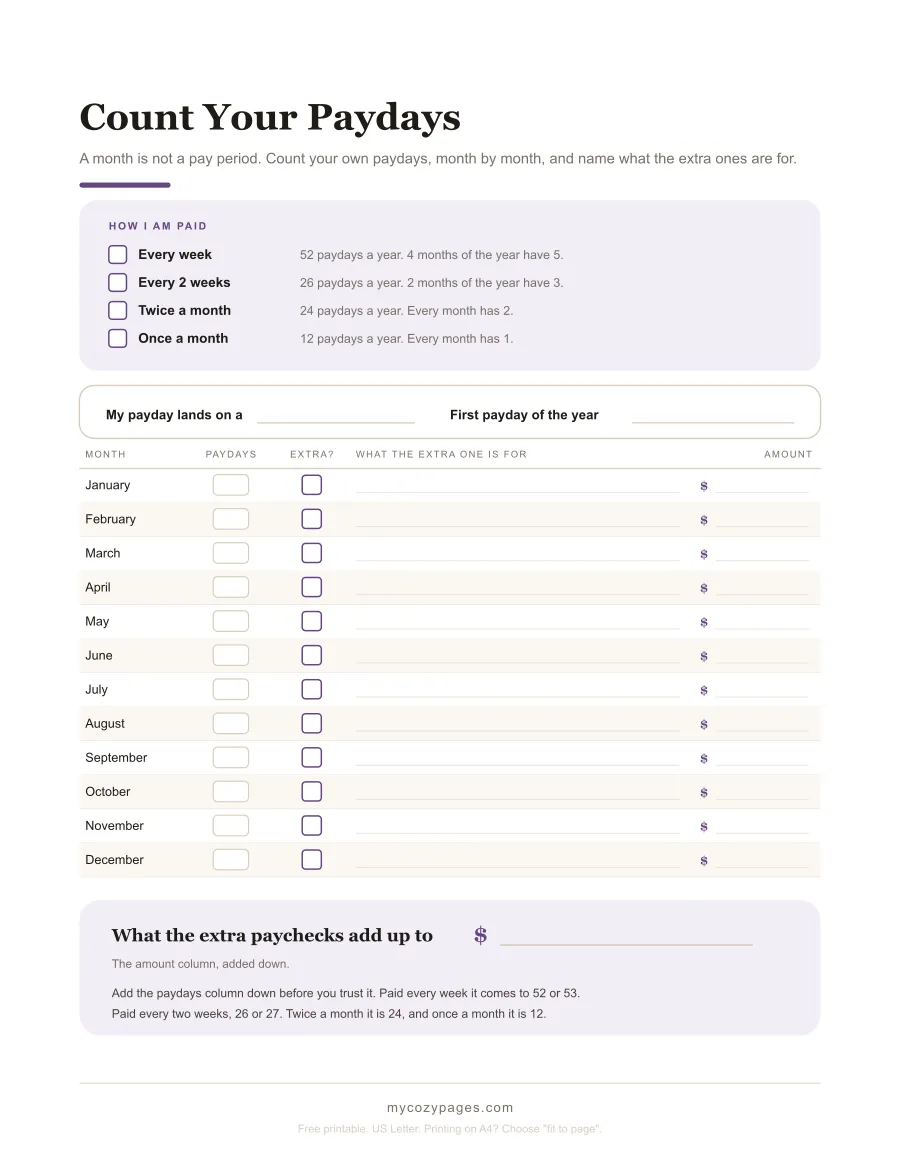
Paycheck Count · 12 months · 4 cycles · one total
Download the paycheck count (PDF)
What the month already owes
Car registration, the insurance that is cheaper paid annually, the subscription that renews every January. On a monthly sheet they are invisible for eleven months and then arrive like bad news.
Eighteen rows, four columns: what it is, what it costs, how often, and the monthly line. The divisors are printed at the top because one of them is a surprise. Yearly divides by twelve, quarterly by three, twice a year by six, and every four weeks is times thirteen then divided by twelve.
Building the list is the part people skip, so start from a complete one. The bill tracker printables include a checklist of 36 recurring costs sorted by how often they land.
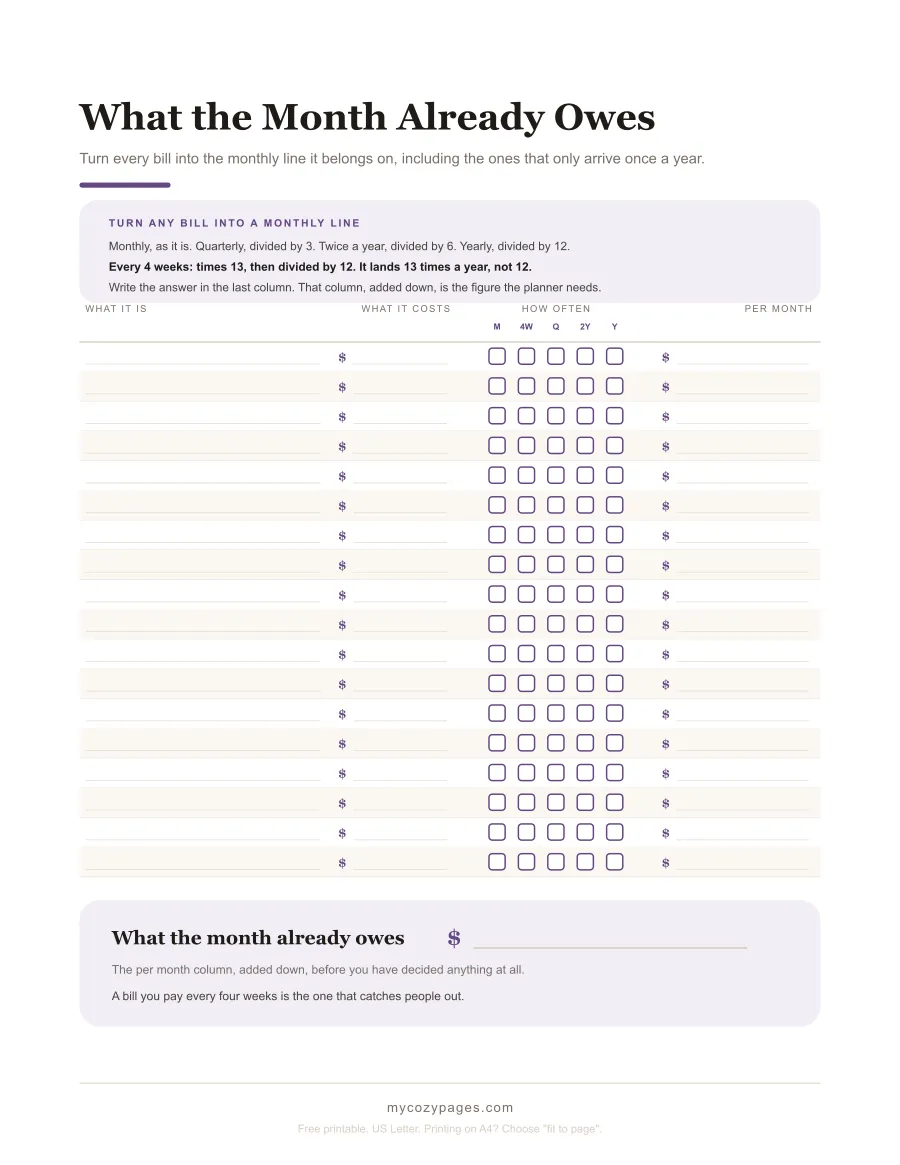
Fixed Costs Per Month · 18 rows · 5 frequencies · the divisors printed
Download the fixed costs sheet (PDF)
Needs, wants, and the part the percentages leave out
The 50/30/20 split is a reasonable starting shape and as a printable it usually arrives as three empty boxes headed 50%, 30% and 20%. The multiplication rarely comes with it. Nor does the test.
This sheet prints the multipliers on the lines, then asks one question: is your yearly fixed cost under the needs figure? If yes, the split fits. If no, it does not fit, and no amount of willpower changes that, so there is a line to write the split you can actually run and a reminder that your three numbers still have to add to 100.
Then the calendar again. Run 50/30/20 on four-week months twelve times instead of across a year and the split you are really running is 46.15 / 27.69 / 18.46. Each one is twelve thirteenths of the number you picked, and the 7.69% that went missing is the pay period a four-week month never planned for. That 20% savings rate was 18.46% all along.
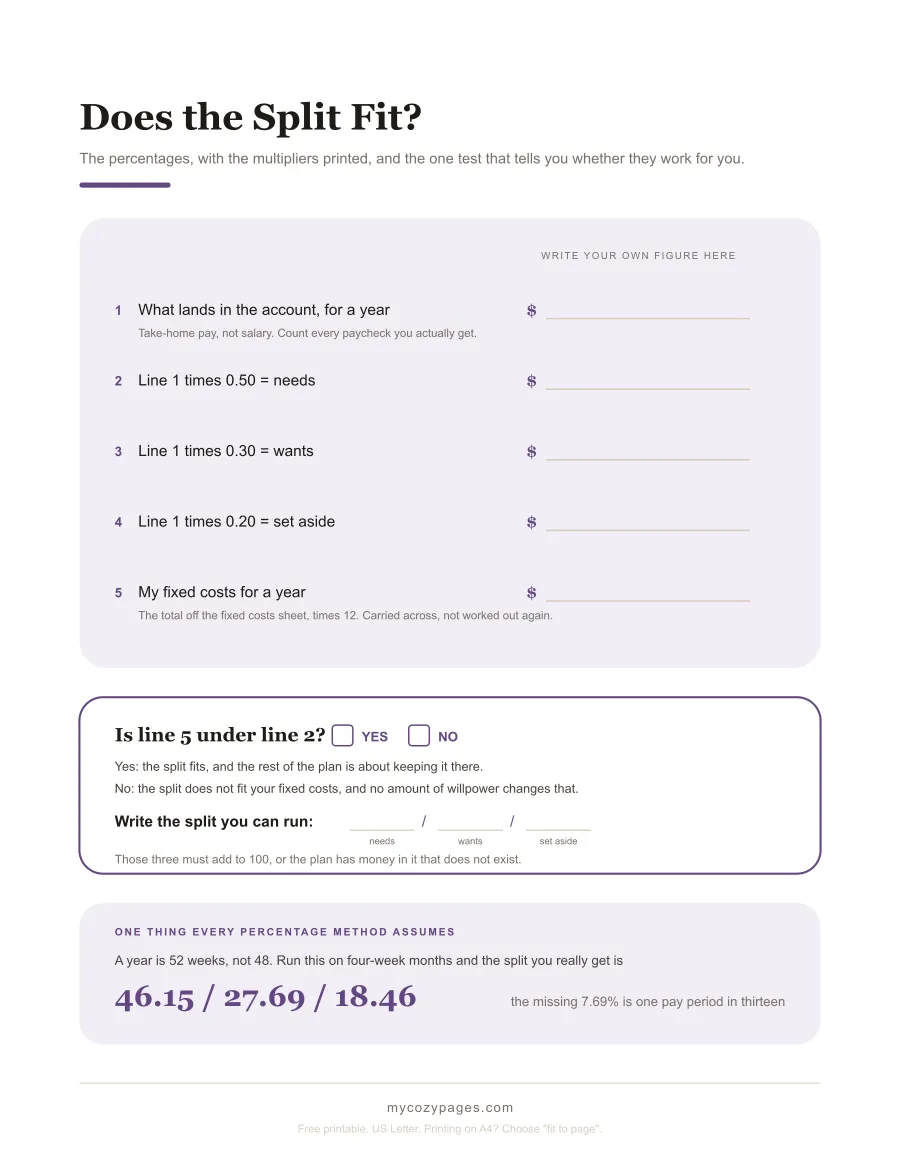
Needs, Wants, Set Aside · 5 lines · one comparison · a split you can rewrite
Download the split worksheet (PDF)
A smaller sheet, if thirty-six rows is too many
Thirty-six lines is a lot to face on the Sunday after a hard month. Nine lines, two totals, one subtraction, and a division that turns the answer into a weekly number. It is the smallest sheet that still balances.
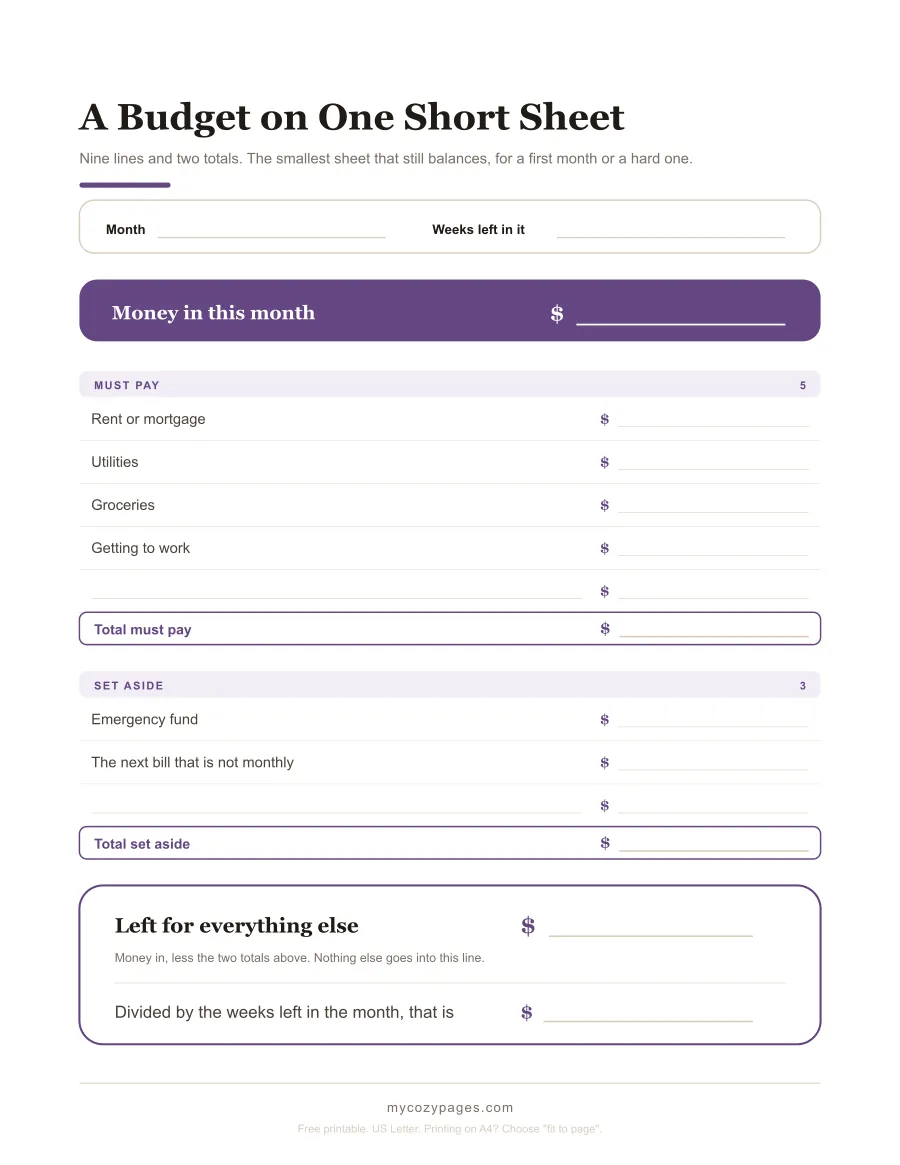
The First Month · 9 lines · 2 totals · a figure for the week
Download the short sheet (PDF)
Changing the plan without starting again
A plan is a guess until a month tests it, and this sheet is for writing the next one. Sixteen categories, four columns: what you planned, what it came to, what you are planning next, and why it moved. One figure per category, carried across from wherever you track spending. Not a list of purchases: the line by line record is what an expense tracker printable is for, and this sheet takes its totals.
If the month revealed a leak rather than a shortfall, the no spend challenge printables are about drawing a line through the part of a month you actually choose.
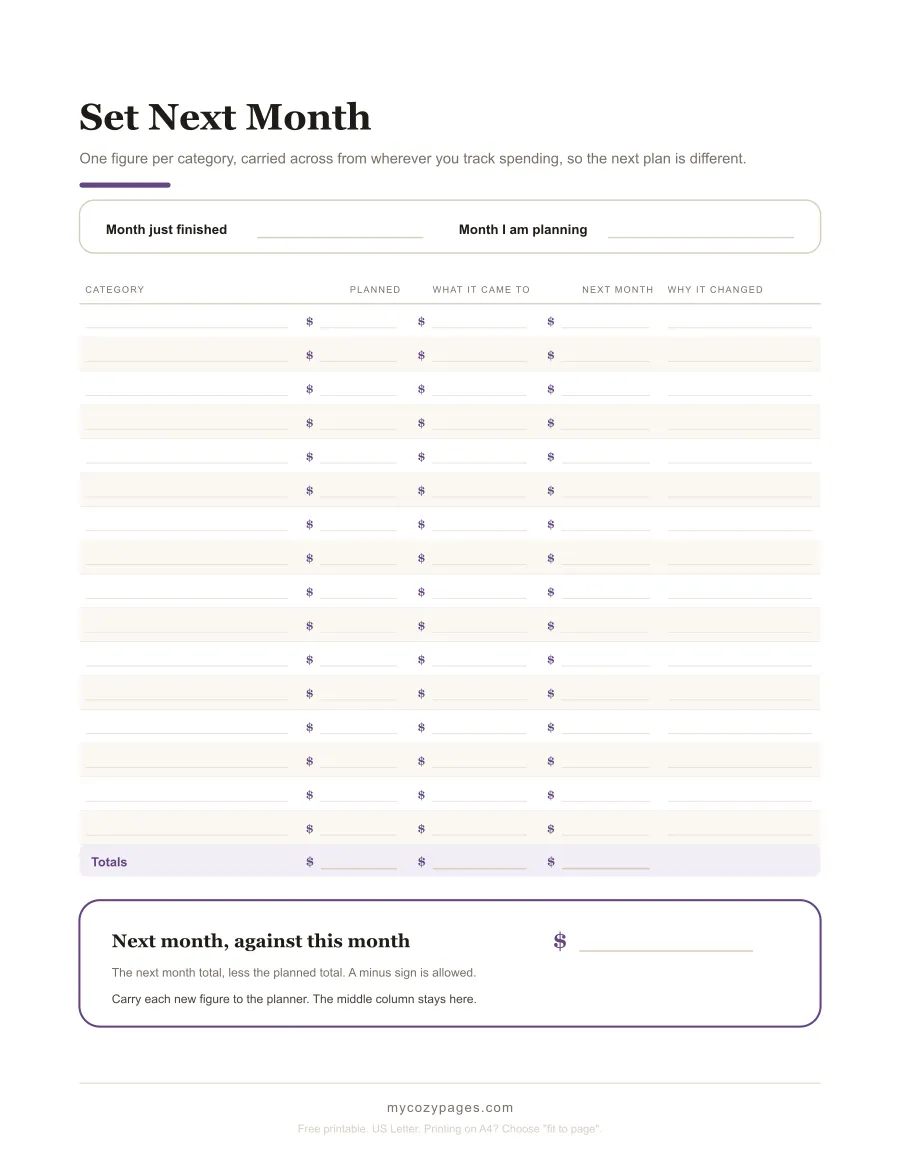
Set Next Month · 16 categories · 3 totals · one difference
Download the next month sheet (PDF)
The printable budget planner pack, sheet by sheet
| Sheet | What it does |
|---|---|
| Monthly budget planner | 36 lines, five totals, one check strip |
| Fillable budget planner | the same sheet, typeable |
| Paycheck count | 12 months, and the extra paychecks named |
| Fixed costs per month | yearly and four-weekly bills, divided down |
| Needs, wants, set aside | the split, and whether it fits you |
| The first month | nine lines, still balances |
| Set next month | one figure a category, and what changes |
All seven are US Letter, 8.5 x 11 inches, and they print on A4 if you choose “fit to page”. Nothing on any of them asks you for a figure it has already asked you for, and every total has the rows that produce it directly above it.
A note before you start
These are planning sheets, not financial advice. A budget cannot create money that is not there, and if what the month reveals is a gap rather than a surplus, a nonprofit credit counselor will do more for you than anything I can print.
What a sheet can fix is narrower and real: a month planned on the wrong clock, a yearly bill with nowhere to sit, a savings line funded out of the remainder, a total that nothing above it produces. Start with the paycheck count if you are paid weekly or every two weeks. Start with the short sheet if last month was hard. Either way, fill it in before the month starts, in pen, and leave it somewhere you will see it in the last week of the month.
Save it for later
Free printable budget planner. Seven sheets: a monthly planner whose five totals actually reconcile, a paycheck count for the months that carry a fifth paycheck, a fixed cost sheet that turns yearly bills into monthly lines, a needs and wants split with a fit test, a short first-month sheet and a fillable version. US Letter, no email needed.
Save this pinFrequently asked questions
What is a printable budget planner?
One page where you decide what the month is allowed to cost before it starts. Money in at the top, every planned cost under it, and a line at the foot that has to come out at zero or tell you where the rest is going. It is a decision, not a record.
What should a monthly budget planner include?
Money in, fixed costs, everyday spending, what you set aside, and debt payments above the minimum, with a total under each one. Then a single line that subtracts all five in order. Most sheets stop at the totals and never print the line that puts them together.
How do I budget when I get paid every two weeks?
Count your paydays first. Twenty-six a year does not divide by twelve, so ten months hold two paychecks and two months hold three. Decide in advance what the third one is for, or it disappears. The paycheck count sheet here is twelve rows for exactly that.
Why does my budget run out at the end of the month?
Often because a weekly cost was written in as four weeks. A year is 52 weeks, not 48, so four or five months of the year carry a fifth grocery week and the plan is 25% short in the last few days of them. The money was never missing. The line was.
Is the 50/30/20 rule any good?
It is a reasonable starting shape, and it breaks quietly in two ways. It says nothing about what to do when your fixed costs already exceed the 50%, and applied to four-week months it quietly becomes 46.15 / 27.69 / 18.46. The split sheet here tests both.
Where do yearly bills go on a monthly budget?
Divide the yearly amount by twelve and put that figure on the sheet as a monthly line, even in the eleven months nothing leaves your account. Quarterly bills divide by three, twice-yearly by six. A bill billed every four weeks lands thirteen times a year, so multiply by 13 and divide by 12.
Should savings be a budget line or whatever is left over?
A line. On this planner the set-aside block sits above the check strip, so it is subtracted alongside rent and groceries rather than funded from the remainder. A savings line that is funded last is not a plan.
Are these budget planner printables really free?
Yes. Every sheet is a free PDF. No email address, no account, no catch. Take one sheet or take all seven as a single file, and print them as often as you like.
Can I type into them instead of printing?
One of them, yes. The fillable budget planner has typeable boxes for every category and every amount, and it opens in any PDF reader. The other six are made for a pen.
What paper size are these printables?
US Letter, 8.5 x 11 inches. They print on A4 if you choose "fit to page" in the print dialog. They are line drawings, so they barely touch your ink.
Get new printables by email
Join the list and I'll email you when there's a new printable. That's all it is: no sales pitch, and every printable on the site stays free to download without it.
Unsubscribe any time. No spam, ever.
You might also like
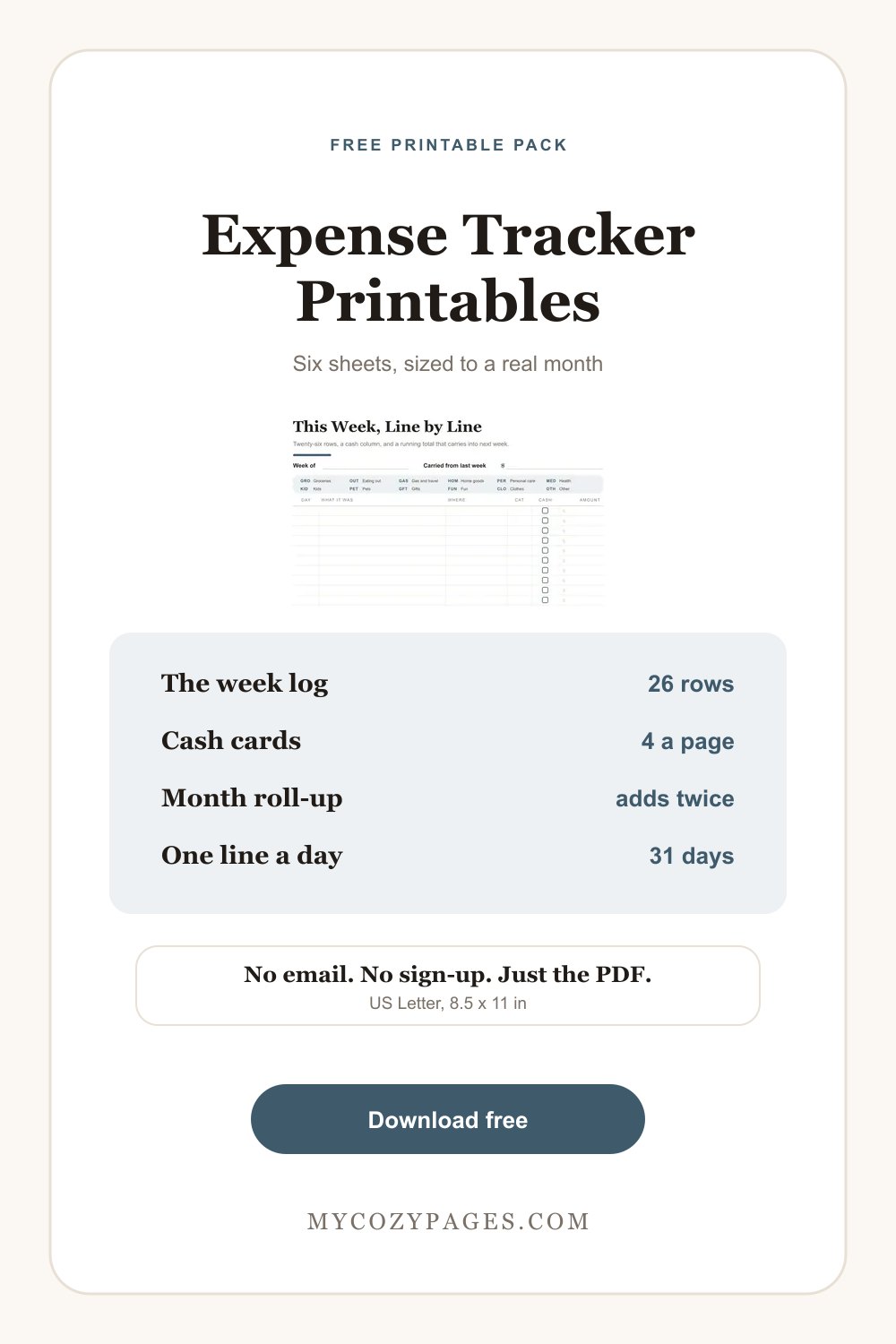
Expense Tracker Printable: 6 Free Sheets
6 free expense tracker printables sized to a real month: a 26-row week log with a cash column, wallet cash cards, and a roll-up that adds up twice.
Get the printable
Bill Tracker Printable: 8 Free Sheets
8 free bill tracker printables: monthly, yearly, a bill calendar, by paycheck and an autopay audit. Every sheet has a column for bills that pay themselves.
Get the printable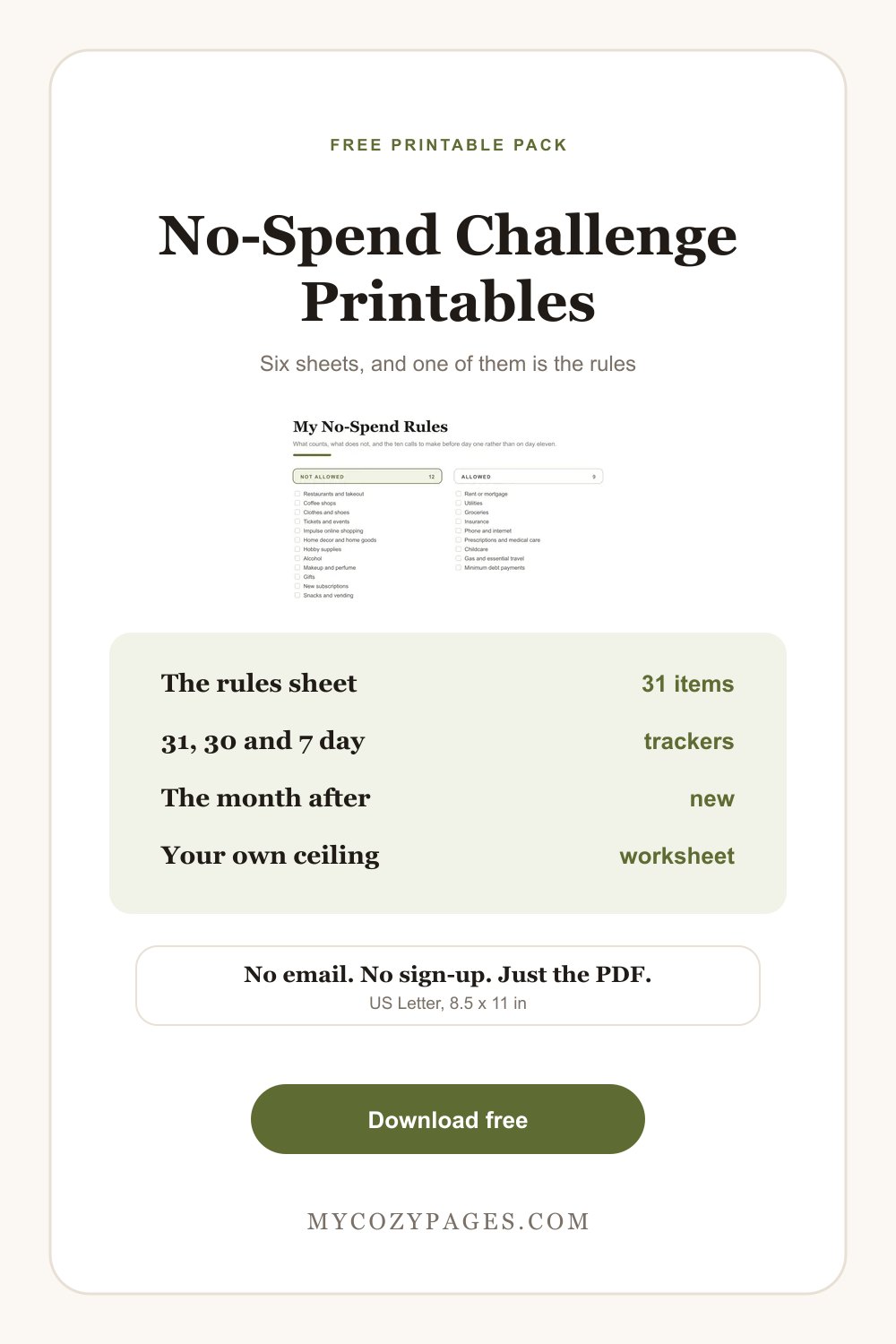
No Spend Challenge Printable: 6 Free Sheets
6 free no spend challenge printables: the rules settled in advance, 31, 30 and 7 day trackers, and the month after. US Letter, no email needed.
Get the printable