FREE EXPENSE PRINTABLES
Expense Tracker Printable: 6 Free Sheets
An average adult makes 47 payments a month. Most printable trackers have room for about half of them, so they give out in the second week. These six are sized to the real number.
- 6 Sheets
- Cash Column
- Free PDF
- No Signup
An expense tracker printable is a sheet you fill in by hand, one line per purchase, to record what a month actually cost after it happened. The six here are sized to the number of payments a month really contains, and that is more than most sheets allow for.
Jump to a sheet
- The week log · 26 rows, a cash column
- Cash cards · four to a page
- Month roll-up · adds up two ways
- Statement translator · for reading a feed back
- One line a day · 31 days, cash and card
Your bank knows exactly what you spent at the grocery store on Tuesday. It knows the date, the amount, and a merchant string that may or may not be the name above the door.
What it does not know is the twenty dollars that left your wallet at a bake sale.
The six payments a month nothing else records
That gap has a size, and the Federal Reserve measures it. The 2026 Diary of Consumer Payment Choice, released on May 11, 2026 and drawn from an October 2025 survey, found that the average US consumer made six cash payments a month. That is 14 percent of everything they paid for. Five out of every six of those were under $25.
Six payments. Seventy-two a year, sixty of them small enough to forget by dinner.
That is the whole case for paper, and it is smaller and sharper than the usual pitch. A grid with twenty-two rows and no cash column is a slower copy of a list your phone already keeps for free. A line for the cash is not.
There are other reasons people reach for a pen. Writing a purchase down while you are still standing at the till is a different act from reading it back three weeks later. Two adults with four cards between them have no single screen that shows the household. Some people would simply rather not hand a budgeting app the keys to their checking account. All of those are real. The cash one is the only one where paper genuinely wins.
How many lines an expense tracker printable needs
Here the arithmetic gets unkind to most of the sheets you can download.
The same Federal Reserve study counts 47 payments a month for the average adult, 30 of them in person and 17 remote. Each of those counts is rounded in the study itself, so six against 47 is not where its 14 percent cash share comes from. Take out bills, online orders and everything bought anywhere unusual, and five kinds of store alone account for 24 payments a month: sixteen at grocery stores, convenience stores, restaurants and bars, and eight at gas stations and general merchandise.
So 47 payments across a thirty-day month is about 1.6 a day. The row counts below were taken off the sheets you actually find, counted line by line, and then divided into that figure.
| Rows on the sheet | Holds the 24 retail payments? | One adult: the last line gets used on |
|---|---|---|
| 9 | no | day 6 |
| 10, and it is titled “monthly” | no | day 7 |
| 12 | no | day 8 |
| 15, one row locked to each category | no | day 10 |
| 22 | no | day 15 |
| 28 | yes | day 18 |
| 54, in two columns | yes | it holds, with 7 rows spare |
One of those seven survives a month. For a household of two adults the figure doubles to 94 payments, and then even the 54-row sheet gives out on day 18.
The obvious fix would be a monthly sheet with forty-seven rows on it. That does not work either. Take the tightest sheet on this site, the one that fits 31 day rows and five subtotals onto a single page, and measure how tall a row has to be. Printed at that height, with nothing on the page but rows, one US Letter sheet holds 34 rows. Thirty-four is less than forty-seven. A month of one adult’s spending does not fit on a page. So a one-page sheet called “monthly” is making a promise its own grid cannot keep.
A week does fit. Eleven payments for one adult, 22 for two. So the lead sheet here is a week with 26 rows, and four of them make a month with room to spare. Once you have a month of real figures, they are what a plan gets written from, and the budget planner printables are where that plan goes.
The week spending log
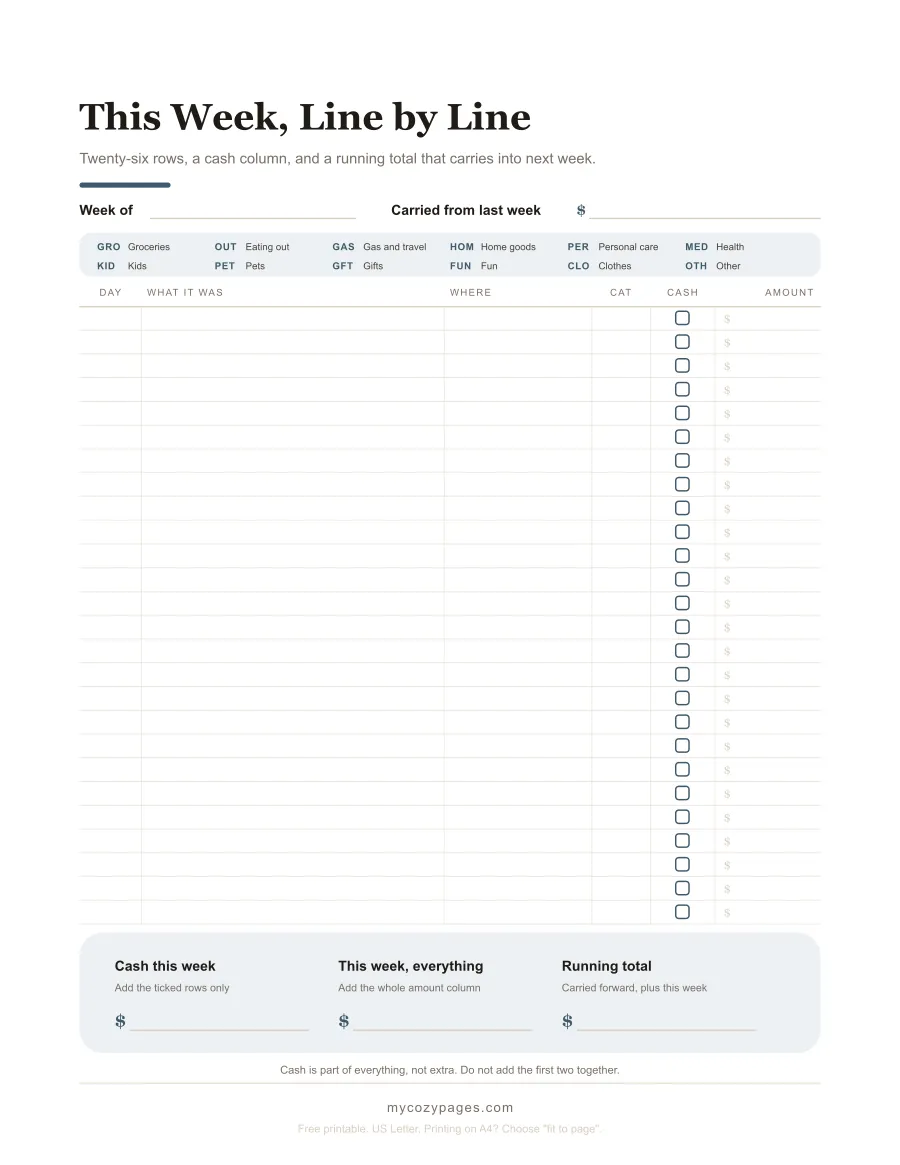
Twenty-six rows, because that covers two adults for a week and leaves four spare for a bad Saturday.
The columns are the day, what it was, where, a three-letter category code, a tick box for cash, and the amount. Twelve category codes are printed in a band across the top of the sheet, so the list is in your hand rather than in a browser tab you closed.
The Week Log · 26 rows · 12 category codes · 1 page
Three figures come off the bottom, and each one says on the sheet what produces it. Cash this week is the ticked rows only. This week, everything is the whole amount column. Running total is what you carried forward plus this week. The sheet also says, in small type, that cash is part of everything rather than something to add on top, because that is a very easy way to overstate your own month by a hundred dollars.
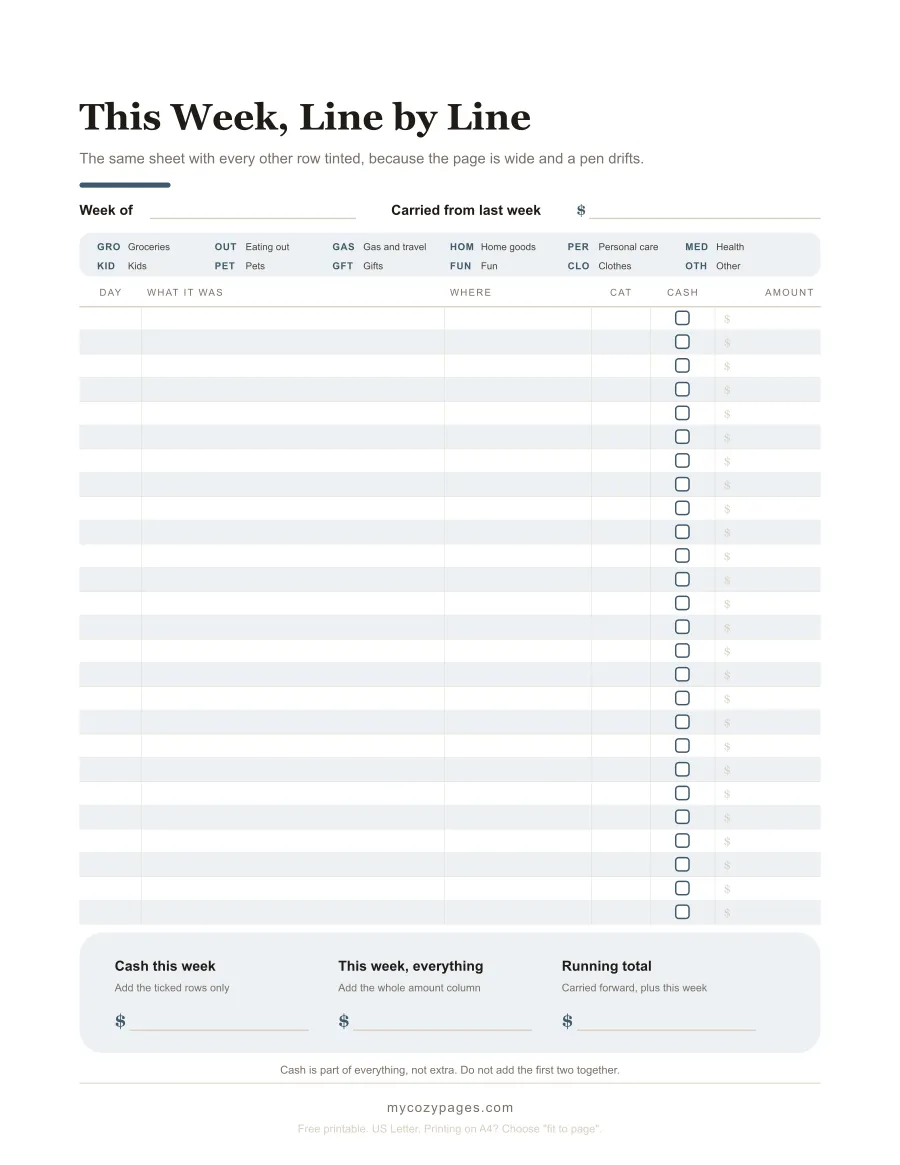
The same sheet, banded
Alternate rows tinted. The page is wide and a pen slides into the wrong row somewhere around Thursday.
Download the banded version (PDF)
The card that goes in your wallet
A cash log on the refrigerator records nothing, because the moment worth catching happens at a till with your wallet already open.
So this sheet is four cards, cut out and carried. Ten lines each. At six cash payments a month that is about seven weeks per card, and roughly six and a half months for the page. That is the honest size of the thing: the spending nothing else sees is small, and it still needs somewhere to land.
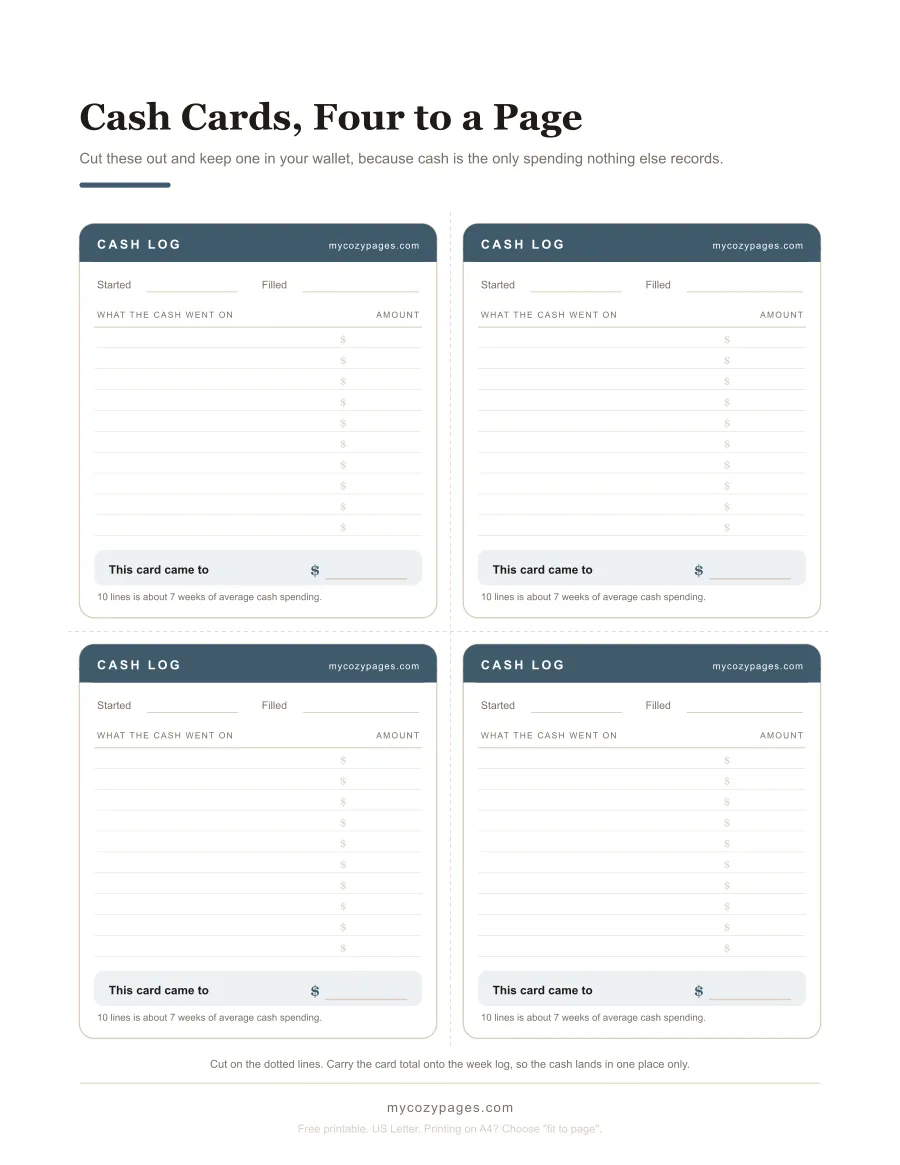
Cash Cards · 4 to a page · 10 lines each · cut lines printed
Carry each card total onto the week log when the card fills up. The money lands in one place that way, and that matters more than it sounds.
Adding it up twice, on purpose
This is the sheet that matters most here. The total on most of these grids is a single column, added once, by a tired person, at the end of a month. If the sum is wrong, nothing says so.
The roll-up fixes that the way a ledger does, by making you arrive at the same figure along two separate paths. Twelve categories down the side, four weeks plus the last few days across the top, and totals in both directions. Add the right-hand column downward and you get the month. Add the bottom row across and you get the month again. The heavy box in the corner is where they have to meet, and you only write in it once the two answers agree.
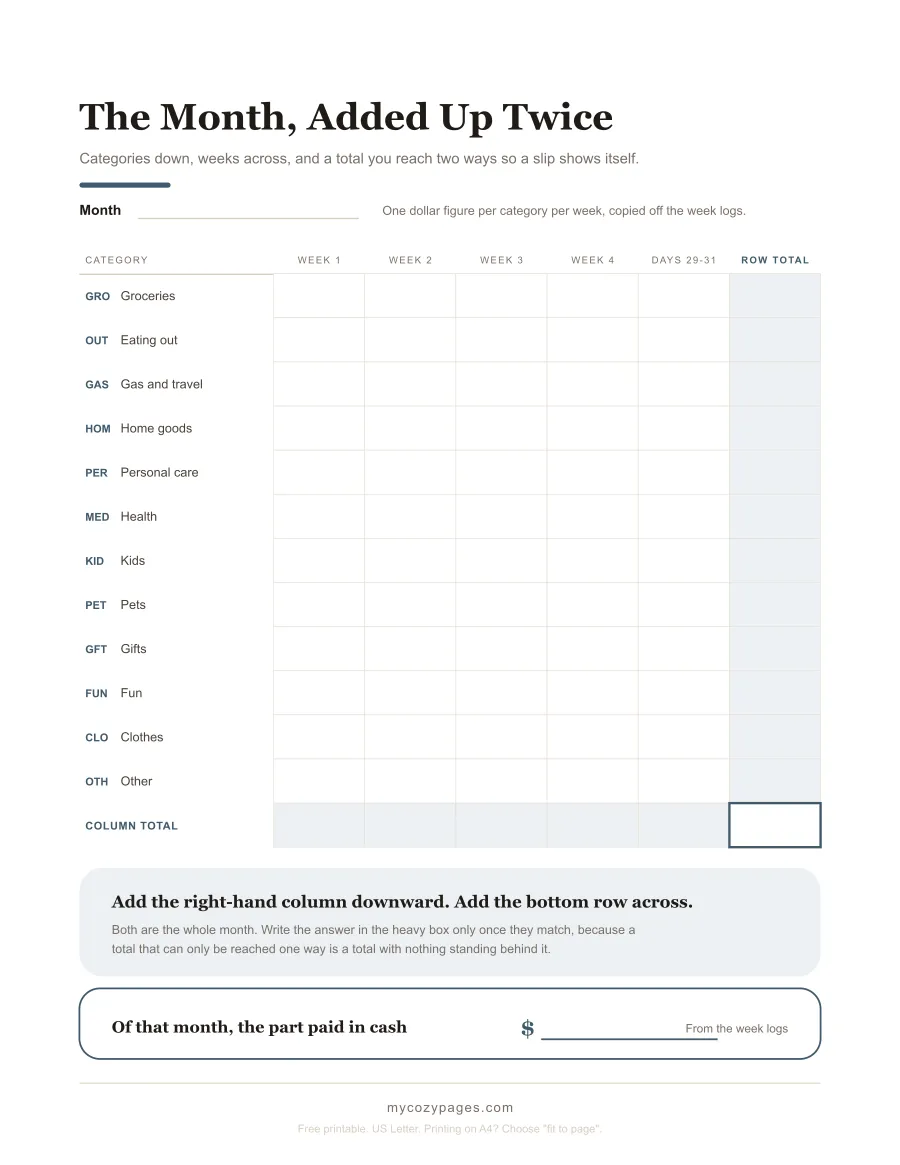
The Month Roll-Up · 12 categories × 5 columns · 60 cells · one grand total, two ways in
There is one more line on it, under the grid: the part of the month you paid in cash, carried from the week logs. No sheet surveyed for this page produces that figure for a month, which is a strange thing to leave out of a tracker whose whole advantage over an app is cash. One gets close and totals cash for a single day, leaving you to print thirty-one pages and add them up somewhere else.
What the statement says and what you bought
Some people do not need help recording spending. They need help reading it back, because a feed full of billing strings is not a record of anything.
This sheet puts the merchant line on the left and what you actually bought on the right, with a category and the amount. Underneath there is a block for cash withdrawals, and it carries a warning in plain type: a withdrawal is one line on a statement and several real purchases, so those lines explain the total rather than adding to it.
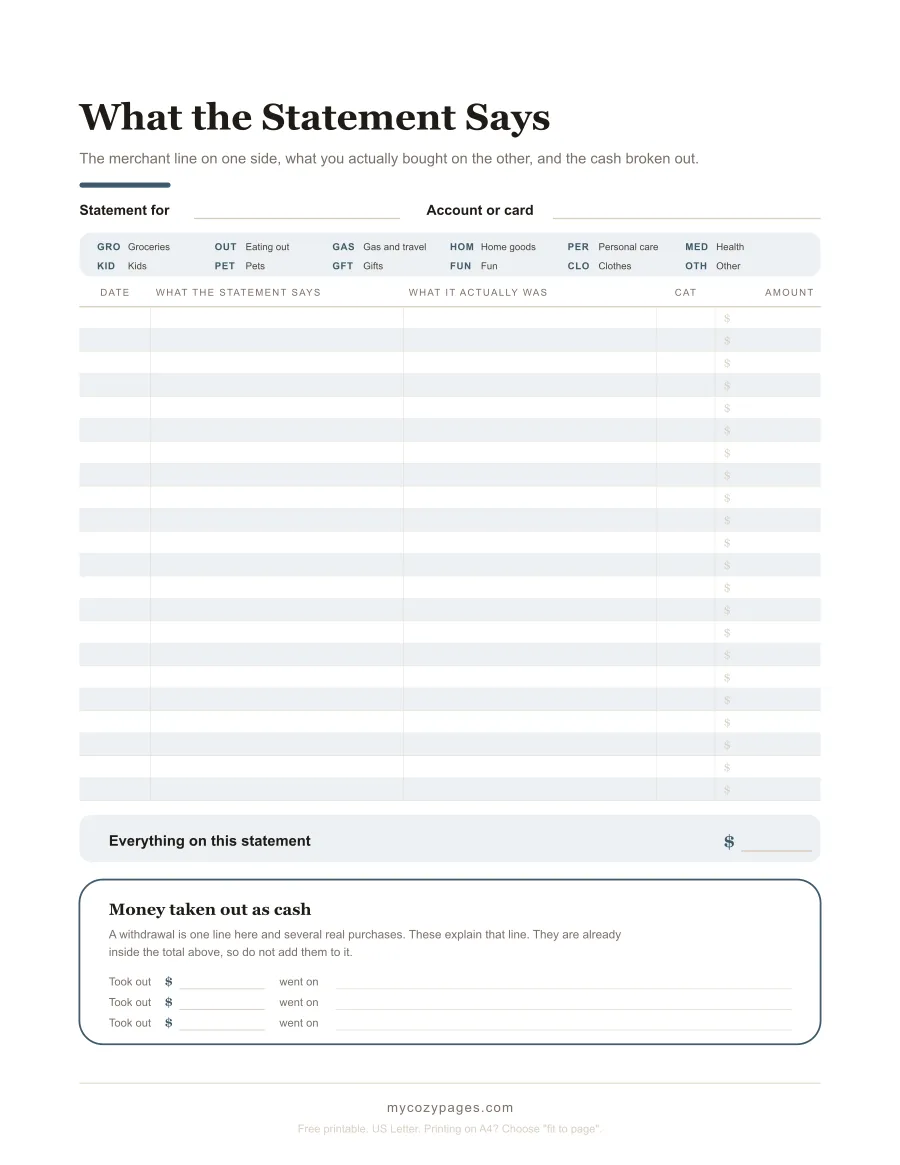
Statement Translator · 22 rows · 3 withdrawal lines · one total
Download the statement translator (PDF)
The month on one line a day
If a full spending log is more than you want, this is the smaller promise: one line a day, with cash and card side by side.
Cash plus card is the day. That holds on every row and again at the foot, where the sheet asks for three month totals instead of one, so this spending tracker printable ends with a cash figure of its own. There are weekly subtotals after days 7, 14, 21 and 28, and one more for days 29 to 31, because a thirty-one day month should not finish with three days nobody added up.
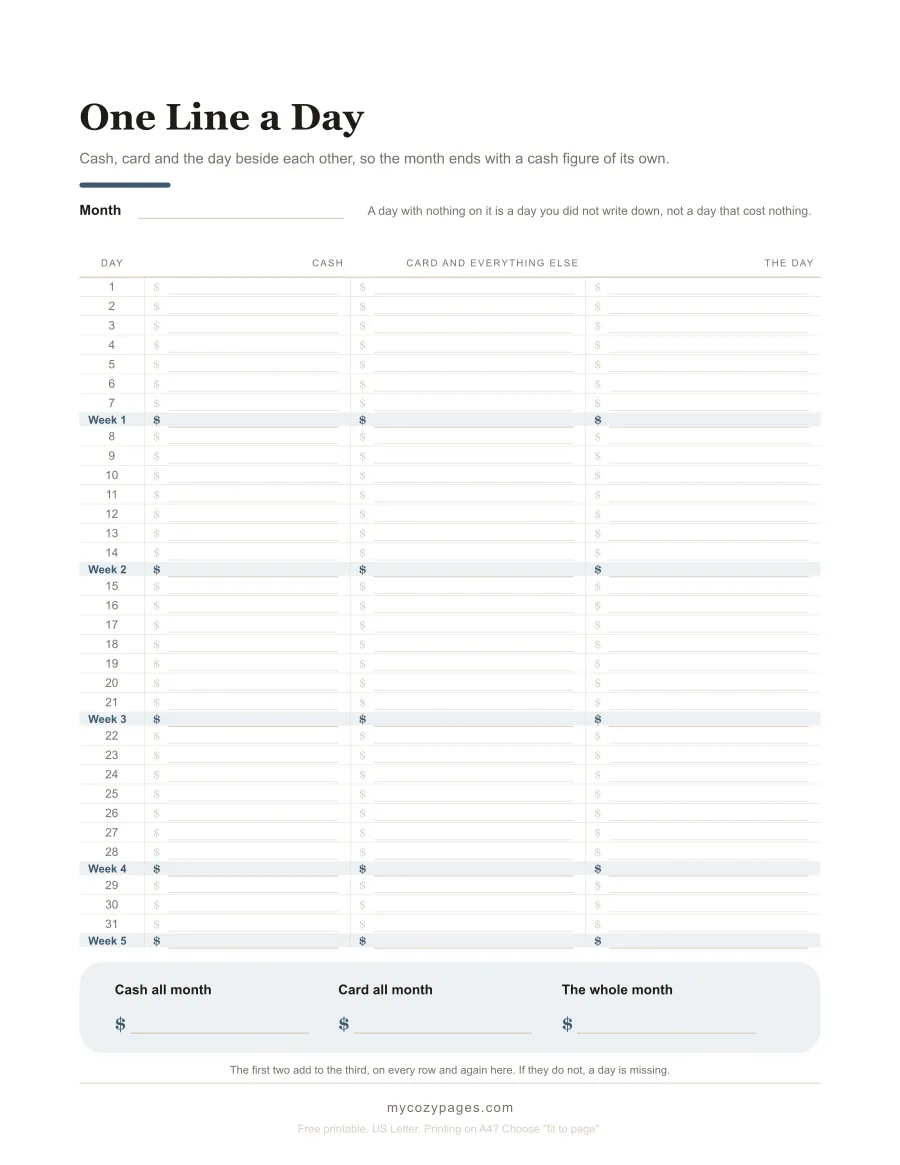
One Line a Day · 31 days · 5 weekly subtotals · cash, card and the whole month
Download the 31 day sheet (PDF)
What belongs on this sheet, and what does not
One rule settles it, and it saves a lot of wasted writing.
If you could have written it down before the month started, it is a bill. Rent, the electric bill, insurance, the car payment: you know the name, roughly the amount and the date, so a list you make once and tick off beats a log you add to. If you can only write it down after it happens, it is an expense, and that is what these sheets are for.
That is why none of the twelve categories printed here is housing, utilities or insurance. A sheet trying to be both ends up holding neither, and plenty of them try, so you find expense trackers whose opening rows are rent, power and insurance, with whatever is left over expected to hold a whole month of actual shopping.
The pack, sheet by sheet
| Sheet | What it does |
|---|---|
| The week log | 26 rows, a cash column, three totals |
| Banded rows | the same week, easier to read across |
| Cash cards | four wallet cards, 10 lines each |
| The month roll-up | 12 categories × 5 columns, added two ways |
| Statement translator | merchant line against what you bought |
| One line a day | 31 days, cash and card kept apart |
All six are US Letter, 8.5 x 11 inches, and they print on A4 if you choose “fit to page”. Every row count quoted on this page is the number of rows actually printed on the sheet.
A note before you start
These are recording sheets, not financial advice. Tracking does not reduce a single bill by itself, and anyone who tells you otherwise is selling something.
Two honest limits. The averages above describe the average US adult and therefore nobody in particular, so count your own week before you trust any of it. And a month of records is only half a job: the point of knowing what the month cost is deciding what the next one is allowed to cost. That is a different sheet and a different habit. When you are ready for that part, the budget planner printables pick it up.
Save it for later
Free expense tracker printables. Six sheets sized to a real month: a 26-row week log with a column for cash, wallet cash cards, a month roll-up that adds up twice so a slip shows itself, a statement translator and a 31-day sheet. US Letter, no email needed.
Save this pinFrequently asked questions
What is an expense tracker printable?
A sheet you fill in by hand, one line per purchase, to record what a month actually cost after it happened. It holds the date, what you bought, where, a category and the amount, and it adds up at the bottom.
Why track expenses on paper when my bank app already does it?
Because of the part the app cannot see. The Federal Reserve counts six cash payments a month for the average adult, five of every six of them under $25, and no statement itemizes those. Writing a purchase down at the till is also a different act from reading it back three weeks later.
How many lines does a monthly expense tracker need?
More than most of them have. An average adult makes 47 payments a month, so a 22-row sheet gives out around day 15 and a 28-row sheet around day 18. Two adults need 94 lines. That is why the main sheet here is a week rather than a month.
What is the difference between an expense tracker and a bill tracker?
A bill is something you could write down before the month started: rent, utilities, insurance, a fixed amount on a known date. An expense is something you can only write down after it happens. If you knew about it in advance, it belongs on a bill tracker instead.
What categories should an expense tracker have?
These sheets print twelve, as three-letter codes so they fit a narrow column: groceries, eating out, gas and travel, home goods, personal care, health, kids, pets, gifts, fun, clothes and other. All twelve are variable spending, because that is what this pack is for.
How do I track cash spending?
Keep the log where the cash is. The pack has four wallet-sized cash cards on one page, ten lines each, or about seven weeks of average cash spending per card. Carry the card total onto the week log so the same money is never counted twice.
How do I know my monthly total is right?
Add it twice. The month roll-up has categories down the side and weeks across, so the grand total can be reached by adding the right-hand column downward and by adding the bottom row across. If the two answers differ, something above is wrong.
Are these expense tracker printables free?
Yes, all six. No email address, no account, no catch. Take one sheet or take the whole pack as a single PDF, and print it as often as you like.
What paper size are these printables?
US Letter, 8.5 x 11 inches. They print on A4 if you choose "fit to page" in the print dialog. All six are line drawings, so they barely touch your ink.
This printable is part of our guide to Printable Budget Planner: 7 Free Sheets.
Get new printables by email
Join the list and I'll email you when there's a new printable. That's all it is: no sales pitch, and every printable on the site stays free to download without it.
Unsubscribe any time. No spam, ever.
You might also like
Printable Budget Planner: 7 Free Sheets
7 free printable budget planner sheets: a monthly planner that balances, a paycheck count, fixed costs and a split that fits. US Letter, no email needed.
Get the printable
Bill Tracker Printable: 8 Free Sheets
8 free bill tracker printables: monthly, yearly, a bill calendar, by paycheck and an autopay audit. Every sheet has a column for bills that pay themselves.
Get the printable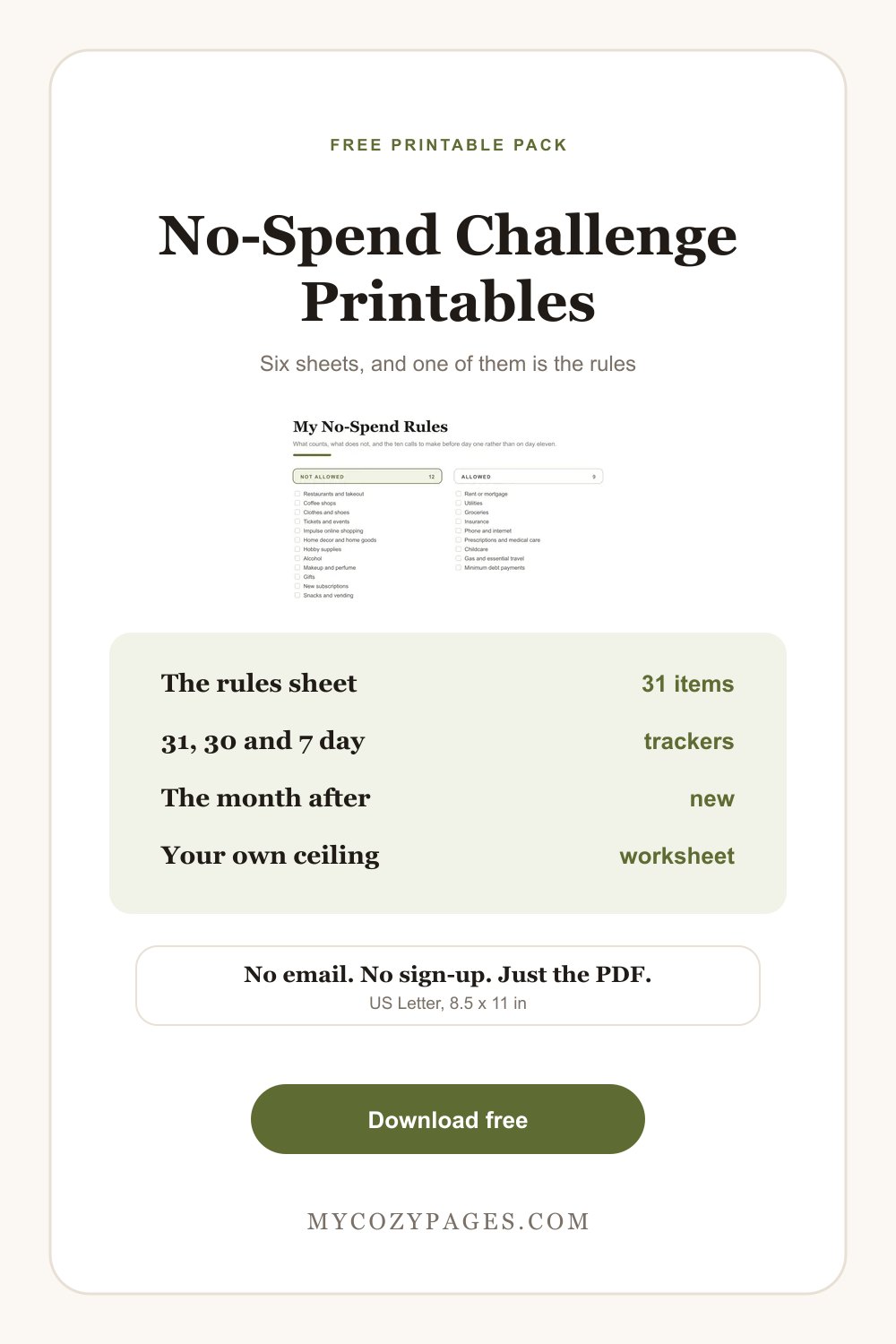
No Spend Challenge Printable: 6 Free Sheets
6 free no spend challenge printables: the rules settled in advance, 31, 30 and 7 day trackers, and the month after. US Letter, no email needed.
Get the printable