FREE NO-SPEND PRINTABLES
No Spend Challenge Printable: 6 Free Sheets
Every no-spend tracker is a grid of empty boxes. None of them says what counts as spending, and that is the argument that actually ends the month. So the first sheet here is the rules.
- 6 Sheets
- The Rules, Printed
- Free PDF
- No Signup
A no-spend challenge is a fixed stretch of time where you buy nothing outside an agreed list of essentials. The hard part isn’t the buying, it’s deciding in advance what counts, because that’s the argument that ends most of them. These six sheets start with the rules and end with the month after.
Jump to a sheet
- The rules sheet · 31 items, 10 rulings
- 31, 30 and 7 day trackers · with a money column
- Your own ceiling · what yours is worth
- The month after · what came back
Day eleven. The pan handle snaps off in your hand, and the question isn’t whether you can afford a new pan, it’s whether buying one ends the challenge.
That’s where a no-spend month usually goes: not in some collapse of nerve on a Friday night, but in a small argument with yourself about whether something counted. You lose the argument, you stop trusting the sheet, and by the midpoint the tracker on the refrigerator is decoration.
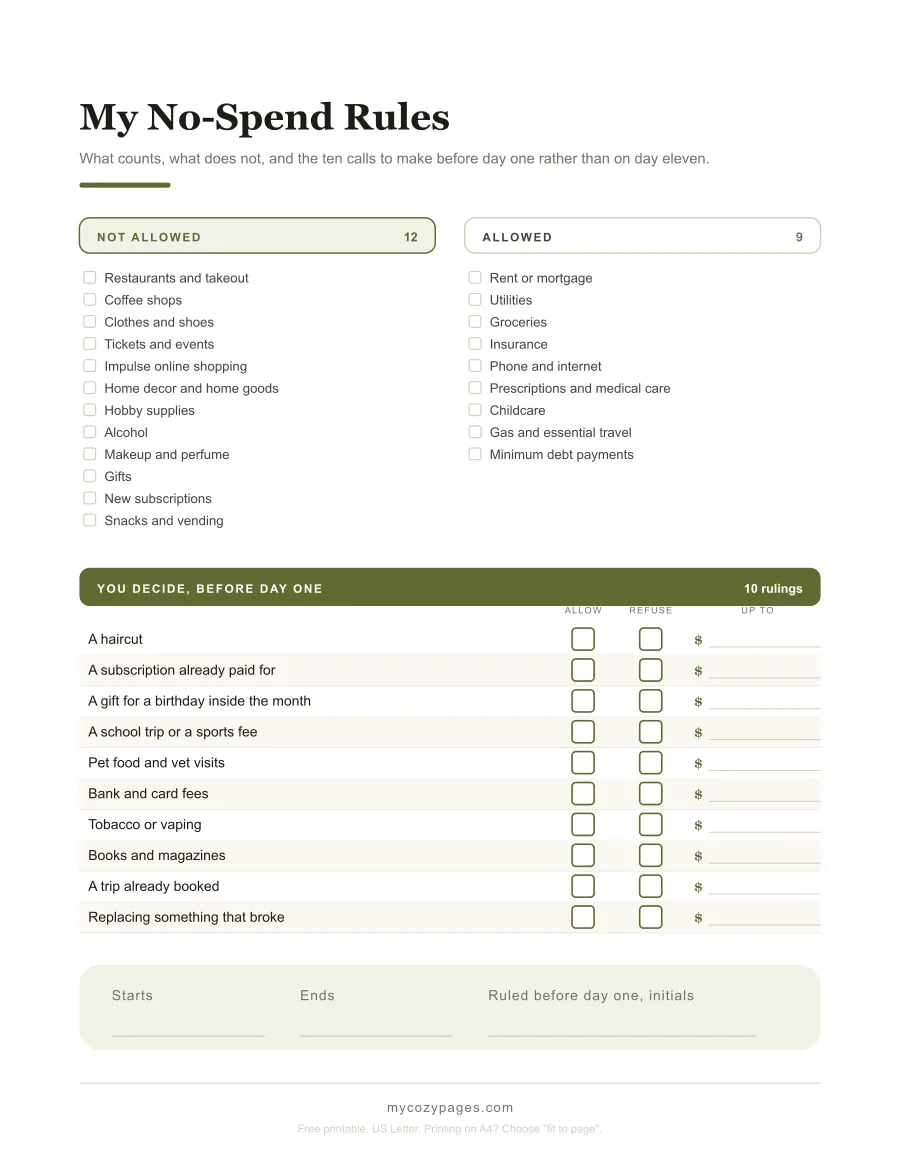
So this pack starts somewhere else. The first sheet isn’t a grid of boxes at all, it’s the rules, with the ordinary cases already printed and the awkward ones left for you to settle on day zero instead of day eleven.
What every no spend challenge refuses
Twelve things turn up on every rules list worth reading: restaurants and takeout, coffee shops, clothes and shoes, tickets and events, impulse online shopping, home decor, hobby supplies, alcohol, makeup and perfume, gifts, new subscriptions, and snacks from a machine.
Line those up against the government’s own spending categories and four of them cover almost all of it. The Bureau of Labor Statistics publishes what an average US household spends each year, broken down by category. For 2024, released on December 19, 2025, the four categories a no-spend month is aimed at look like this.
| What the rules refuse | A year | A month |
|---|---|---|
| Food away from home | $3,945 | $328.75 |
| Entertainment | $3,609 | $300.75 |
| Apparel and services | $2,001 | $166.75 |
| Alcoholic beverages | $643 | $53.58 |
| All four | $10,198 | $849.83 |
That’s the target: everything the rules ban, for a whole year, in one column.
What every no spend challenge protects
Now the other side of the same list, and this is the part no page prints.
Rent or mortgage, utilities, groceries, insurance, phone and internet, prescriptions and medical care, childcare, gas, and the minimum payments on any debt: nine items allowed by every version of the rules, for the obvious reason that refusing them isn’t frugality.
| What the rules protect | A year |
|---|---|
| Housing | $26,266 |
| Transportation | $13,318 |
| Personal insurance and pensions | $9,797 |
| Food at home | $6,224 |
| Healthcare | $6,197 |
| Cash contributions | $2,292 |
| Education | $1,569 |
| All seven | $65,663 |
That’s 83.6% of an average household’s spending, sitting in categories the challenge isn’t allowed to touch, which reframes the whole exercise. If you run a no-spend month and it feels like it barely moved anything, you weren’t doing it wrong, because five dollars in every six was never on the table.
The gray zone, and why the month ends there
Between those two lists sits a band that nobody rules on, and it’s bigger than it looks.
A haircut. A subscription you already paid for back in March, a birthday that happens to land inside the month, a school trip, pet food, bank fees, tobacco, books, a trip booked in June. And the pan.
In the published figures that band is personal care, miscellaneous, tobacco and reading: $2,673 a year, or $222.75 a month. Set beside the $849.83 the rules actually define, that works out at 20.8% of everything a no-spend month could conceivably refuse. One fifth of the challenge is undefined, and you’re expected to adjudicate it in the moment, in your own favor, while holding a broken pan.
That’s the failure. Not willpower. A definition nobody wrote down.
The rules sheet
So the lead sheet in this pack is the one that settles all of it in advance. Twelve refused, nine allowed, and then ten borderline cases with an allow box, a refuse box, and a line for a dollar limit if the answer is “yes, but not more than this”.
It gets signed and dated at the bottom, which matters more than it sounds, because a ruling you make on day eleven isn’t a ruling, it’s a negotiation.
31 printed items · 10 rulings · signed and dated before day one
Download the rules sheet (PDF)
The most a no spend month can be worth
Here’s the figure the galleries leave out.
If you refused every single thing the rules ban, and did it flawlessly for a month, an average US household would reach $849.83. That’s $28.33 a day across a thirty-day month, or $27.41 a day across a thirty-one day one, and stretching the rules to cover the gray zone as well only lifts the absolute maximum to $1,072.58.
Two things worth saying plainly about that number.
The first is arithmetic: the three groups above add to $78,534, while the BLS publishes the yearly total as $78,535. The missing $1 is their own rounding, not a mistake in the table, and it seemed better to say so than to quietly nudge a column.
The second is bigger. These are averages across 135.76 million households, so they describe nobody in particular. A $3 coffee every weekday morning is $90 over a month, which is 10.6% of the ceiling, and if that’s genuinely your only discretionary spending then your ceiling is $90 and no printable is going to change it.
There’s also a trap inside the food line. Food away from home is 38.8% of what a household spends on food, and the rules refuse it while protecting the other 61.2%. But the meals still get eaten. A restaurant dinner you skipped reappears as groceries at $17.05 a day instead of $10.81, so some of that $328.75 was never recoverable in the first place.
Your own ceiling, not ours
Which is why the pack has a worksheet rather than a promise: four figures off your last bank statement, added up, with the national average printed alongside so you can see which side of it you’re on.
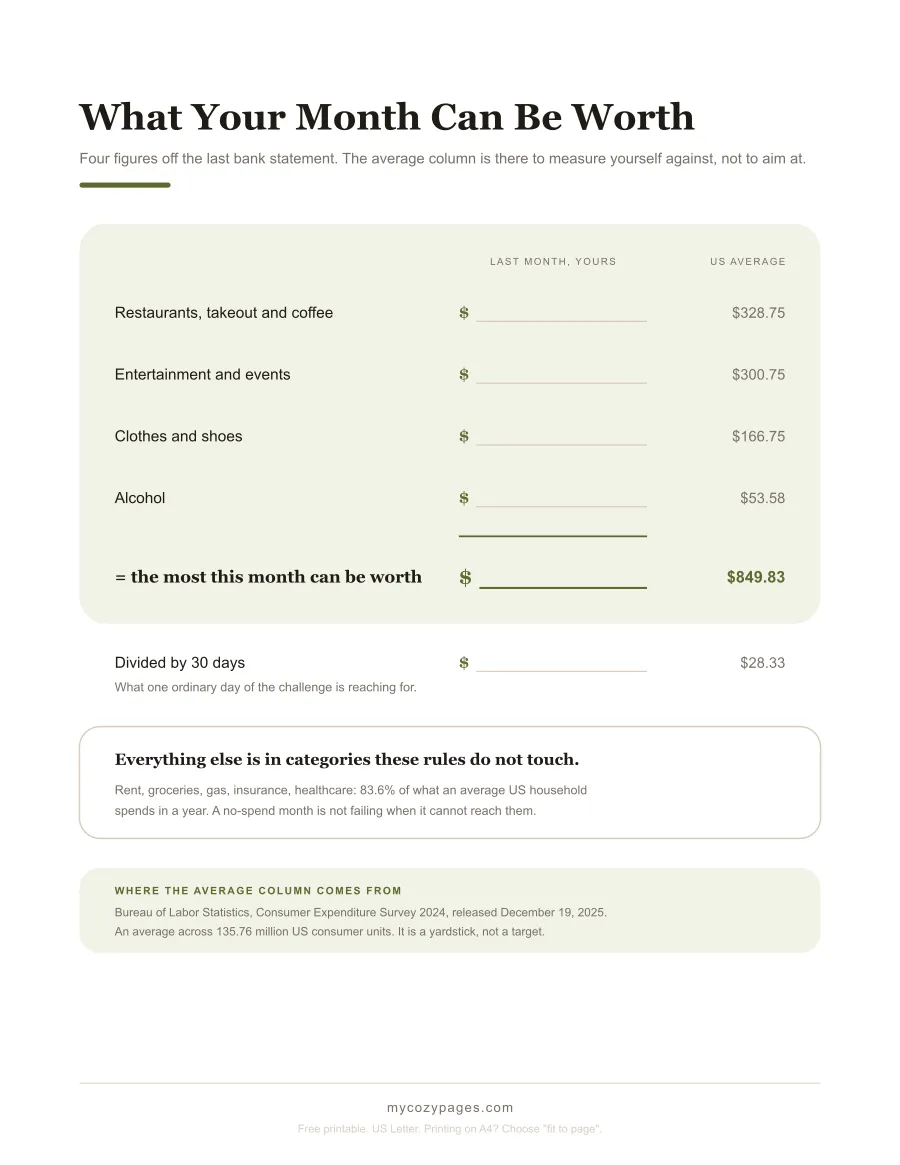
4 inputs · your own total · the average shown for comparison
Download the ceiling worksheet (PDF)
The trackers
Three of them, all with the same four columns, and the third column is the one that doesn’t exist anywhere else: what the thing you said no to actually cost.
Every other tracker records whether you spent, with a tick, or a red circle, or a colored-in square. At the end of thirty days you have a streak and no number, and that is exactly why people end up quoting somebody else’s savings total instead of their own.
31 days
Seven rows, a week subtotal, seven more, and so on to the end of the month. The last block is short and still gets added up, so no day goes unrecorded.
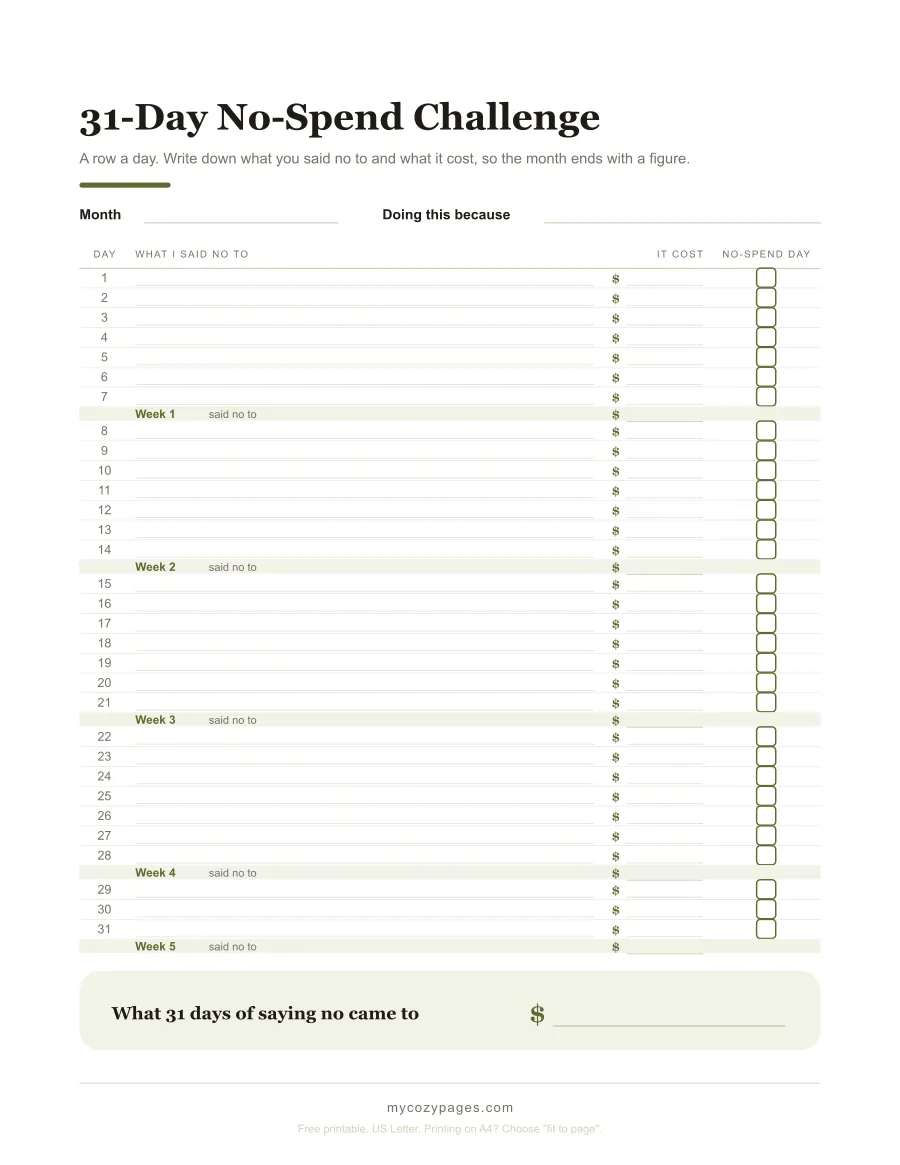
Download the 31 day tracker (PDF)
30 days
The same sheet for April, June, September and November.
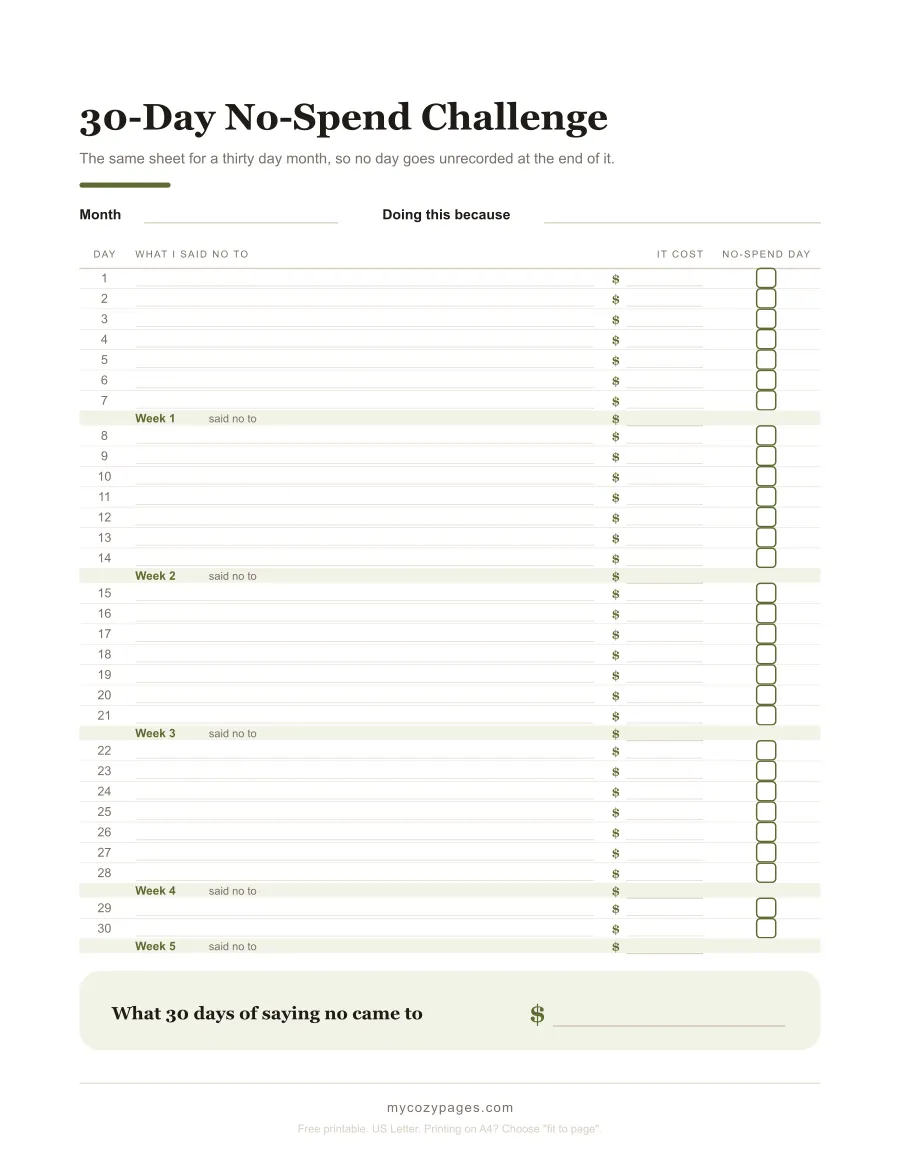
Download the 30 day tracker (PDF)
7 days
Bigger rows, one week. Take this one if you’ve never run a challenge before, or if a month already went wrong and starting again in February feels like too much.
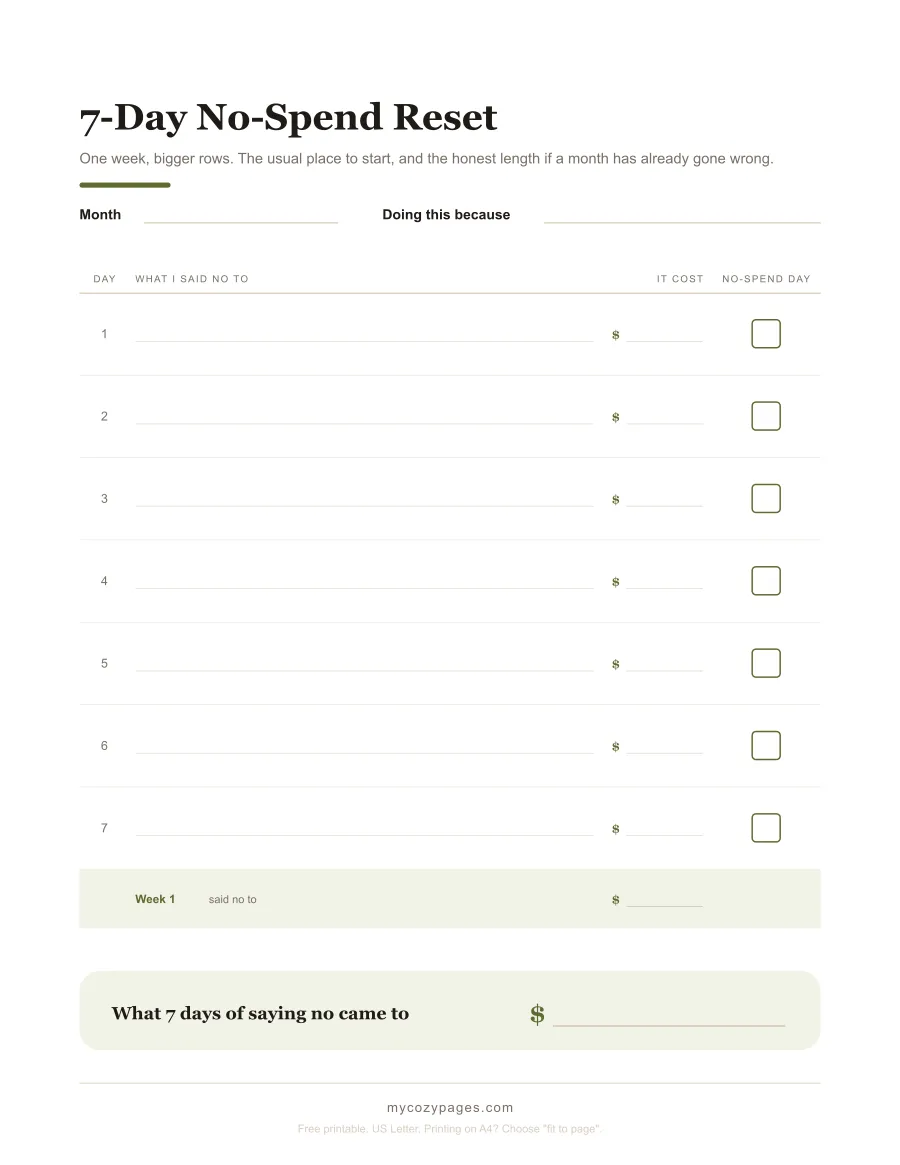
Download the 7 day reset (PDF)
The month after
A no-spend month only keeps what you genuinely canceled, because anything you merely postponed comes back in the next thirty days, and over the two months together the total is unchanged.
Nothing on a normal tracker shows you which happened. So the last sheet puts the two columns side by side: what you refused during the month, and what you bought once it ended. The line across the bottom is the difference, and that’s the real result.
The money that survives has to go somewhere, incidentally, or it just sits in checking and quietly evaporates. If that’s where you are, the money needs somewhere to go on the day it is refused rather than at the end of the month.
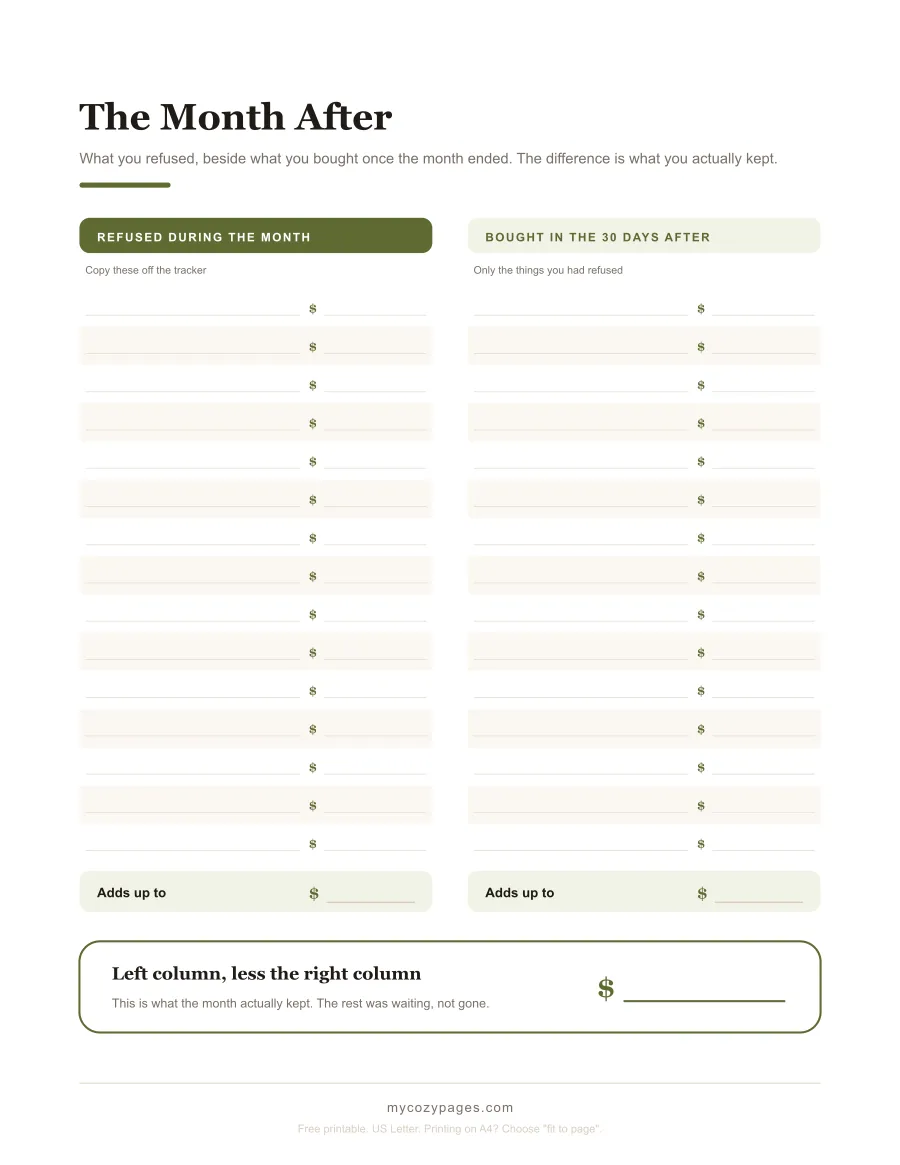
Download the month after sheet (PDF)
The pack, and what each sheet is for
| Sheet | What it does |
|---|---|
| The rules | 31 items, 10 rulings made before day one |
| 31 days | a row a day, with what each refusal cost |
| 30 days | the same, for a thirty-day month |
| 7 days | a week, bigger rows, a first attempt |
| The month after | canceled against postponed |
| Your own ceiling | four figures, your own total |
All six are US Letter, 8.5 x 11 inches, and they print on A4 if you choose “fit to page”. The figures printed on the ceiling worksheet aren’t typed in by hand: they’re computed from the published category table, then read back off the rendered sheet before the file is saved.
A note before you start
These are tracking sheets, not financial advice, and a no-spend month isn’t a plan. It’s a measurement. You learn what a month costs when you stop topping it up. That is useful once and much less useful the fourth time.
Two honest limits. A challenge can’t reach the 83.6% of spending that rent, groceries, insurance and healthcare account for, so it won’t rescue a month that was already short before you started. And if there’s a card carrying interest, the money a no-spend month frees is usually better aimed at that than at anything else.
What’s left after those two is the part of a month you actually choose, which is all this pack was ever for.
Save it for later
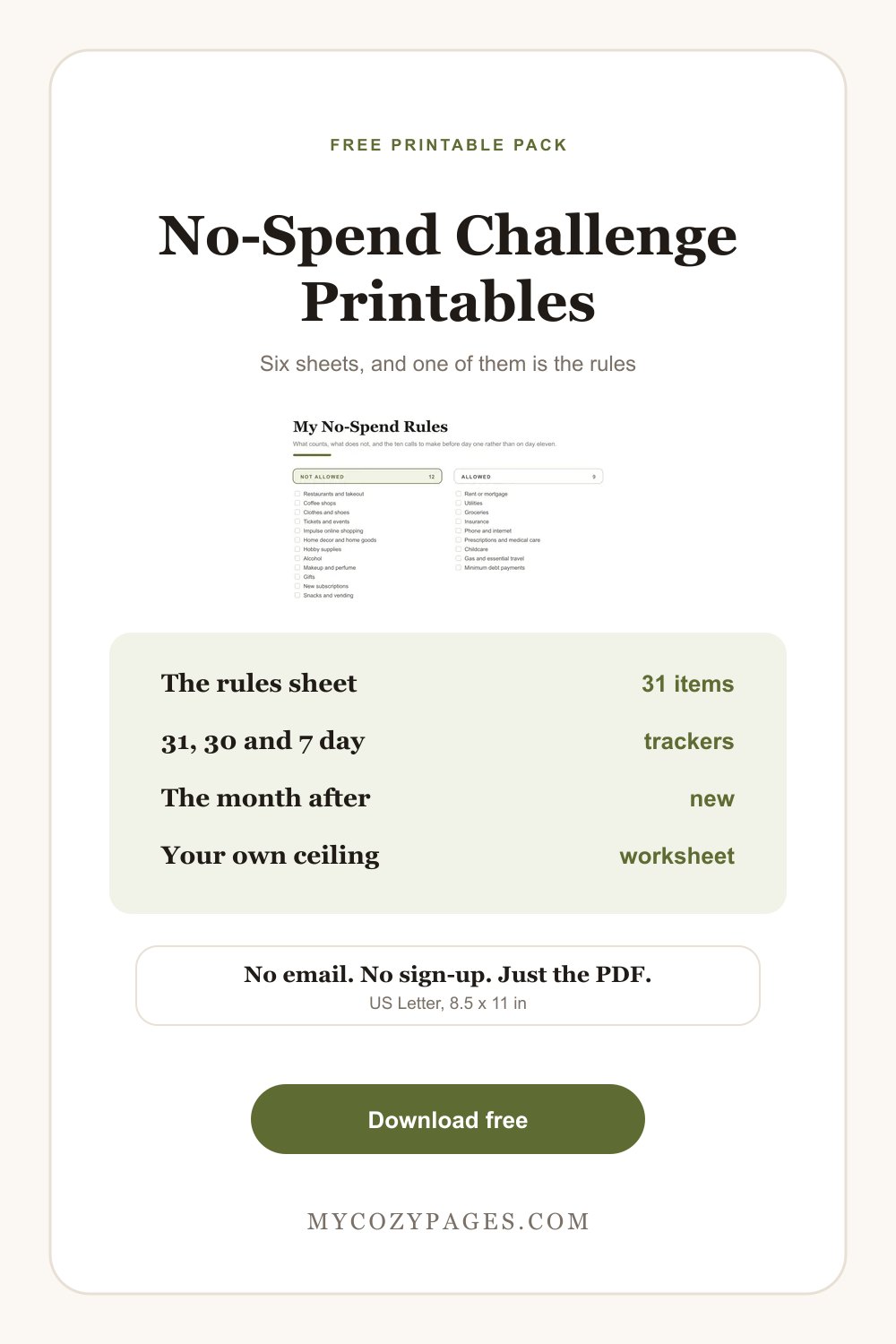
Free no spend challenge printables. Six sheets: a rules page with the ten borderline cases to settle before day one, 31, 30 and 7 day trackers with a column for what the thing you refused actually cost, a month-after sheet, and a worksheet for your own ceiling. US Letter, no email needed.
Save this pinFrequently asked questions
What is a no spend challenge?
A set period, usually a week or a month, where you buy nothing outside a list of essentials you agreed on first. Nothing gets put aside on a schedule. Something gets refused, which makes it a very different exercise from a savings challenge.
What counts as spending in a no spend challenge?
Rent, utilities, groceries, insurance, gas, medical care, childcare and minimum debt payments are allowed on every list. Restaurants, coffee, clothes, tickets, home decor, hobbies, alcohol, gifts and new subscriptions are refused on every list. The useful work is in the dozen cases nobody rules on, which is what the rules sheet is for.
How much money does a no spend month actually save?
There is a ceiling, and it is lower than most pages suggest. For an average US household, the four categories every rule list refuses come to $849.83 a month, so that is the most a flawless month can reach. Your own figure depends entirely on what you were spending, which is why the pack includes a worksheet for it.
How long should a no spend challenge be?
A week is the usual first attempt and a month is the usual target. There is a 7 day sheet here for the first one and a 30 and 31 day sheet for the second, so a thirty-one day month does not end with a day nobody wrote down.
What happens if I spend on day four?
Almost always it means a case your rules never covered, not a failure of nerve. Write the ruling on the sheet, keep going, and the same question will not cost you anything the second time it comes up.
Are these no spend challenge printables free?
Yes, all six. No email address and no account. Take one sheet, or the whole pack as a single PDF.
Does a no spend month work if I just buy it all later?
No, and nothing on a normal tracker shows you the difference. A canceled purchase and a postponed one look identical on a grid of ticked boxes, so there is a month-after sheet here that puts the two side by side.
What paper size are these printables?
US Letter, 8.5 x 11 inches. They print on A4 if you choose "fit to page" in the print dialog.
This printable is part of our guide to Printable Budget Planner: 7 Free Sheets.
Get new printables by email
Join the list and I'll email you when there's a new printable. That's all it is: no sales pitch, and every printable on the site stays free to download without it.
Unsubscribe any time. No spam, ever.
You might also like
Bill Tracker Printable: 8 Free Sheets
8 free bill tracker printables: monthly, yearly, a bill calendar, by paycheck and an autopay audit. Every sheet has a column for bills that pay themselves.
Get the printable
11 Free Printable Savings Challenges (PDF)
Pick from 11 free printable savings challenges, from a $500 mini sheet to $10,000. Color in a box each time you save. Instant download, no email.
Get the printable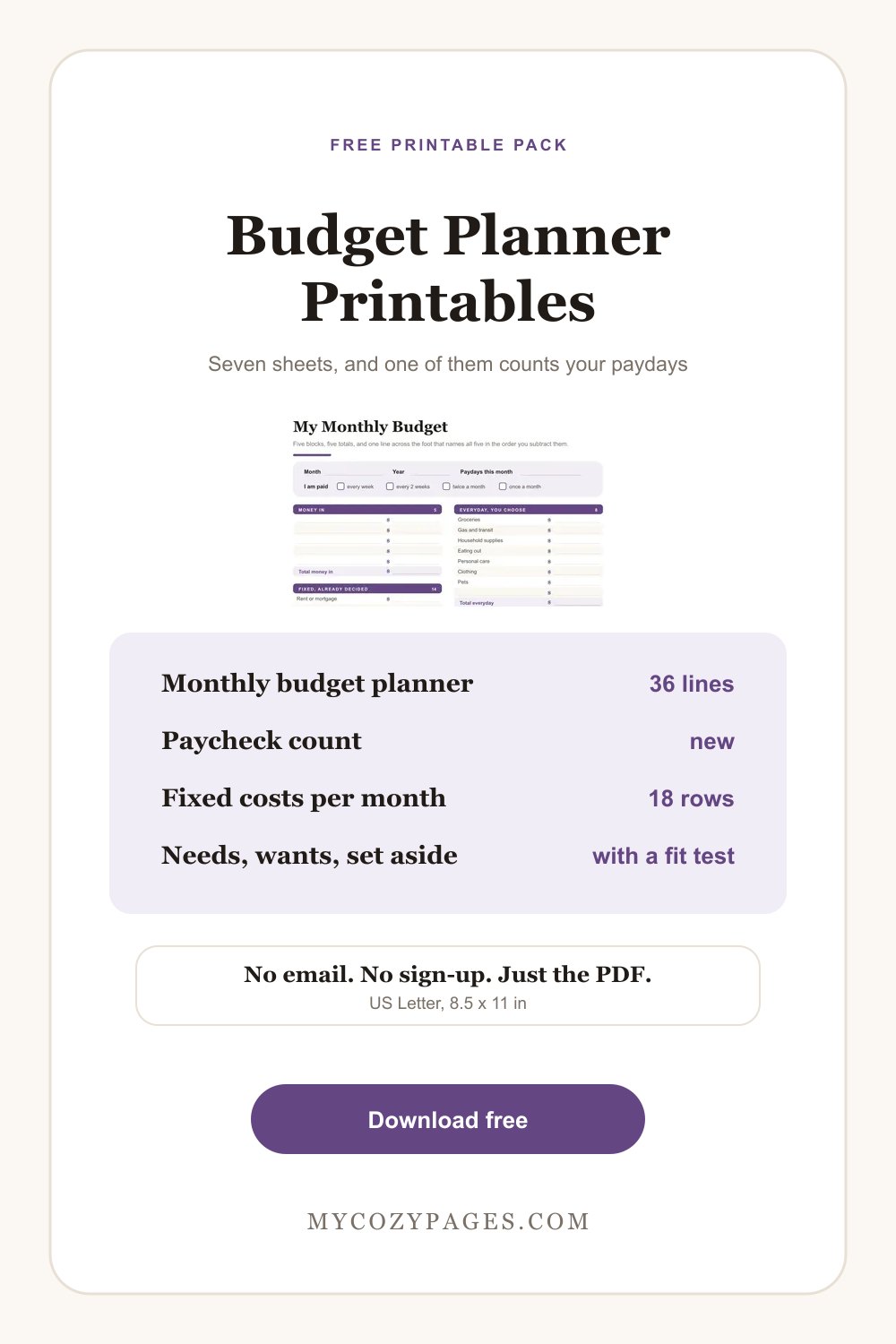
Printable Budget Planner: 7 Free Sheets
7 free printable budget planner sheets: a monthly planner that balances, a paycheck count, fixed costs and a split that fits. US Letter, no email needed.
Get the printable