FREE SAVINGS PRINTABLE
Low Income Savings Challenge Printable: 9 Free Trackers
Every savings chart prints its total. None of them prints the number that decides whether you finish: the most it will ever ask you for at once. These nine are sorted by exactly that, starting at a dollar a week.
- 9 Trackers
- From $1 a Week
- Free PDF
- No Signup
A low income savings challenge is a tracker built around a small amount that never goes up. The number that matters is not the total, it is the largest single deposit, because that is the one that makes people stop. These nine are sorted by exactly that, from a dollar a week to ten.
Pick by the most you can spare at once
- $1 a week · $52 a year
- $2 a week · $104 a year
- $3 a week · $156 a year
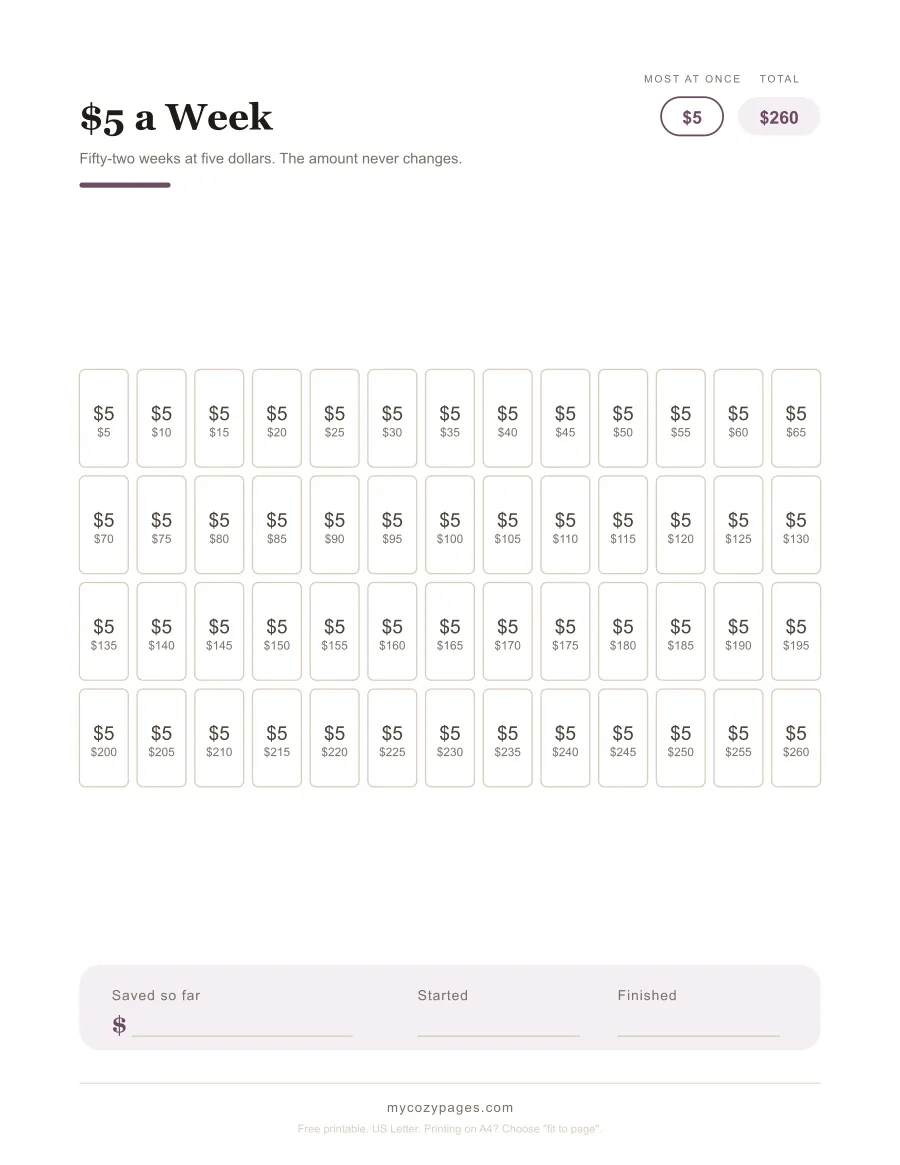
- $5 a week · $260 a year
- $10 a week · $520 a year
- Coins, not notes · 25 cents a day
- No fixed amount · hours that change
Nobody types “low income savings challenge” as their first search.
You searched for a savings challenge, found the 52 week one, and looked at the chart. Somewhere near the bottom right it asks for $52 in a single week. And you closed it, came back, and added two words to say so.
So this page isn’t going to hand you another chart and call it encouraging. It is going to tell you the one number the others leave out.
The number nobody prints
Every savings challenge page prints the total. The 52 week challenge makes $1,378. The 100 envelope challenge makes $5,050. Those are the headlines, and they are true.
Here’s what they don’t print: the most the sheet will ever ask you for at once.
| Challenge | Total | Average week | The hardest single ask |
|---|---|---|---|
| 52 week | $1,378 | $26.50 | $52 |
| 100 envelope | $5,050 | $50.50 | $100 |
| Penny challenge | $667.95 | $1.83 | $3.65 |
The average on the 52 week challenge is $26.50, which sounds manageable. But you don’t pay the average. You pay $52 in week fifty-two, and $475 across the last ten weeks, which is 34% of the entire year’s saving crammed into its last ten weeks.
That is why people stop in November. It isn’t a discipline problem. The chart is designed to get hardest exactly when the heating comes on and Christmas arrives.
About the penny challenge
This is the one every page recommends when money is tight, and it’s the hardest one here to finish.
The penny challenge asks for one cent on day one, two cents on day two, and so on to $3.65 on day 365. The total is $667.95. The biggest single day is only $3.65, which is why it looks like the gentle option.
Look at the two ends of it instead:
| What its first month costs | $4.96 |
| What its last month costs | $108.50 |
| What a whole year of $2 a week costs | $104.00 |
The penny challenge’s final month costs more than an entire year of $2 a week. It gets about 22 times harder from its first month to its last, and like the 52 week chart, the worst of it lands in December.
None of that makes it a bad challenge. It makes it a badly aimed one. It’s recommended to people on tight budgets precisely because it starts at a penny, and the start is the only part anyone looks at.
If you like the penny challenge and want it anyway, it is on the savings challenge printables page with the correct $667.95 total. The nine sheets below go the other way: the amount never changes, so the last week costs exactly what the first one did.
Sorted by the most it ever asks
Every savings challenge for low income budgets here is flat, so find the row you could pay in a bad week rather than an average one.
| Every week | Most at once | 52 weeks makes | That is |
|---|---|---|---|
| $1 | $1 | $52.00 | a full tank, or a birthday |
| $2 | $2 | $104.00 | more than the penny challenge’s last month |
| $3 | $3 | $156.00 | a month of groceries for one |
| $5 | $5 | $260.00 | most of a security deposit |
| $10 | $10 | $520.00 | a used washing machine |
Every one of those is flat. Week one costs what week fifty-two costs, so there’s no month where it suddenly gets harder.
$1 a week, $52 a year
The smallest one here, and the one to take if you have tried a challenge before and not finished it.
Fifty-two dollars isn’t a life-changing sum and this page won’t pretend otherwise. What it is, is fifty-two weeks of not breaking a streak, which is the thing that makes the next one possible.
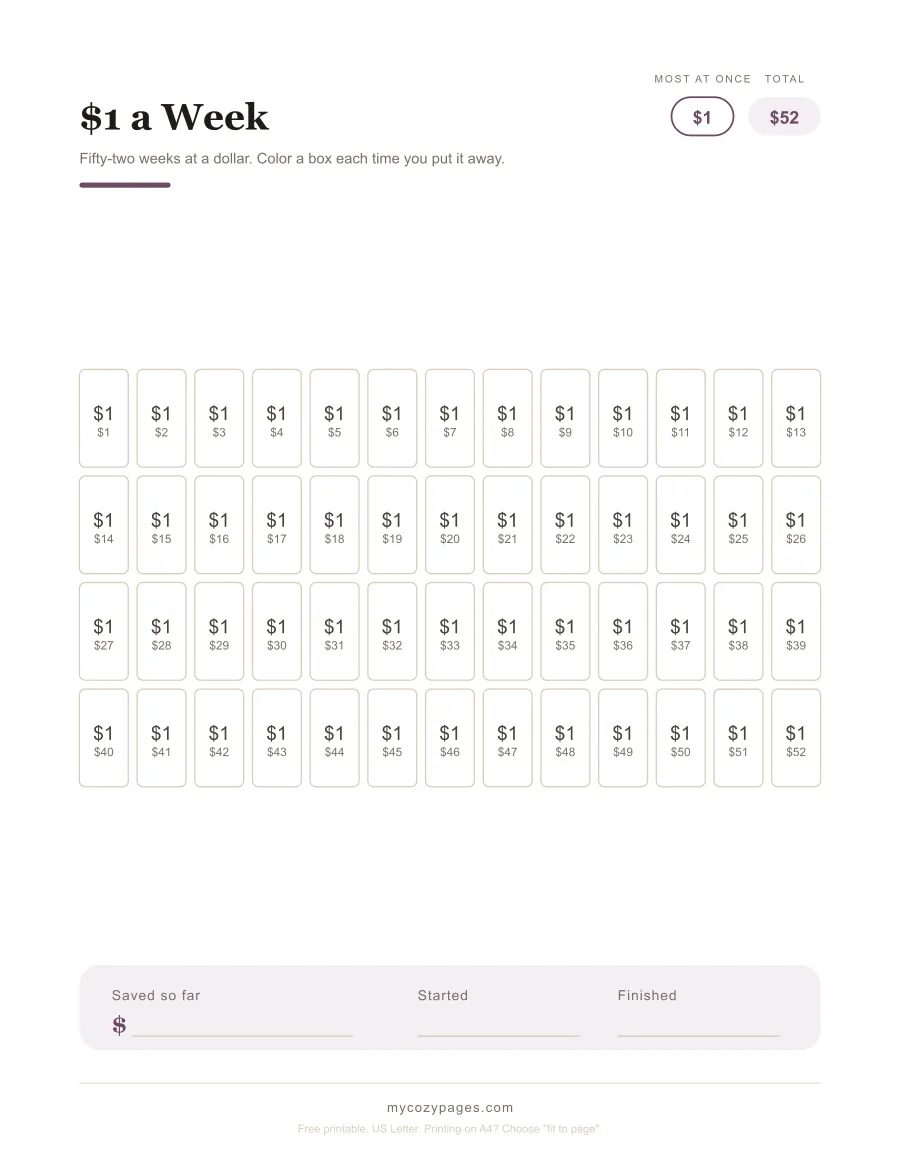
52 boxes · $1 each · running total under every box
Download the $1 a week tracker (PDF)
$2 a week, $104 a year
Two dollars a week for a year is $104, and it’s worth sitting with that number for a second, because it beats the entire last month of the challenge everyone recommends instead.
It is also the smallest amount here that reaches three figures, which matters more than it should. A hundred dollars is the point where a saved balance starts to feel like a thing rather than a gesture.
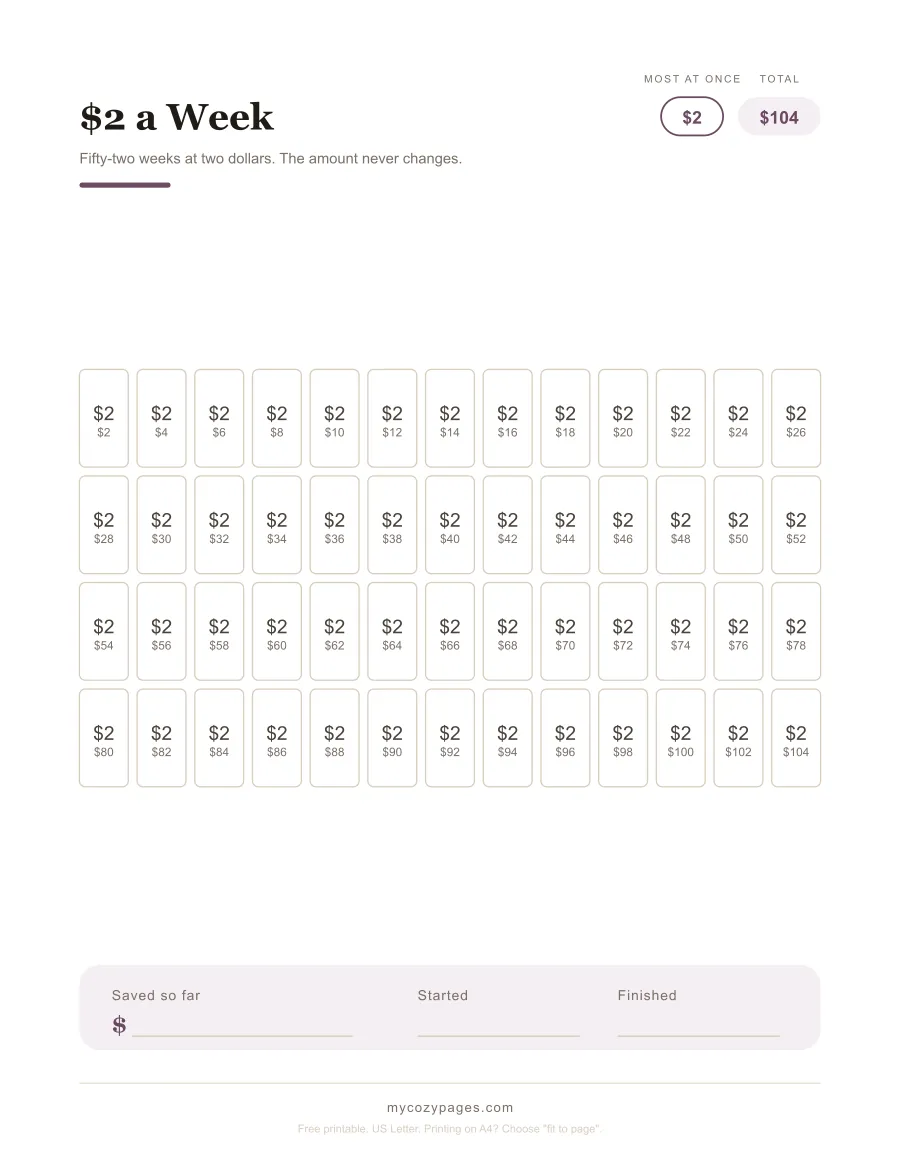
52 boxes · $2 each · reaches three figures
Download the $2 a week tracker (PDF)
$3 a week, $156 a year
The middle of this set. Three dollars is small enough to come out of a week without rearranging anything, and $156 over a year is a real cushion against one small emergency.
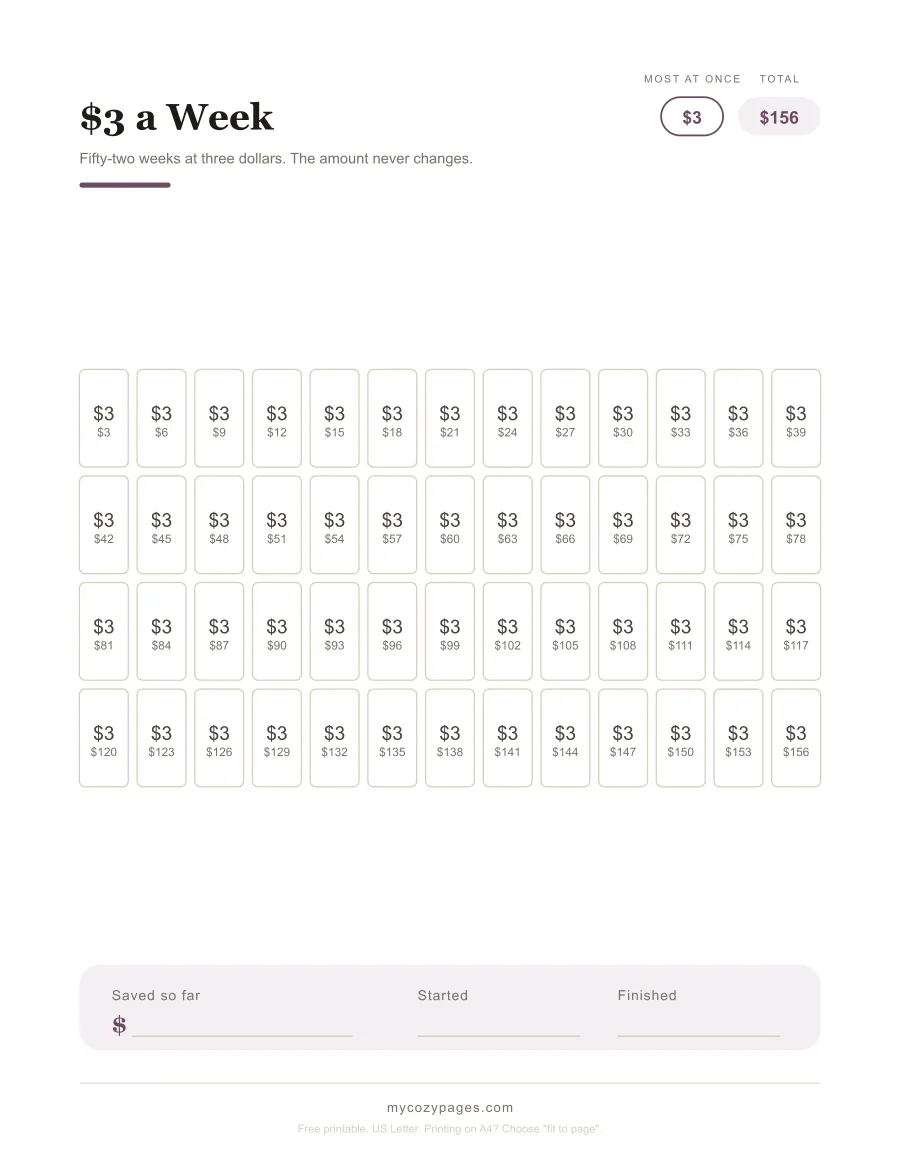
52 boxes · $3 each · $156 in a year
Download the $3 a week tracker (PDF)
$5 a week, $260 a year
If you can hold five dollars a week for a year without it hurting in February, this is the one I’d point most people at.
$260 is roughly a security deposit, or a car repair that would otherwise go on a card. And $5 is a number you can set as a standing transfer and then stop thinking about, which is the whole trick.
52 boxes · $5 each · $260 in a year
Download the $5 a week tracker (PDF)
$10 a week, $520 a year
The largest here. Ten dollars a week is $520 over a year, which is a washing machine, a month’s rent in some places, or the start of a genuine emergency fund.
Take it only if ten dollars is comfortable in your worst week of the year, not your best. Dropping from $10 to $5 halfway through is fine and the sheet doesn’t mind, but starting at $5 and staying there beats starting at $10 and quitting in March.
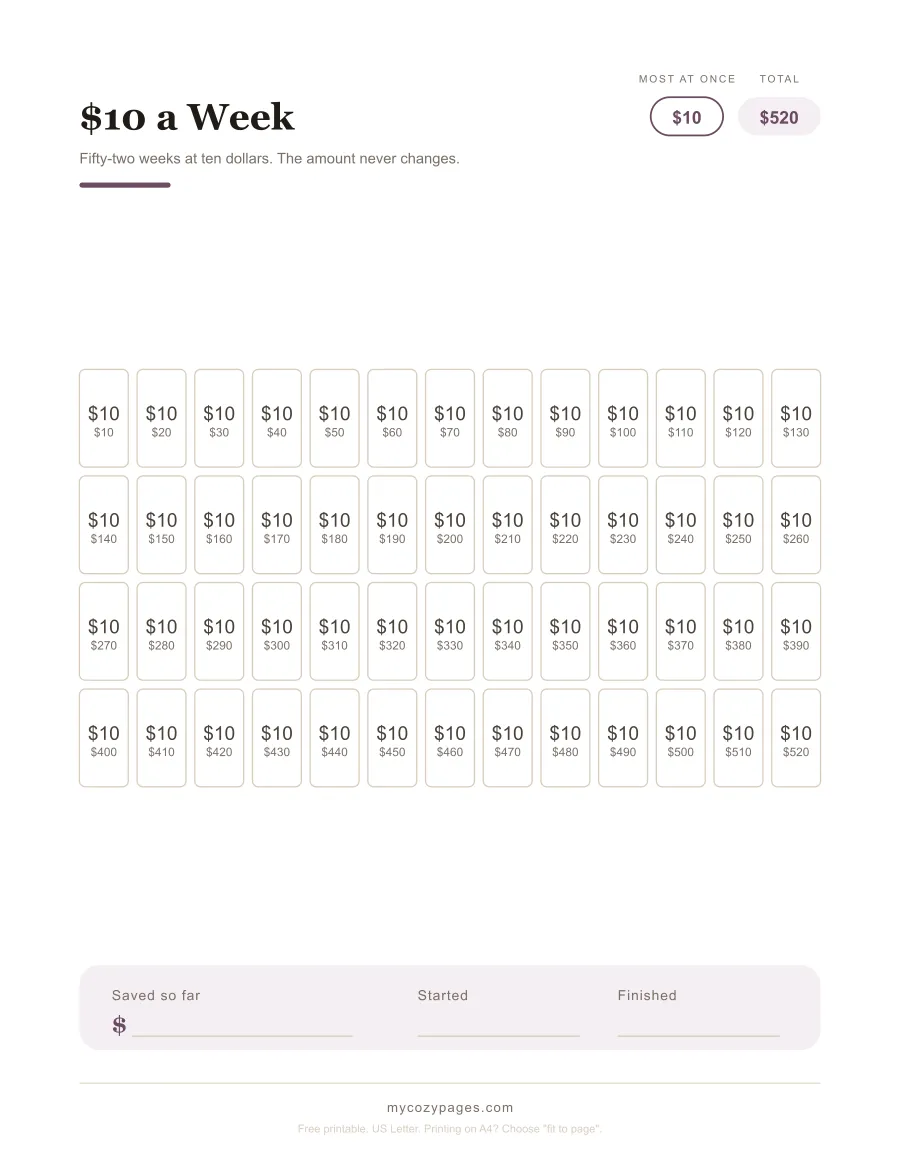
52 boxes · $10 each · $520 in a year
Download the $10 a week tracker (PDF)
When a dollar a week is still too much
Two sheets that work in coins rather than notes, one box a day.
25 cents a day
A quarter a day is $91.25 over a year, and a quarter is the smallest amount any sheet on this page asks for. It’s the honest answer when a dollar a week isn’t reliably there.
The boxes are grouped in blocks of seven so a week is countable, and they are left blank rather than printed with “$0.25” three hundred and sixty-five times.
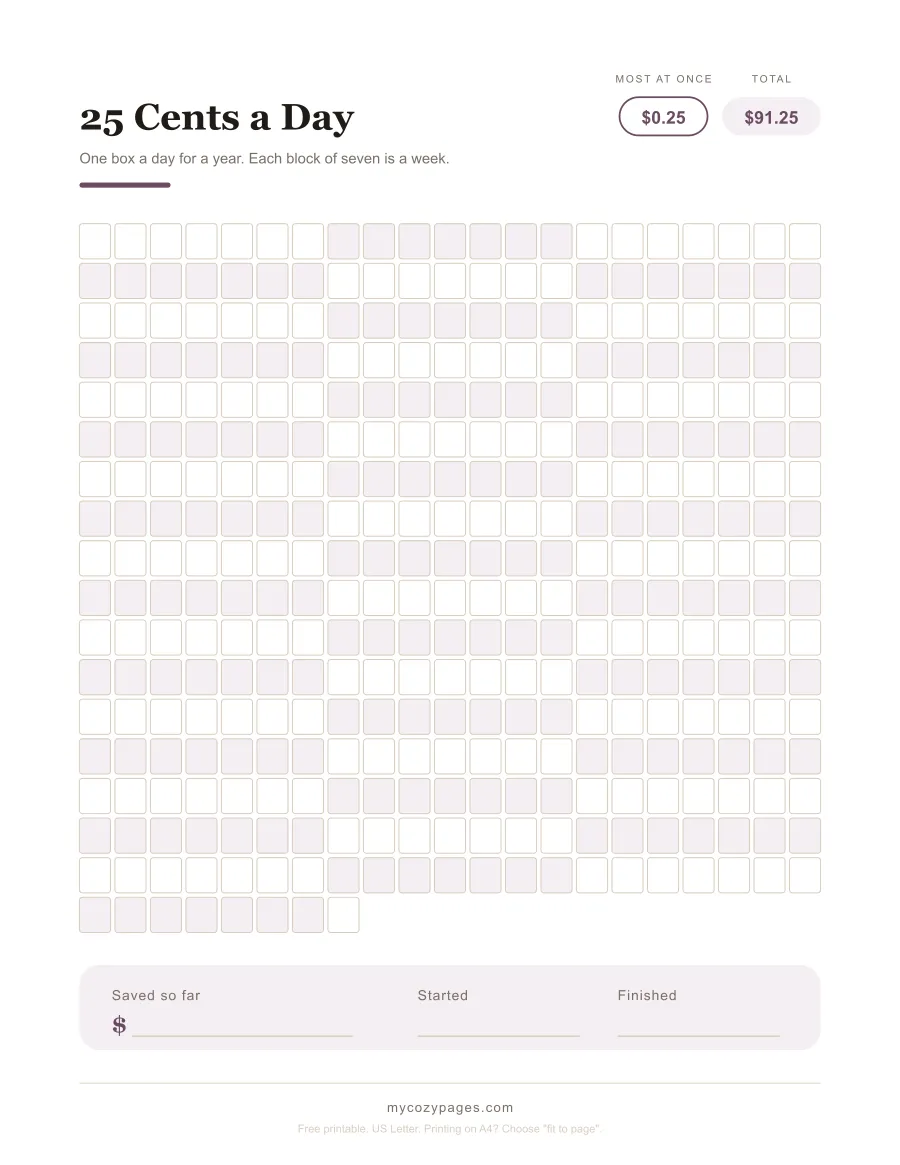
Download the 25 cents a day tracker (PDF)
$1 a day
A dollar a day is $365 a year, and it suits anyone who handles cash daily rather than getting one payment a week. Same layout, same blank boxes, seven to a block.
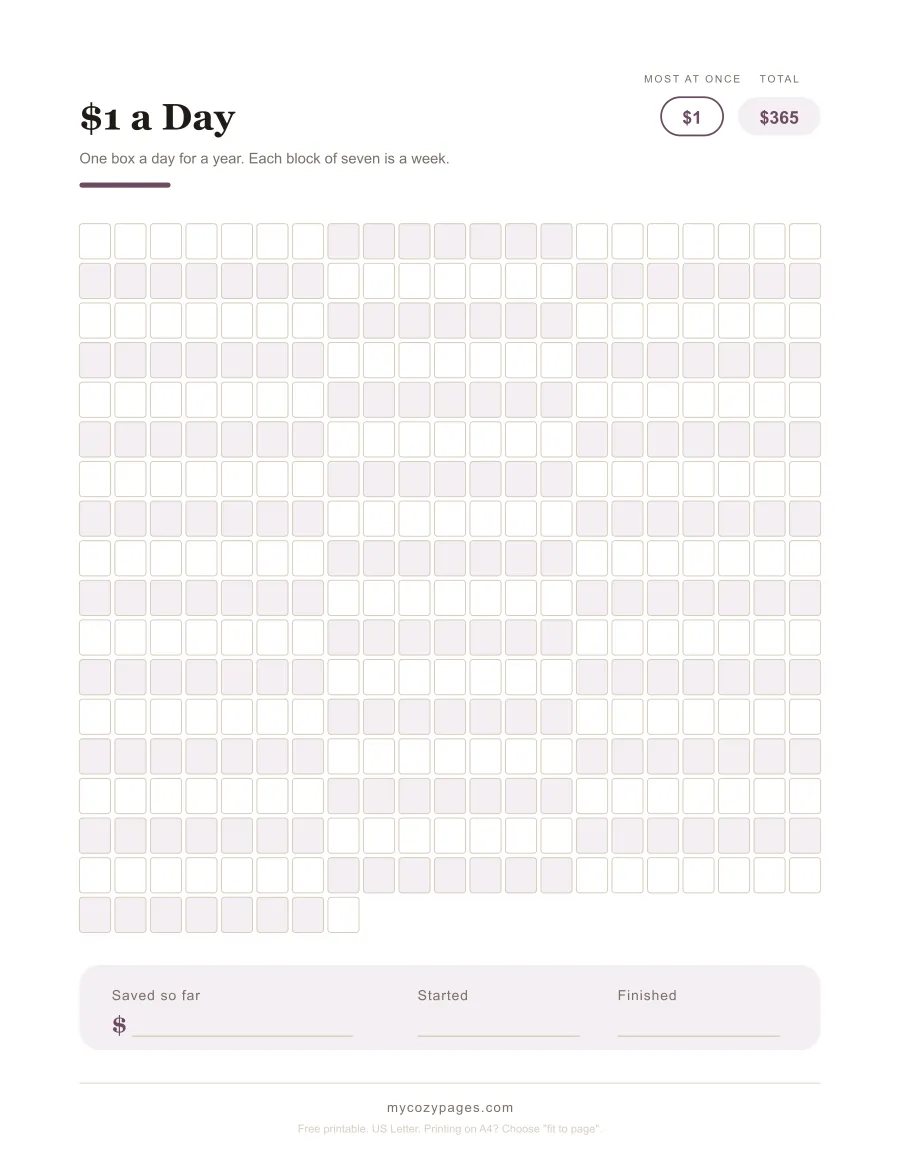
Download the $1 a day tracker (PDF)
When the week decides for you
Shift work, variable hours, a good month and then a thin one. A fixed amount is the wrong shape for that, and pretending otherwise just builds in a week where you’ll fail.
This sheet has 52 slots and no amounts printed. You write in what the week allowed. Some weeks that is $12, some weeks it’s $1, and some weeks the honest entry is a dash. The total at the bottom is whatever you reach, and it isn’t compared against anything.
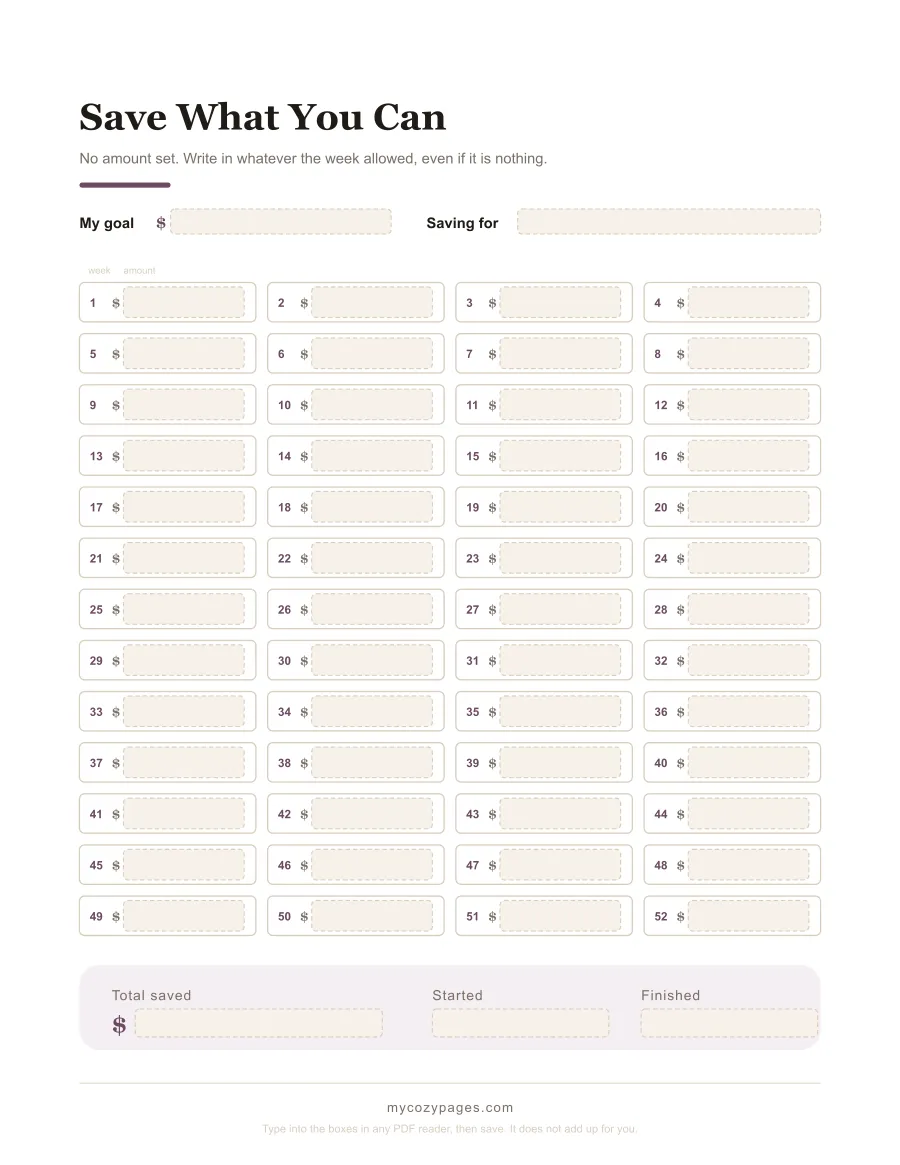
Download the save-what-you-can sheet (PDF)
Four challenges on one page
Printing costs money, and a page of printables that assumes it doesn’t is missing the point.
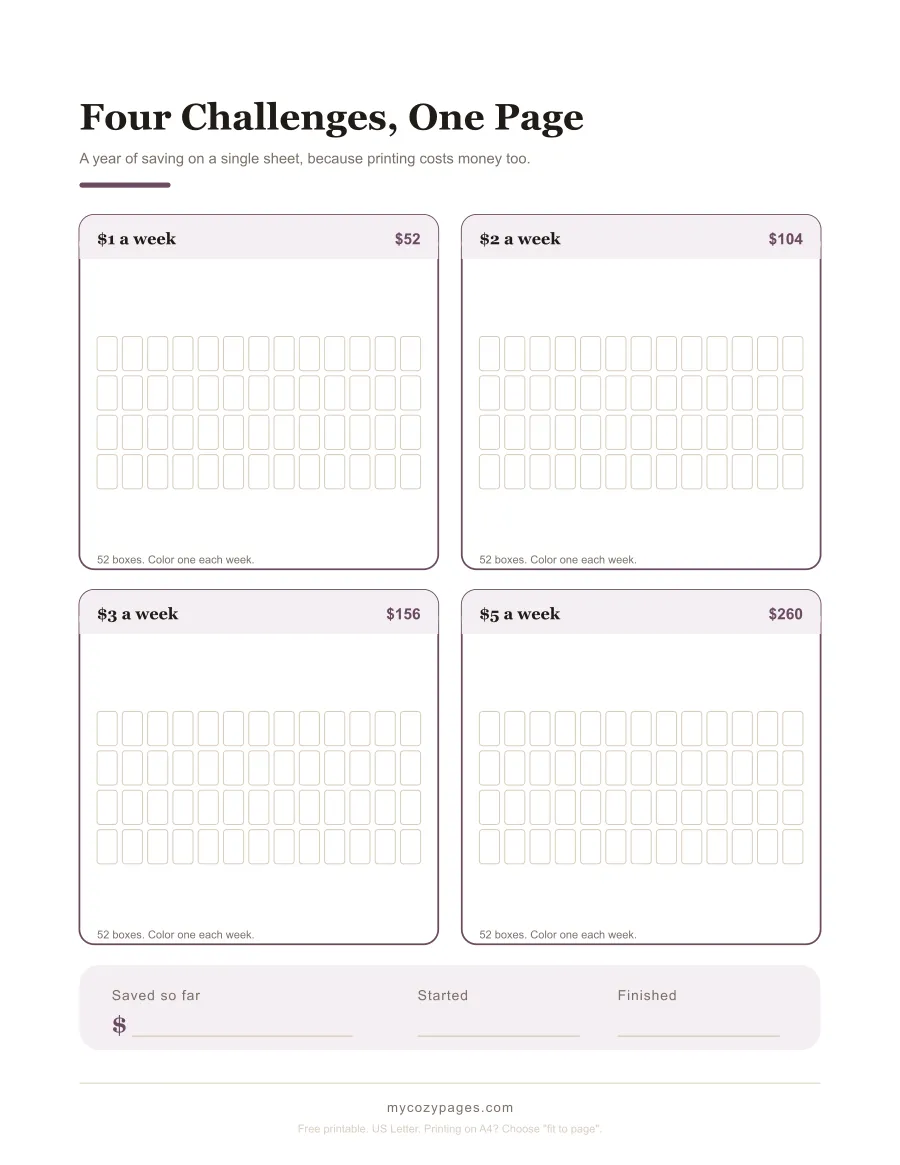
This one puts four small savings challenge printables in the corners of a single sheet: $1, $2, $3 and $5 a week. Run one, run all four for different things, or cut it in quarters and put one on the refrigerator.
The boxes on it are deliberately blank. Each corner already says what one box is worth, so printing that figure another 208 times would use more ink than the boxes themselves.
Download the four-on-one-page sheet (PDF)
You are not behind on your own
One figure worth having, because the number of people quietly assuming they are the only ones is large.
The Federal Reserve asks every year whether people have three months of expenses set aside. In the 2025 survey, published in May 2026, 55% of all adults said they did. Split by household income:
| Household income | Has three months set aside |
|---|---|
| Less than $25,000 | 21% |
| $25,000 to $49,999 | 39% |
| $50,000 to $99,999 | 55% |
| $100,000 or more | 75% |
So among households under $25,000, 79% do not have three months saved. That isn’t a statement about effort. It’s a statement about arithmetic, and it’s the ordinary situation rather than the exception.
When you cannot pay a week
It will, and none of these involve starting the sheet again.
- Leave the box empty and carry on. A flat challenge has no order to keep. A missed week is one box, not a broken chart.
- Drop a row rather than stop. Going from $5 to $2 a week keeps the habit and still finishes at $104. Stopping finishes at whatever you had.
- Put the money somewhere slightly inconvenient. A separate account with no card, or a tin that is not in the kitchen. Far enough that spending it takes a decision.
- Don’t add it to a credit card balance. If there’s a card carrying interest, paying it down beats saving alongside it in almost every case.
All nine, side by side
| Tracker | Most at once | Boxes | Makes |
|---|---|---|---|
| $1 a week | $1 | 52 | $52.00 |
| $2 a week | $2 | 52 | $104.00 |
| $3 a week | $3 | 52 | $156.00 |
| $5 a week | $5 | 52 | $260.00 |
| $10 a week | $10 | 52 | $520.00 |
| 25 cents a day | $0.25 | 365 | $91.25 |
| $1 a day | $1 | 365 | $365.00 |
| Save what you can | you choose | 52 | open |
| Four on one page | $1 to $5 | 208 | four totals |
All nine are US Letter, 8.5 x 11 inches, and print on A4 if you choose “fit to page”. The totals are not typed in by hand: they are computed and then read back off the rendered sheet before the file is saved, which is why the quarter-a-day page can say $91.25 and mean it to the cent.
A note before you start
These are tracking sheets, not financial advice. A printable can’t create money that isn’t there, and if the month runs out before there is anything to put in a box, no chart is going to fix that.
If that’s where you are, the bill tracker printables are the more useful place to start, because seeing what leaves and when is what makes a spare five dollars visible in the first place. If you’d rather see how these compare with the larger challenges, the savings challenge printables page has eleven of them side by side, and the 52 week savings challenge is the escalating one this page keeps measuring against.
Save it for later
Free low income savings challenge printables. Nine flat-amount trackers sorted by the most each one ever asks for at once: $1, $2, $3, $5 and $10 a week, 25 cents and $1 a day, a save-what-you-can sheet, and four challenges on a single page to save ink. US Letter, no email needed.
Save this pinFrequently asked questions
What is a low income savings challenge?
It is a savings tracker built around a small fixed amount that never rises, rather than one that starts small and climbs. The total is modest on purpose. What matters is that the biggest single deposit stays something you can pay in a bad week as well as a good one.
How much can you realistically save on a low income?
More than most charts assume, as long as the amount stays flat. $5 a week is $260 over a year and $10 a week is $520. Neither ever asks for more than it did the first week, which is the part that makes them finishable.
Is the penny challenge good if money is tight?
It is the one most often recommended and it is the hardest to finish. Its first month costs $4.96 and its last month costs $108.50, so it gets roughly 22 times harder over the year, and the hardest part lands in December. A flat $2 a week costs $104 for the whole year.
What is the easiest savings challenge to actually finish?
A flat one, at an amount you would not notice missing. Most people do better with $5 a week for a year than with a chart that averages $5 but asks for $20 in some weeks.
How do I save when my hours change week to week?
Use the save-what-you-can sheet. It has 52 slots and no amounts printed, so you write in whatever the week allowed, including nothing. The total is whatever you reach.
Are these low income savings challenge printables free?
Yes, all nine. No email address and no account. Take one sheet, or the whole pack as a single PDF.
How do I save on printing costs?
Use the four-on-one-page sheet, which puts the $1, $2, $3 and $5 challenges on a single side of paper. The boxes on it are deliberately left blank, since the amount is in each corner heading and printing it 208 times would use more ink than the boxes.
What if there is genuinely nothing left to save?
Then a tracker cannot help, and no printable will change that. The more useful first step is seeing where the month goes, which is what a bill tracker is for.
This printable is part of our guide to 11 Free Printable Savings Challenges (PDF).
Get new printables by email
Join the list and I'll email you when there's a new printable. That's all it is: no sales pitch, and every printable on the site stays free to download without it.
Unsubscribe any time. No spam, ever.
You might also like
11 Free Printable Savings Challenges (PDF)
Pick from 11 free printable savings challenges, from a $500 mini sheet to $10,000. Color in a box each time you save. Instant download, no email.
Get the printable
52 Week Savings Challenge Printable: 16 Free Charts
Save $1,378 in 2027 with 16 free 52 week charts: dated 2027, reverse, biweekly, kids, fillable and more. Every total checked. No email needed.
Get the printable
$10,000 Savings Challenge Printable: 8 Free Trackers
8 free $10,000 savings challenge printables, one for each pace. Pick the weekly amount you can actually pay and the timeline works itself out.
Get the printable