FREE SAVINGS PRINTABLE
$10,000 Savings Challenge Printable: 8 Free Trackers
Most pages pick your timeline for you and never say what it costs. This one goes the other way: choose the weekly amount you can actually pay, and the finish date falls out of it. Eight trackers, one for each pace.
- 8 Trackers
- Every Total Checked
- Free PDF
- No Signup
A $10,000 savings challenge is a printable tracker you fill in as you put money aside, until the boxes add up to $10,000. There is no single version: what changes is how much you save each time, and that decides how long it takes. At $250 a week it is 40 weeks. At $100 a week it is 100 weeks. At $50 a week it is 200. Pick the amount you can actually pay and the finish date follows.
Jump to your pace
- $250 a week · 40 weeks
- $200 a week · 50 weeks
- $100 a week · just under 2 years
- $50 a week · the slow one most people finish
- $500 a month · if you save by payday
- No fixed amount · irregular income
Here’s the thing about this keyword that took me a while to notice. Every other savings challenge is a method: the 52 week one, the 100 envelope one, they all hand you a number. This one is the opposite. You already have the number. $10,000 is usually attached to something specific, a deposit, a wedding, a car, finally moving out. What you don’t have is a timeline.
And the pages that come up for it almost all say “$10,000 in 52 weeks” and then never tell you what that costs.
It’s $192.31 a week. I suspect that’s exactly why nobody prints it. You can’t set up a standing transfer for $192.31 and feel normal about it, and you certainly can’t plan around it.
What $10,000 actually is
Before picking a pace, it helps to know what size of thing you are looking at.
The Bureau of Labor Statistics put average household spending at $78,535 for 2024. That’s $1,510 a week, or about $6,545 a month.
Which means $10,000 is roughly six and a half weeks of ordinary spending for an average US household. A month and a half.
That cuts both ways, and both ways are worth knowing.
It’s encouraging, because six weeks of spending is a real, human-sized amount rather than a lottery win. And it’s sobering, because if you were hoping $10,000 was a three month emergency fund, for the average household three months is closer to $19,600. Measure it against your own spending, not the average, and you will know which one you are looking at.
Start from what you can pay
Most $10,000 savings challenge charts hand you a timeline and leave you to work out what it costs. This table goes the other way. Find the row you can pay every week without flinching, and read across.
| Every week | Weeks to $10,000 | Which is | Lands on |
|---|---|---|---|
| $250 | 40 | 9 months | exactly $10,000 |
| $200 | 50 | just under a year | exactly $10,000 |
| $150 | 67 | 1 year 3 months | $10,050 |
| $125 | 80 | 1 year 6 months | exactly $10,000 |
| $100 | 100 | 1 year 11 months | exactly $10,000 |
| $75 | 134 | 2 years 7 months | $10,050 |
| $50 | 200 | 3 years 10 months | exactly $10,000 |
| $25 | 400 | 7 years 8 months | exactly $10,000 |
Two of those overshoot by $50, because $10,000 doesn’t divide evenly by 150 or 75. The last week is a short one, or you finish $50 up. Not a problem, but I’d rather tell you than round it away.
The rest of this page is one section per pace, with the tracker for it.
$250 a week, 40 weeks
The fastest pace here that I would put in front of anyone. Forty weeks is a little over nine months, so a goal you need funded inside a year has room to spare.
$250 a week is $1,083 a month, so this is the version for a household with genuine room, or for two people splitting it. If you’re doing this alone on one income, look further down the table before you print it.
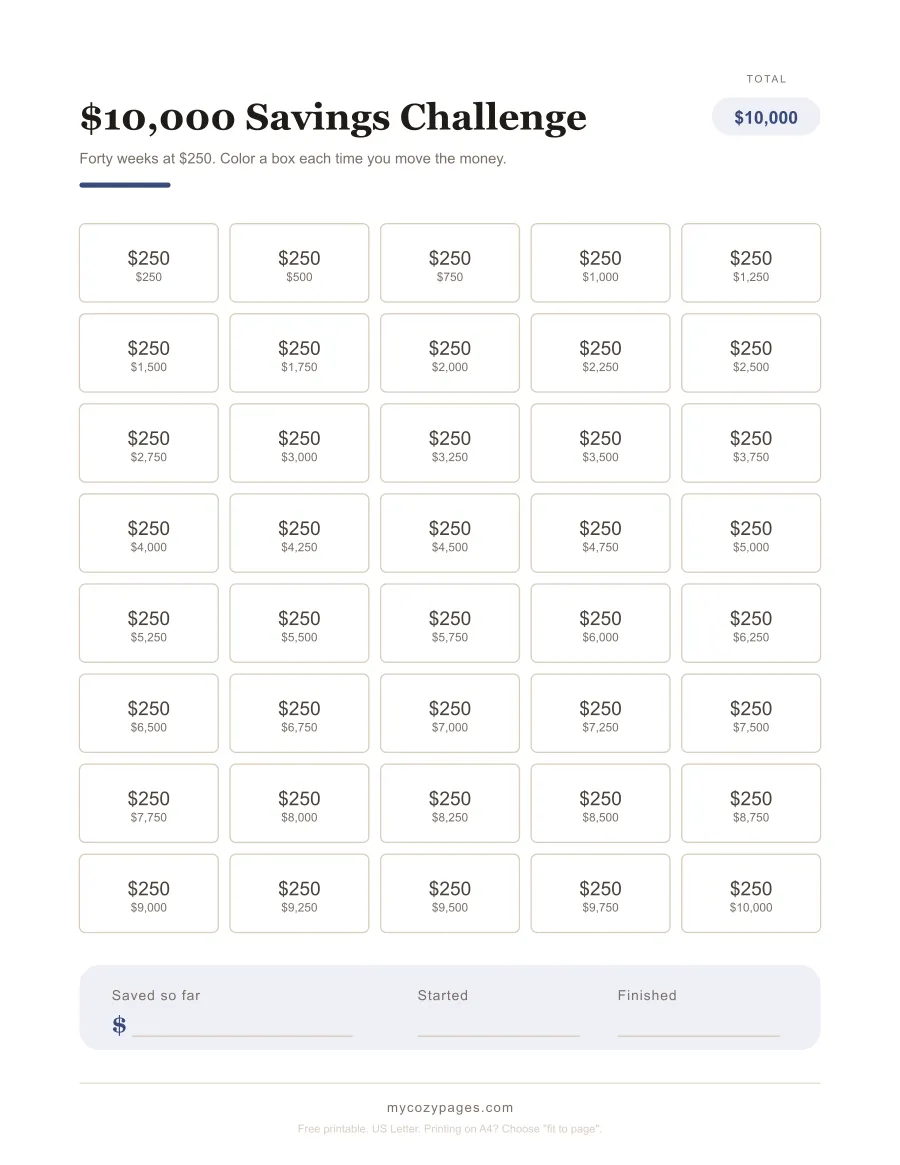
40 boxes · $250 each · running total under every box
Download the $250 a week tracker (PDF)
$200 a week, 50 weeks
This is the honest version of “save 10,000 in a year”. Fifty weeks at a round $200 gets you there with two weeks to spare, and $200 is a number you can actually set up as a transfer.
Compare that with the $192.31 everyone quotes and doesn’t print. Same year, $8 a week more, and a figure you can remember.
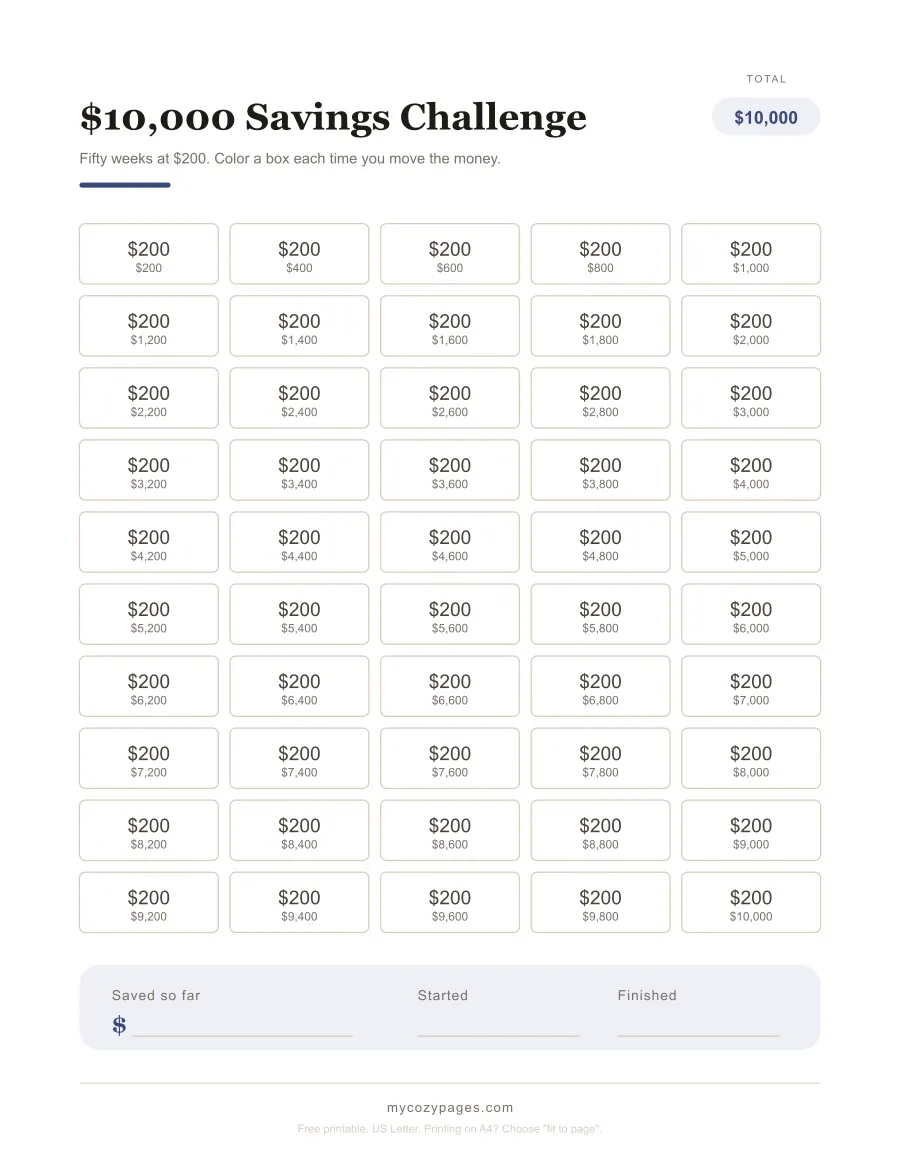
50 boxes · $200 each · finishes inside a year
Download the $200 a week tracker (PDF)
$100 a week, 100 weeks
A hundred weeks is one year and eleven months. It sounds long written down and it’s the pace I would point most people at, because $100 a week survives a bad month in a way that $250 doesn’t.
The sheet is a hundred boxes of $100, which is also the neatest arithmetic on this page: every ten boxes is another thousand.
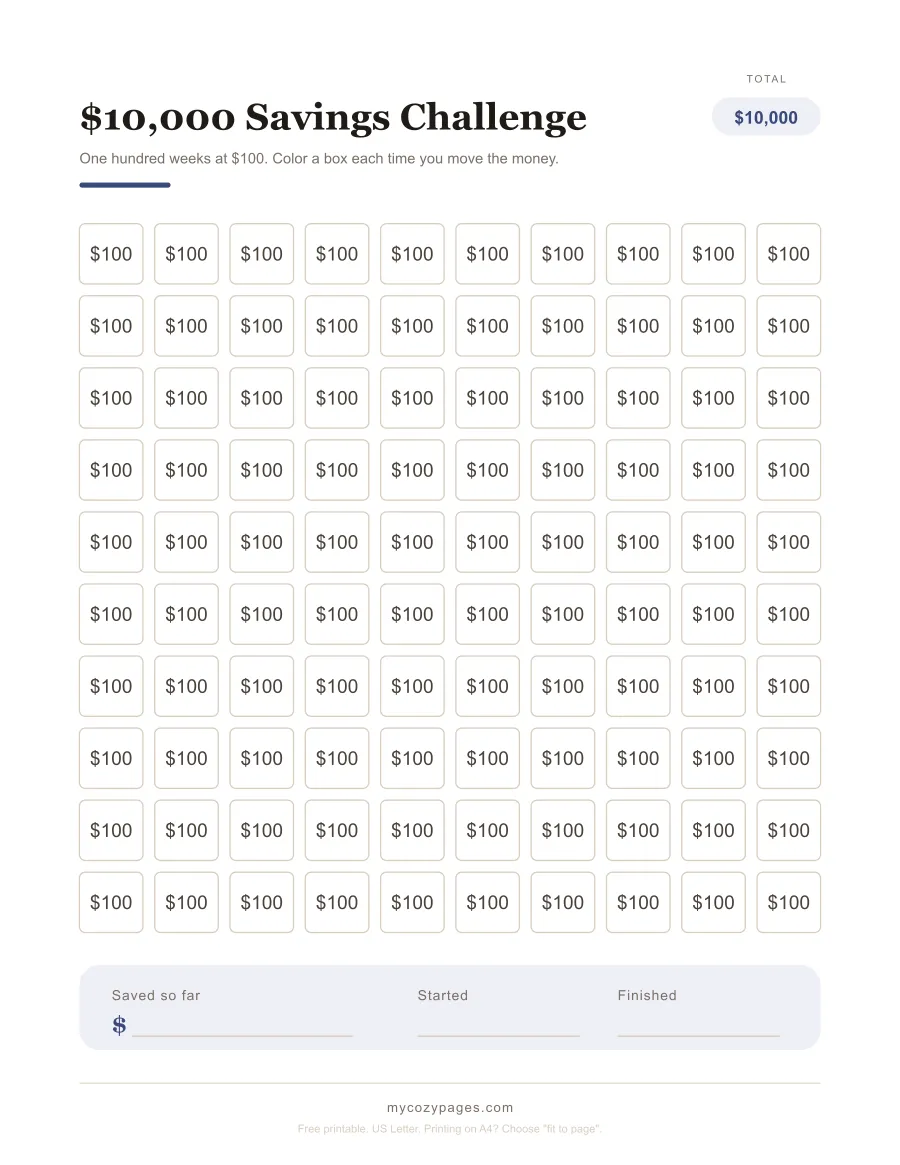
100 boxes · $100 each · ten across, so each row is $1,000
Download the $100 a week tracker (PDF)
$50 a week, 200 weeks
Nearly four years, and the pace most likely to actually get finished.
Nobody puts this on a pin because “save $10,000 in four years” isn’t exciting. But $50 a week is small enough that you keep doing it through a car repair and a bad December, and a slow challenge you complete beats a fast one you abandon in week nine.
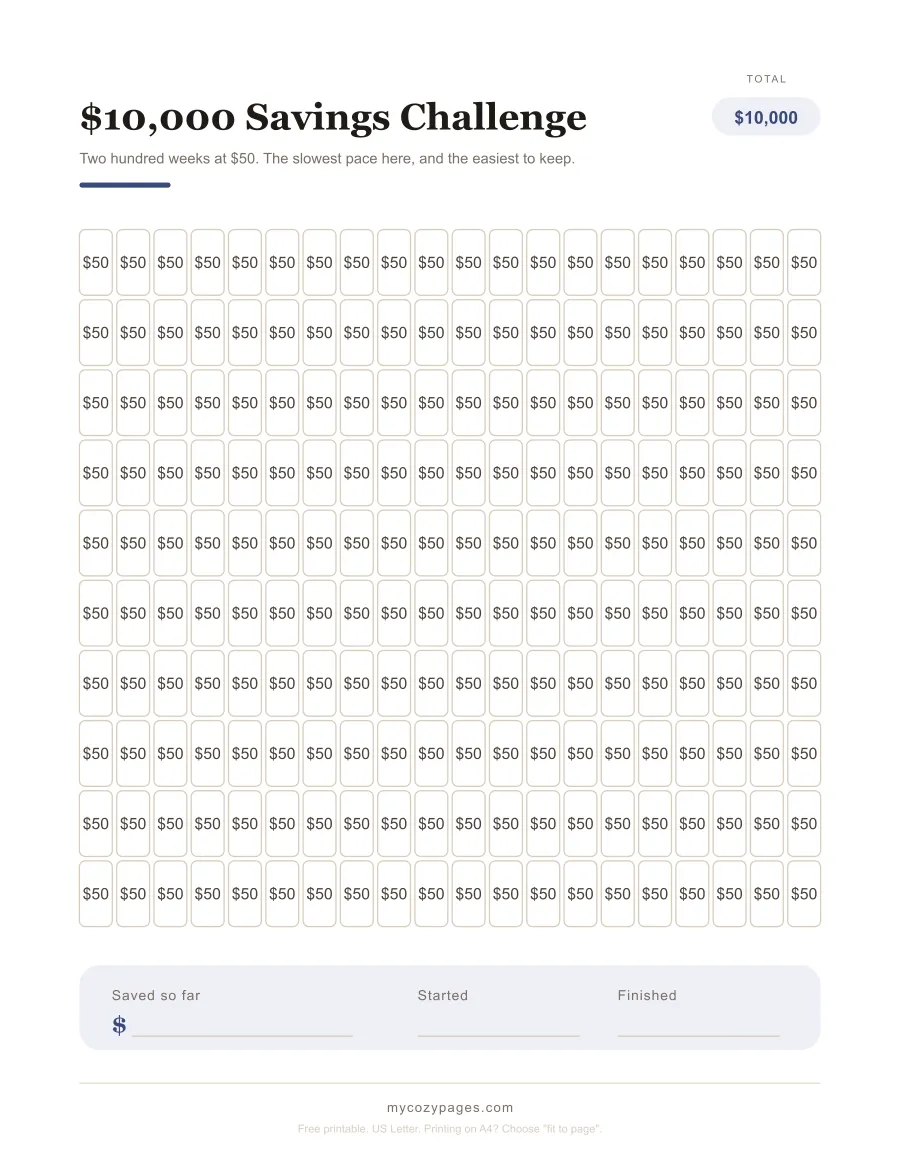
200 boxes · $50 each · the long game
Download the $50 a week tracker (PDF)
$500 a month, 20 months
Some people don’t save by the week at all. They save on payday and forget about it until the next one.
Twenty boxes, $500 each, one a month. One year and eight months, and only twenty things to remember instead of a hundred.
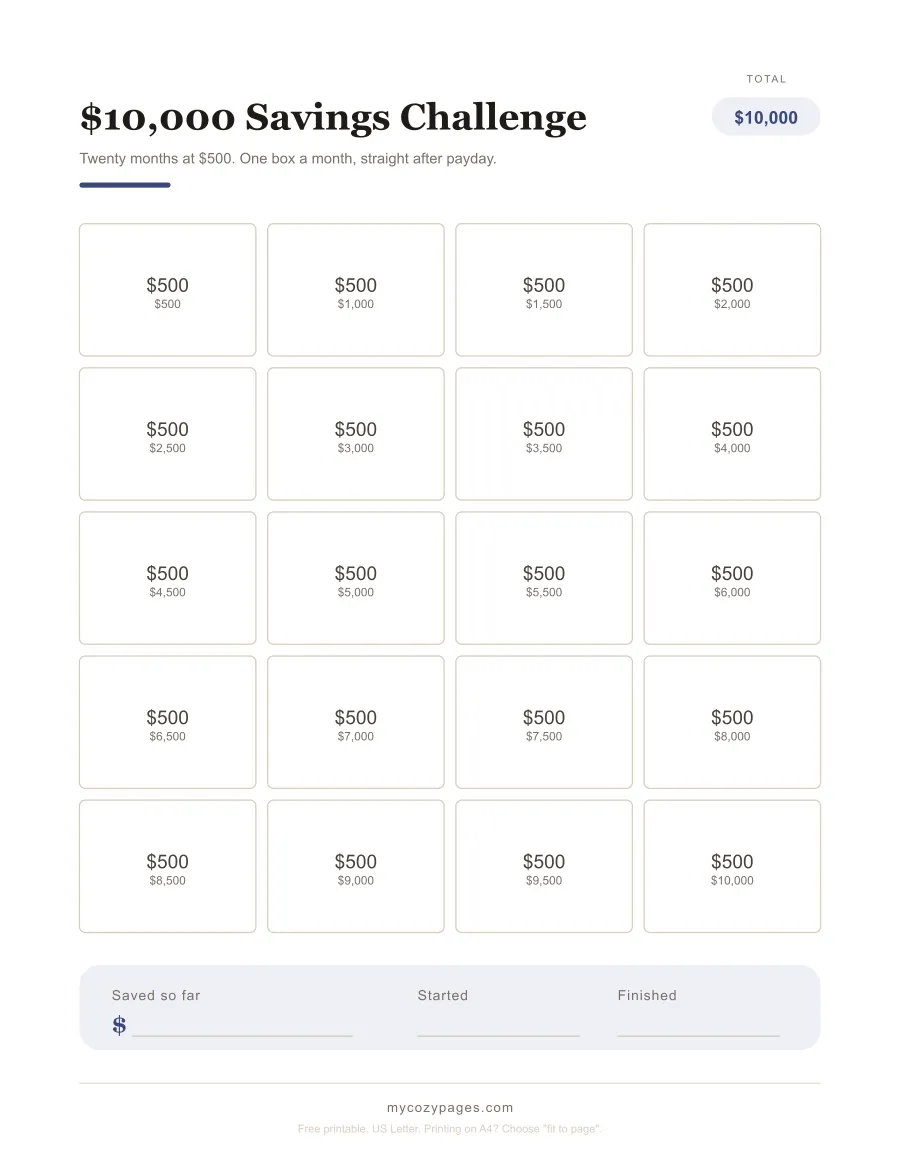
20 boxes · $500 each · one a month for 20 months
Download the $500 a month tracker (PDF)
When a fixed amount doesn’t suit you
Three sheets for the weeks that aren’t all the same size.
The thermometer
Forty rungs of $250, filling from the bulb up, with the running total printed beside the scale. You don’t have to save $250 at a time, you just fill a rung whenever you have put that much away in total. Good if your income is lumpy and you’d rather watch a level rise than count boxes.
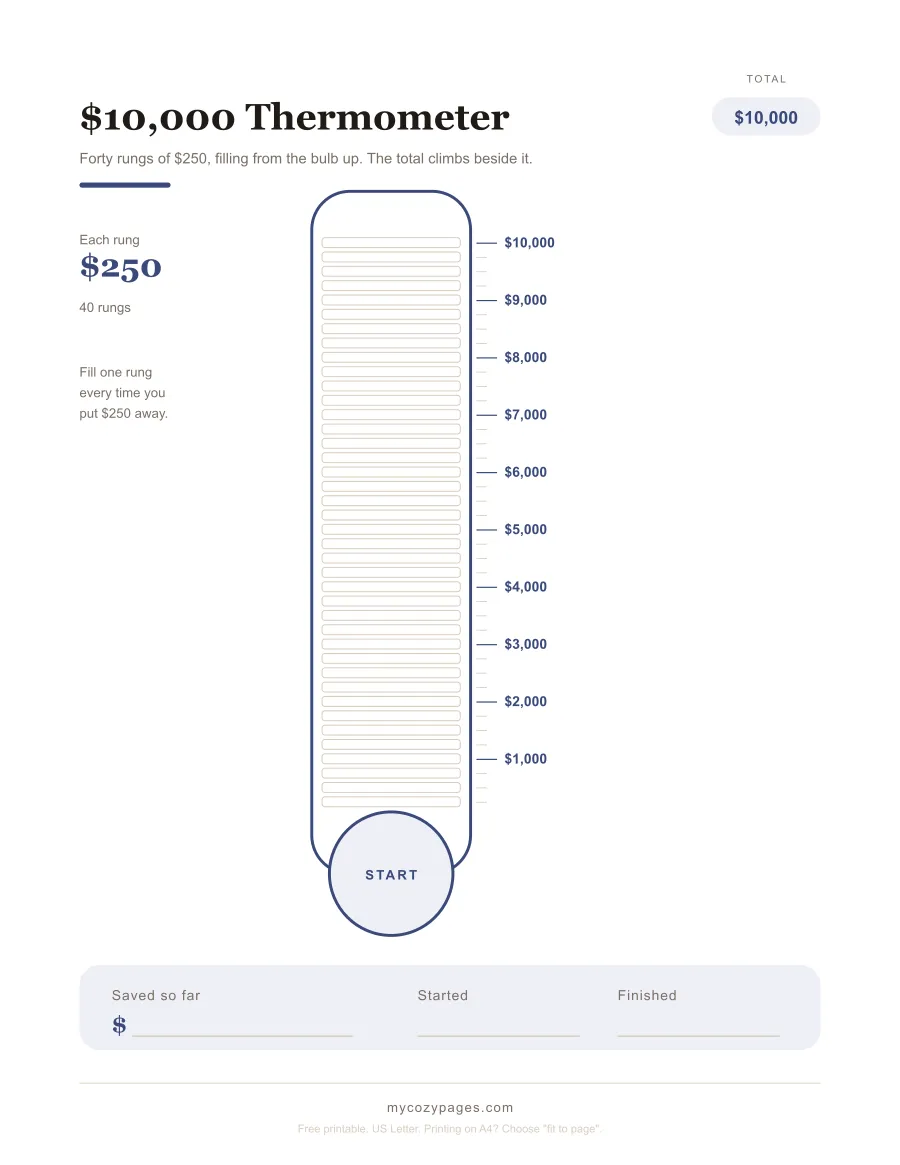
Download the thermometer (PDF)
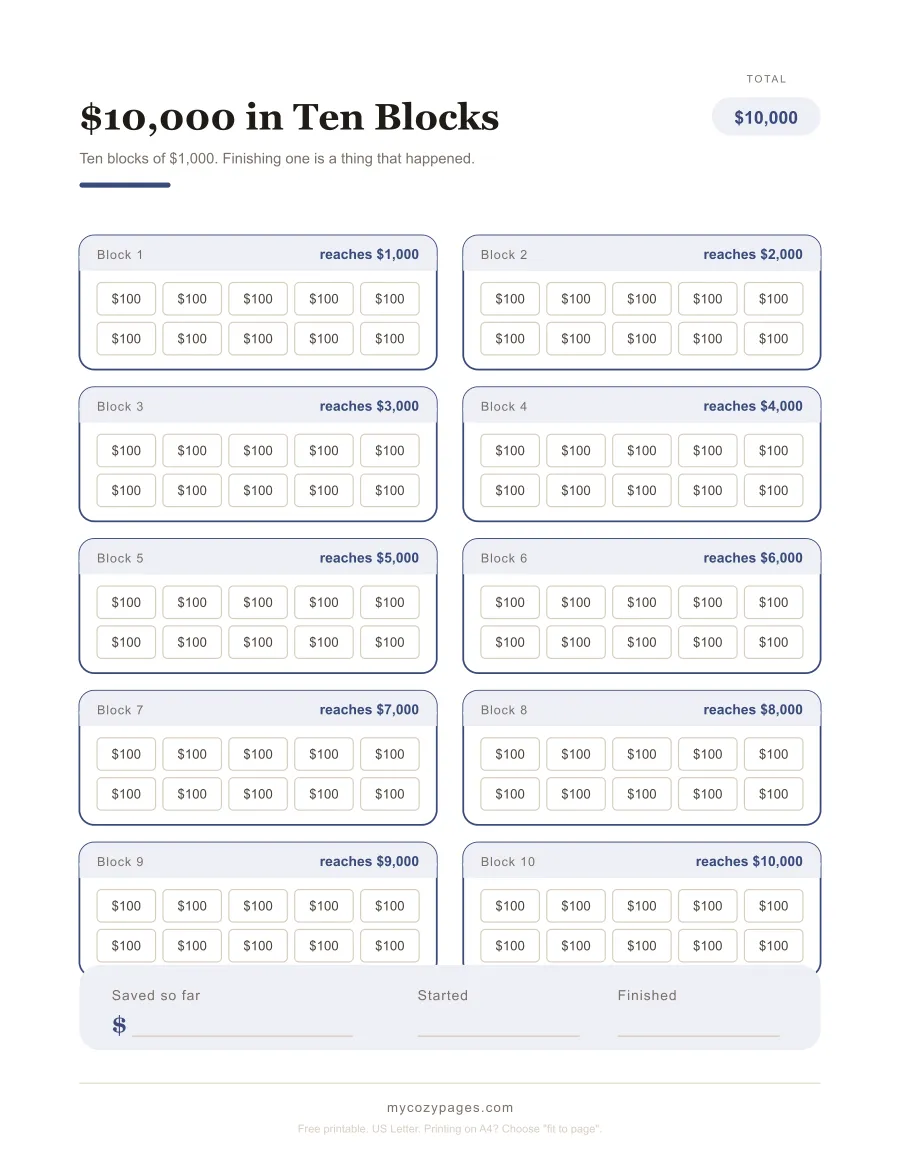
Ten blocks of $1,000
Two hundred identical boxes is a wall. Ten blocks, each one worth a thousand and each one labeled with the total it gets you to, is a staircase. Finishing block three is a thing that happened; coloring in box fifty-seven isn’t.
Download the milestone tracker (PDF)
Write your own amounts
A hundred blank slots and a goal line at the top. Put in $80 one week and $15 the next, because that’s what the week allowed. Typeable in any PDF reader if you’d rather not print it.
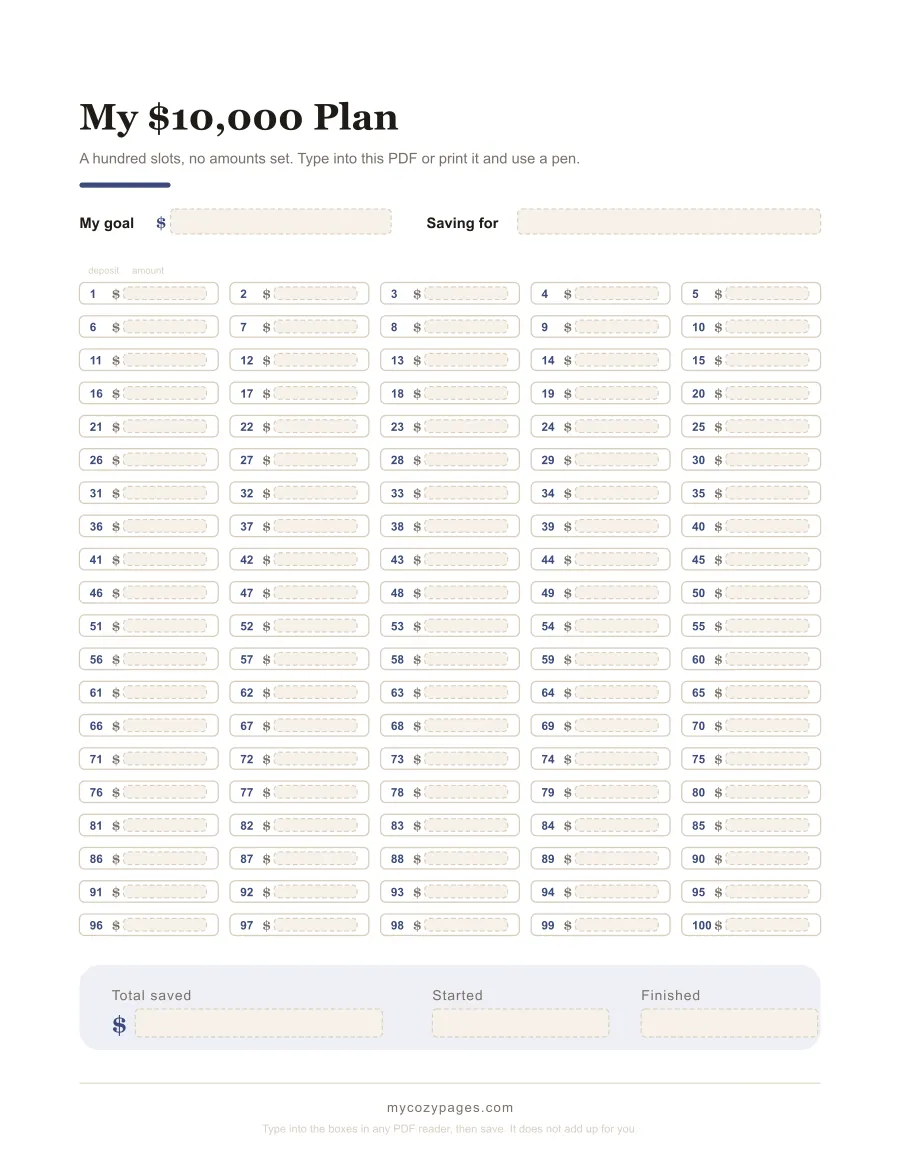
Download the write-your-own (PDF)
About the “$10,000 in 100 days” version
You will see this one everywhere, so it’s worth doing the arithmetic out loud.
A hundred days at $100 a day is $10,000. The multiplication is fine. What the pages offering it don’t mention is that $100 a day is $3,044 a month, every month, for a little over three months. Against average household spending of $6,545 a month, that’s asking you to put away almost half of everything, without your life changing.
If you have just sold something or had a windfall, it’s a perfectly good way to park the money in stages. As a savings plan from a normal paycheck, it isn’t one.
One more thing worth flagging. Some versions offer a gentler-looking alternative: start at $2 and go up by $2 a day. That adds up to $10,100 over 100 days, not $10,000, and it averages $101 a day. It isn’t the easier option it looks like.
When a week goes wrong
It will. A few things that help, none of which involve starting over:
- Move the finish date, not the amount. Missing three weeks at $100 doesn’t mean you failed, it means you finish three weeks later. Write the new date on the sheet.
- Drop a pace rather than stop. Going from $200 to $100 a week doubles the time and keeps the habit. Stopping ends it.
- Put windfalls straight on the sheet. A tax refund or a bonus fills several boxes at once, and there’s no rule saying every box has to come from a paycheck.
- Keep the money where you cannot see it. A separate savings account with no card attached, so the balance isn’t sitting under your nose every time you open the banking app.
Every 10k savings challenge printable here
| Tracker | Boxes | Each | Pace |
|---|---|---|---|
| $250 a week | 40 | $250 | 40 weeks |
| $200 a week | 50 | $200 | 50 weeks |
| $100 a week | 100 | $100 | 100 weeks |
| $50 a week | 200 | $50 | 200 weeks |
| $500 a month | 20 | $500 | 20 months |
| Thermometer | 40 rungs | $250 | any pace |
| Ten blocks | 100 | $100 | any pace |
| Write your own | 100 | you choose | any pace |
Every 10000 savings challenge printable here is US Letter, 8.5 x 11 inches, and prints on A4 if you pick “fit to page”. Every total on every one of them is worked out in code and checked before the file is written, so the boxes always add up to what the header says.
A note before you start
These are tracking sheets, not financial advice. They can’t tell you whether $10,000 is the right goal for you, and if you’re carrying high interest debt, paying that down will usually do more good than saving alongside it.
If $10,000 is further than you want to look right now, the savings challenge printables page has eleven of them starting at $500, the 100 envelope challenge reaches $5,050 by drawing a number at random, and the bill tracker printables are where to start if the reason there’s nothing left to save is that you aren’t sure where it went.
Save it for later
Free $10,000 savings challenge printables. Eight trackers in one PDF, one for each pace: $250, $200, $100 and $50 a week, $500 a month, a thermometer, ten milestone blocks and a write-your-own. Pick what you can pay and the timeline follows. US Letter, no email needed.
Save this pinFrequently asked questions
How long does it take to save $10,000?
It depends entirely on the weekly amount, and that is the only lever you really have. At $250 a week it takes 40 weeks. At $100 a week it takes 100 weeks, which is just under two years. At $50 a week it takes 200 weeks.
How much do I need to save each week to reach $10,000 in a year?
About $192.31, which is why nobody prints it. $200 a week is the nearest figure you would actually set up as a transfer, and it gets you there in 50 weeks, two weeks inside the year.
Is the $10,000 in 100 days challenge realistic?
The arithmetic works, since 100 days at $100 a day is $10,000. What it means in practice is $3,044 a month, every month, for over three months. For most households that is not a savings plan, it is a second rent.
Is $10,000 a good emergency fund?
It is a serious cushion but it is not usually three months of expenses. Average US household spending was $78,535 in 2024, which puts three months closer to $19,600. Measure it against your own spending rather than an average.
What is the easiest way to save $10,000?
Pick an amount you can move on the same day every week without thinking about it, then let the calendar do the work. The people who finish are almost never the ones who picked the fastest pace.
Can I save $10,000 if my income is irregular?
Yes, but not on a fixed weekly amount. Use the write-your-own sheet or the thermometer, both of which let you put in whatever the week allowed rather than a set figure.
Are these $10,000 challenge printables free?
Yes, all eight of them. No email address, no account. Download one or take the whole pack as a single PDF.
What should I do if I miss a few weeks?
Nothing dramatic. Carry on from where you stopped and accept that the finish date moved. A challenge you resume in March beats one you abandoned in February.
This printable is part of our guide to 11 Free Printable Savings Challenges (PDF).
Get new printables by email
Join the list and I'll email you when there's a new printable. That's all it is: no sales pitch, and every printable on the site stays free to download without it.
Unsubscribe any time. No spam, ever.
You might also like
11 Free Printable Savings Challenges (PDF)
Pick from 11 free printable savings challenges, from a $500 mini sheet to $10,000. Color in a box each time you save. Instant download, no email.
Get the printable
100 Envelope Challenge Printable: 12 Free Designs
12 free 100 envelope savings challenge printables for kids, teens and families. Totals from $100 to $10,100. Pick a version and a pace you can finish.
Get the printable
Low Income Savings Challenge Printable: 9 Free Trackers
9 free low income savings challenge printables, sorted by the most each one ever asks for at once. Flat amounts from $1 a week, no email needed.
Get the printable